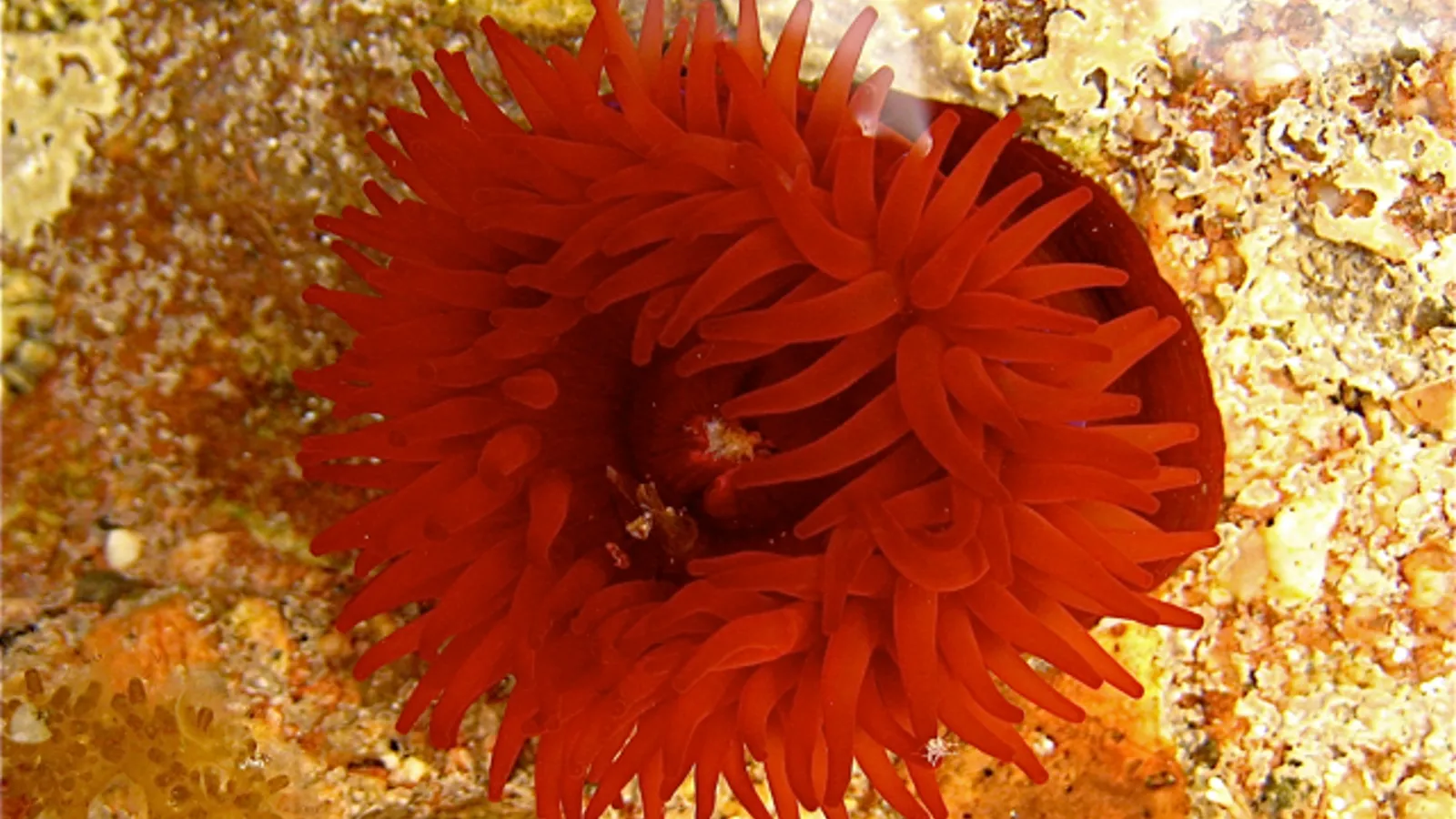
Beadlet anemone
Actinia equina
— Where the name comes from
Actinia comes from aktís, the ray: the crown of tentacles arranged in rays is what gave the name to all the sea anemones. Equina means “of a horse”, alluding to the dark red of the column, the colour of a bay. The Italian name looks instead at the animal when it is closed and out of water, tentacles withdrawn: a red glossy ball stuck to the rock, indistinguishable from a small tomato.
— Facts
- Group
- Cnidarians · Cnidaria
- Order
- Sea anemones
- Habitat
- Intertidal rocks, even exposed to air
- Range
- Eastern Atlantic and Mediterranean
- Size
- 3–7 cm across
- Diet
- Small crustaceans, molluscs and fish paralysed by the tentacles
- Lifespan
- Over 20 years
— Characteristics
- 01
It withstands hours out of water by closing into a ball.
- 02
It gives birth to fully formed young, which emerge from the mouth.
- 03
It fights its neighbours with specialised swollen tentacles.
— What sets it apart
Sea anemones wage war over territory, and they wage it slowly. When two colonies of different strains touch, they inflate special tentacles called acrorhagi, loaded with stinging cells, and strike the rival repeatedly for hours or days until one retreats or dies: on the rocks one can see bands of bare stone marking the border between two clones. The combatants recognise each other chemically, and do not attack individuals identical to themselves — that is, their offspring, which are clones and which the mother bears live, expelling them through her mouth.