
Blue sea star
Linckia laevigata
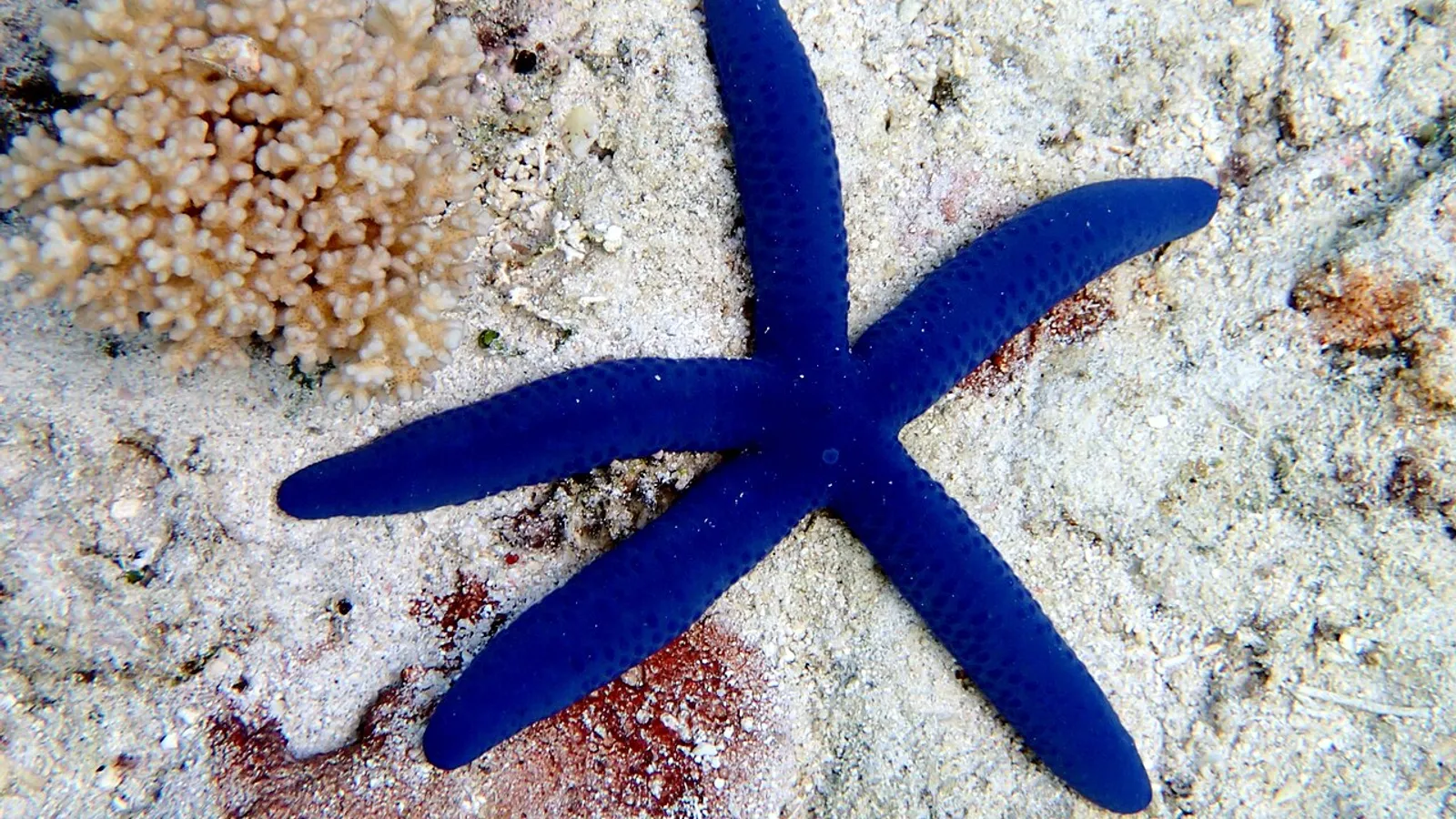
— Where the name comes from
The genus remembers Johann Heinrich Linck, the German naturalist who in 1733 published the first systematic treatise on starfish, illustrating dozens of species at a time when they were still curiosities for a cabinet. Laevigata means “smooth, polished”, and distinguishes this species from relatives bristling with tubercles. The colour, which is what everyone notices, does not appear in the name.
— Facts
- Group
- Echinoderms · Echinodermata
- Order
- Sea stars
- Habitat
- Coral reefs and shallow sandy flats
- Range
- Tropical Indo-Pacific
- Size
- 20–30 cm across
- Diet
- The film of algae and detritus on rock
- Lifespan
- 10 years
— Characteristics
- 01
The intense blue comes from a rare pigment, linckiacyanin.
- 02
A detached arm regenerates an entire starfish on its own.
- 03
It moves a few metres a day, walking on thousands of tube feet.
— What sets it apart
It reproduces by falling to pieces as well. An arm that comes off — to a predator, to a wave, or because the animal lets it go — can regenerate the whole disc and the other four arms, producing a complete and genetically identical individual: comet-shaped specimens are often found, with one long arm and four just beginning, which are starfish under reconstruction. It is why the aquarium trade, which takes thousands for their colour, does not easily dent the populations, but it is also why a damaged starfish almost never dies.
