
Great hammerhead
Sphyrna mokarran
— Where the name comes from
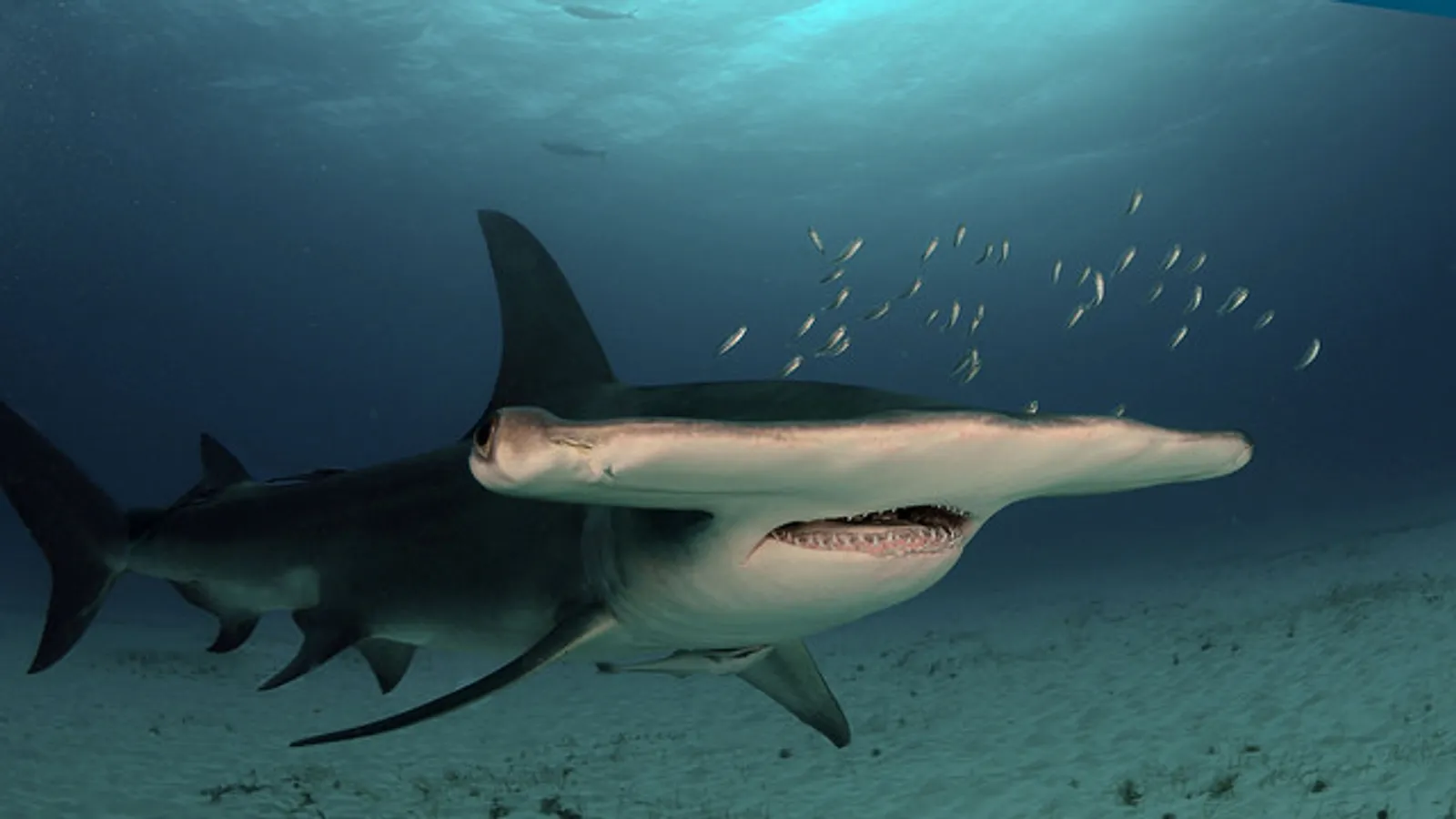
Sphyrna is the Greek sphŷra, hammer: the anvil-shaped head that names the animal in almost every language. The epithet mokarran comes from an Arabic word for shark. The hammer head — the cephalofoil — is no ornament: it is an instrument.
— Facts
- Group
- Fish · Actinopterygii · Chondrichthyes
- Order
- Ground sharks
- Habitat
- Tropical coastal and oceanic waters, reefs and shelves
- Range
- The tropical belts of every ocean
- Size
- 3.5–6 m, up to 450 kg
- Diet
- Carnivore — fish, cephalopods, and above all rays
- Lifespan
- 20–40 years
— Characteristics
- 01
The wide flat head sets the sense organs apart like the arms of a metal detector.
- 02
It often swims tilted onto one side, a posture that cuts the effort of swimming.
- 03
It favours rays, which it flushes from beneath the sand.
— What sets it apart
The hammer head is an antenna. By spreading the ampullae of Lorenzini — the receptors that pick up the faint electric fields every living animal gives off — along a wide bar, the hammerhead sweeps the seabed as if with a detector, catching the hidden heartbeat of a ray buried under the sand. Eyes at either end also give it a field of view of nearly 360 degrees. It has turned its own face into a sensor.
