
Goblin shark
Mitsukurina owstoni
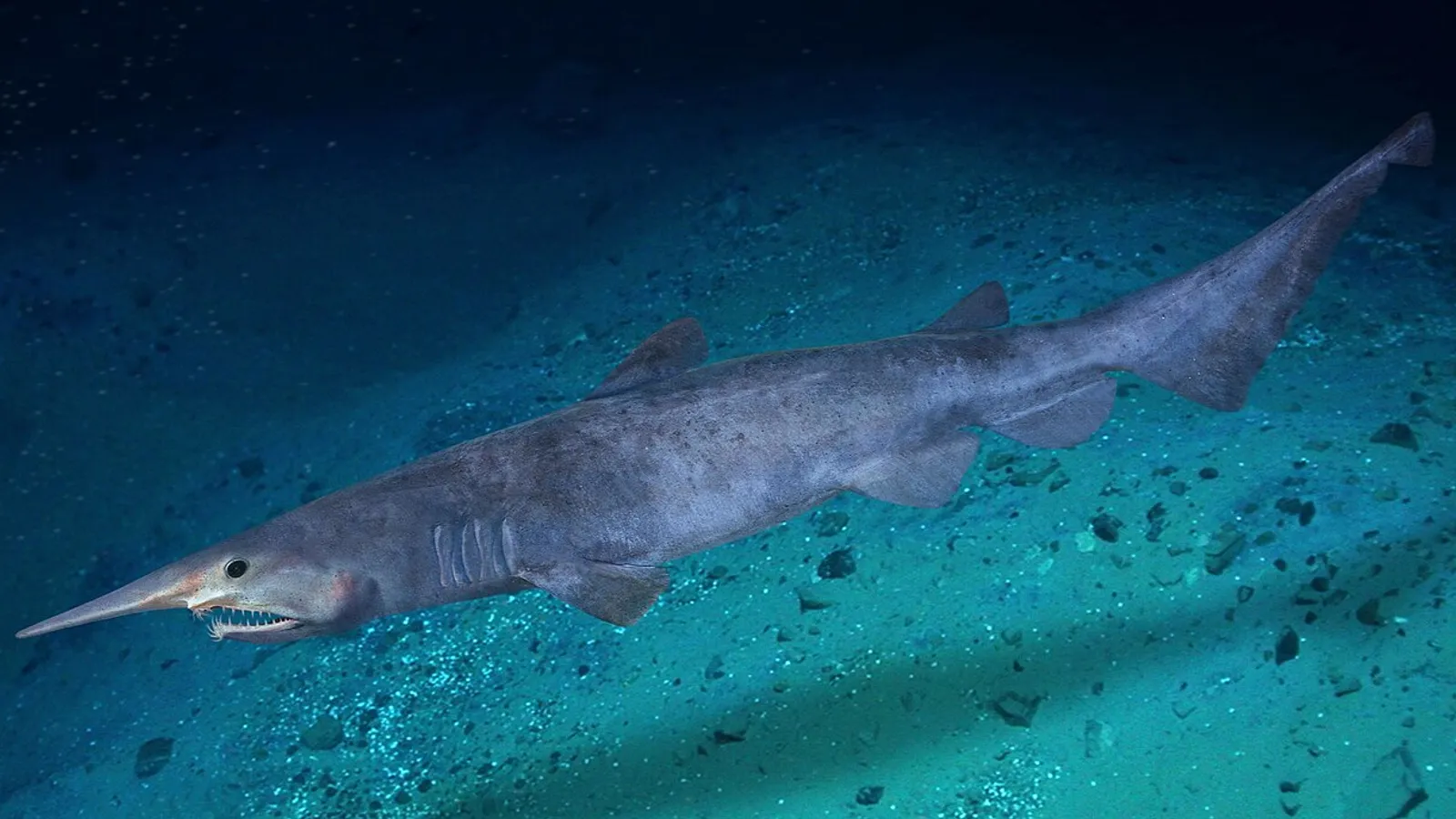
— Where the name comes from
Mitsukurina recalls Kakichi Mitsukuri, a zoologist at the University of Tokyo, and owstoni Alan Owston, an English collector living in Yokohama who obtained the first specimen in 1898. The common name comes from the Japanese tengu-zame, “tengu shark”, after the long-nosed demon of folklore: Japanese fishermen knew it long before science did.
— Facts
- Group
- Fish · Actinopterygii · Chondrichthyes
- Order
- Mackerel sharks
- Habitat
- Continental slopes and submarine canyons between 200 and 1,300 metres
- Range
- All oceans, but known chiefly from Japan
- Size
- 3–4 m, up to 6 m; 150–200 kg
- Diet
- Deep-sea fish, squid, crustaceans
- Lifespan
- unknown
— Characteristics
- 01
It has a long soft flattened rostrum packed with electrical sensors.
- 02
The skin is translucent and shows the blood vessels: hence the pink.
- 03
It is the only living member of a family that appeared 125 million years ago.
— What sets it apart
Its jaws are not attached to the skull as ours are: they hang on elastic ligaments and can be thrown forward until they project beyond the snout. Footage obtained in 2016 from a Japanese submersible showed the launch takes less than a tenth of a second and reaches the highest speed ever measured for a shark’s bite. It is the solution of a slow animal living where prey is scarce: it does not chase, it harpoons.
