
Great white shark
Carcharodon carcharias
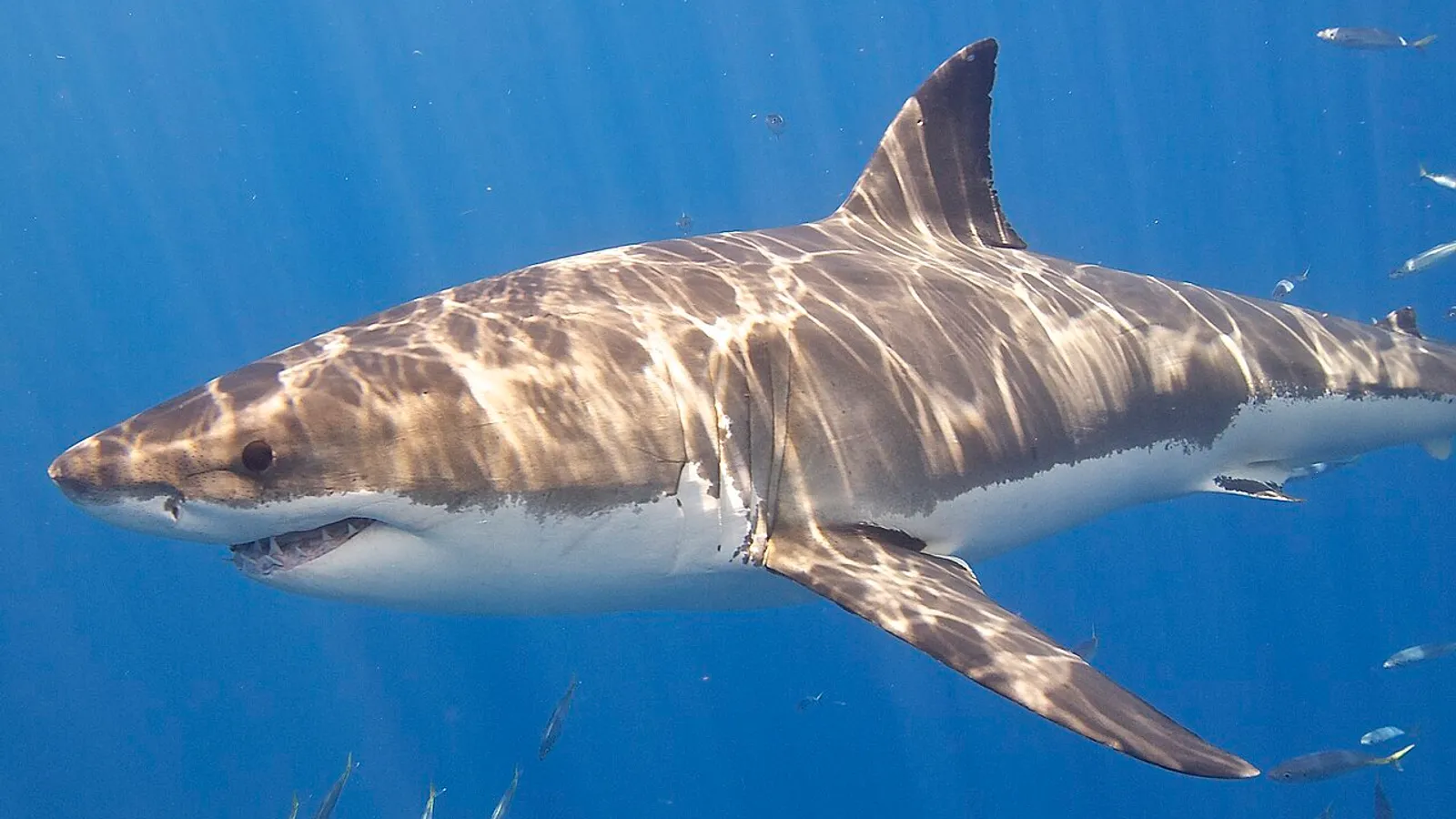
— Where the name comes from
From the Greek kárcharos, “sharp, jagged”, joined to odoús, tooth: “ragged tooth”. The name describes the one part of the animal that ancient naturalists often saw — the fossil teeth, which were taken for petrified dragons’ tongues.
— Facts
- Group
- Fish · Actinopterygii · Chondrichthyes
- Order
- Mackerel sharks
- Habitat
- Temperate coastal and pelagic waters
- Range
- All oceans; present, though rare, in the Mediterranean
- Size
- 4–6 m, up to 2 tonnes
- Diet
- Carnivore — seals, fish, dead cetaceans
- Lifespan
- 70 years and more
— Characteristics
- 01
Partly endothermic: it keeps muscle and brain above the temperature of the water.
- 02
The teeth are replaced in rolling rows throughout life.
- 03
The ampullae of Lorenzini detect electric fields of a few nanovolts.
— What sets it apart
The Mediterranean holds a population of white sharks genetically cut off from all others for some 450,000 years. The leading idea is that a small group from the Australian Pacific took a wrong turn during an interglacial, came in through Gibraltar and never left. The white sharks of our sea descend from a navigational error.
