
Springbok
Antidorcas marsupialis
— Where the name comes from
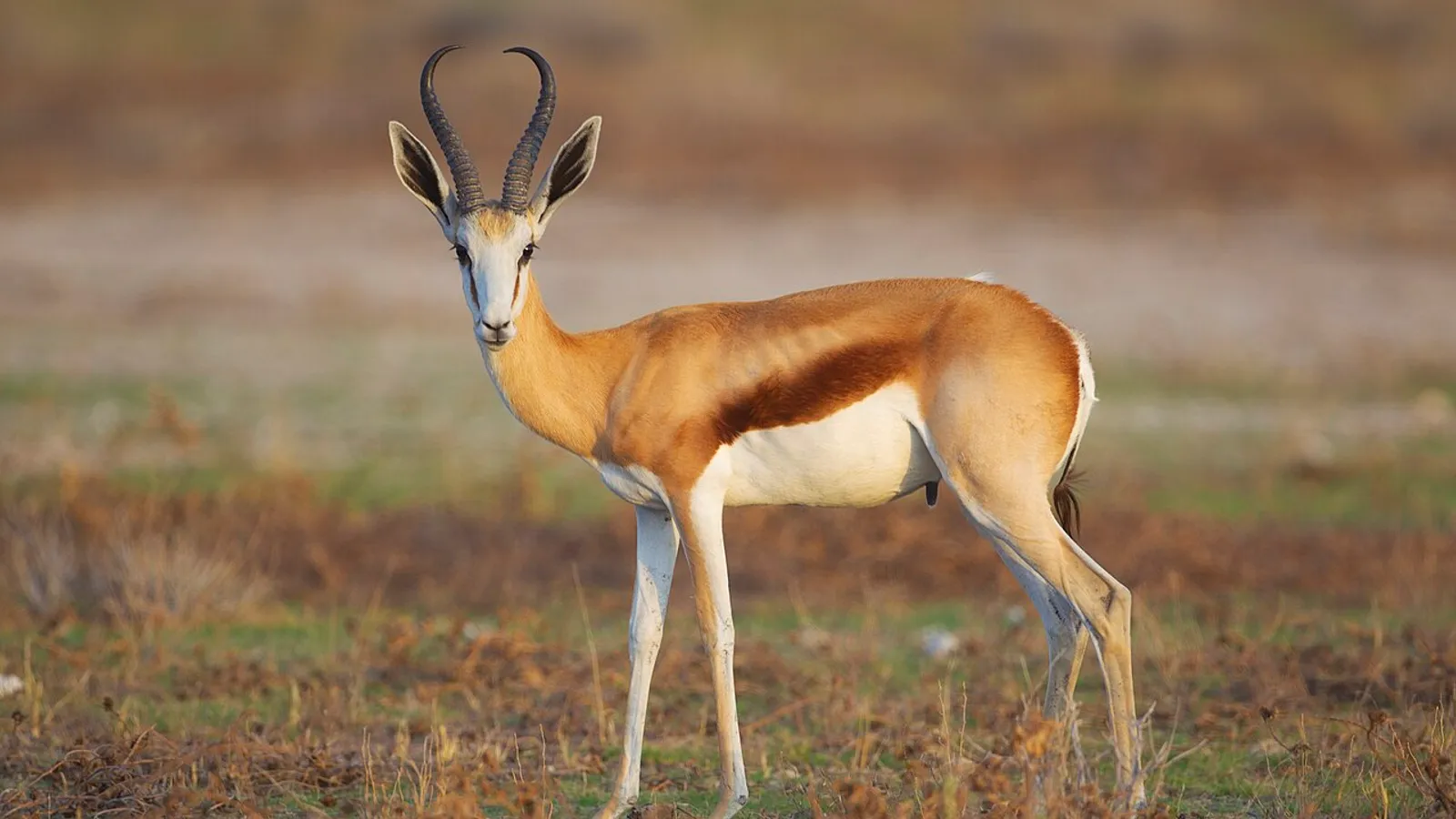
Springbok is Afrikaans and means “jumping antelope”, from springen and bok. The epithet marsupialis, from the Latin marsupium, “pouch”, indicates no pouch for young: it is the fold of skin along the back that opens during the leap, revealing a fan of white hair. Antidorcas is Greek and means “instead of a gazelle”, for the likeness to true gazelles, to which it does not belong.
— Facts
- Group
- Mammals · Mammalia
- Order
- Even-toed ungulates
- Habitat
- Arid savannah, open grassland, the semi-desert of the Karoo and the Kalahari
- Range
- Southern Africa: South Africa, Namibia, Botswana, Angola
- Size
- 120–150 cm long, 27–48 kg
- Diet
- Herbivore — grasses, shrubs, succulent roots and tubers
- Lifespan
- 7–10 years
— Characteristics
- 01
It leaps two metres straight up on stiff legs, a behaviour called pronking.
- 02
During the leap it opens the dorsal fold and shows a crest of long white hair.
- 03
It can live without drinking, taking water from roots and succulents dug up with its muzzle.
— What sets it apart
Until the 19th century it formed the most stupendous migrations ever documented anywhere: the trekbokke, columns of millions of animals that took whole days to pass and left the grassland shaved behind them. Colonists described them as rivers of animals kilometres wide. Fences, rifles and farming snuffed them out within a few decades, and the last great march dates to 1896. The species is doing well and is not threatened: what went extinct is not the animal, it is the phenomenon.
