
Arabian oryx
Oryx leucoryx
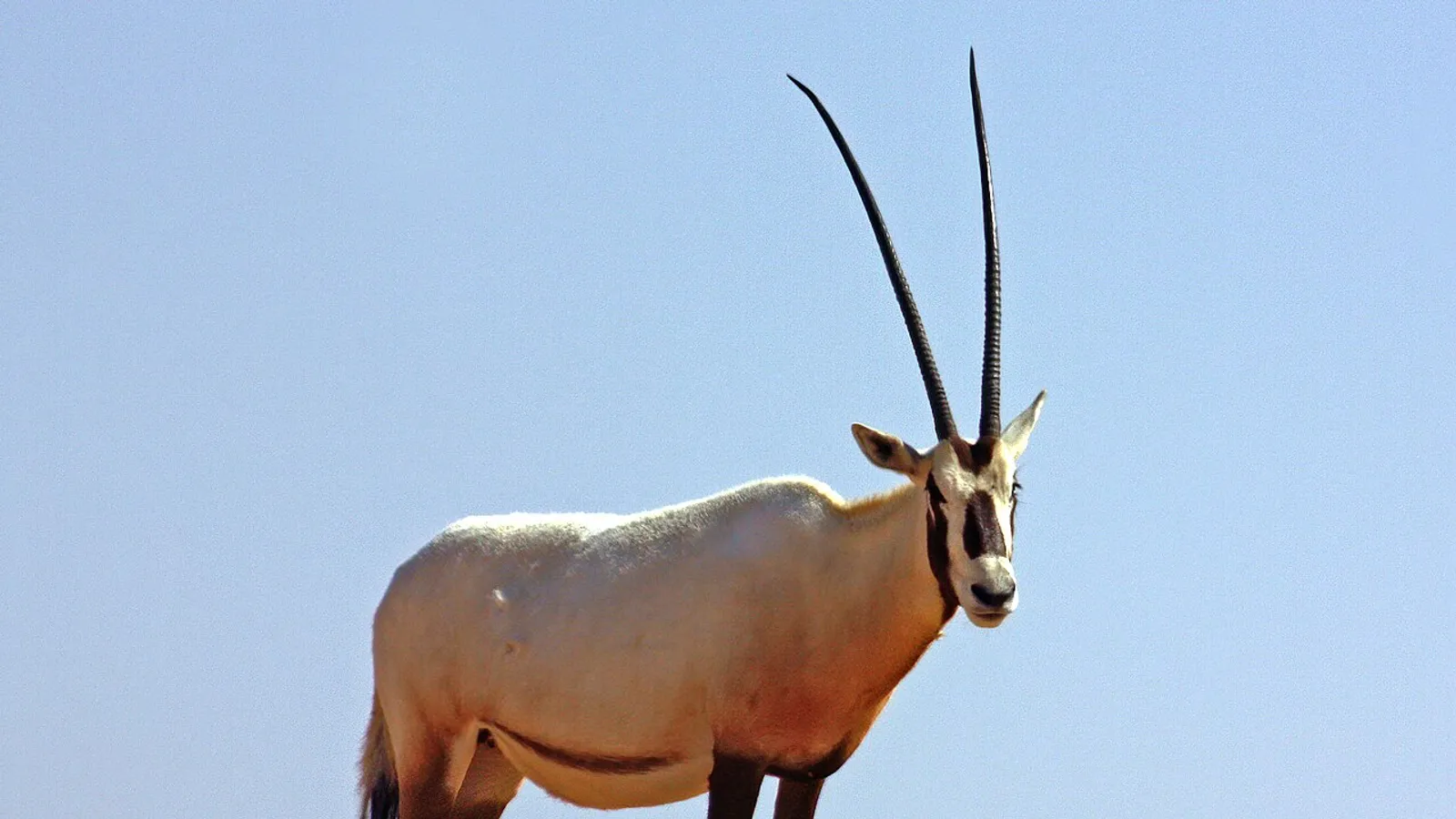
— Where the name comes from
Óryx in Greek was the pickaxe, the pointed tool, and by extension the antelope with horns straight as spikes. Leucoryx adds leukós, “white”. Many scholars see in this animal the origin of the unicorn myth: seen in profile at a distance, an oryx shows its two horns perfectly superimposed, and ancient travellers came home telling of a white desert beast with a single straight horn.
— Facts
- Group
- Mammals · Mammalia
- Order
- Even-toed ungulates
- Habitat
- Sandy and gravel desert, arid plains with sparse vegetation
- Range
- The Arabian peninsula: Oman, Saudi Arabia, the Emirates, Jordan — all reintroduced populations
- Size
- 160 cm long, 65–75 kg
- Diet
- Herbivore — desert grasses, shoots, tubers, wild melons
- Lifespan
- About 20 years
— Characteristics
- 01
It detects rain tens of kilometres away and moves towards the storms across the desert.
- 02
The white coat reflects light, while dark legs absorb heat on cold mornings.
- 03
It lets its own body temperature rise several degrees during the day so as not to sweat.
— What sets it apart
In 1972 the last wild Arabian oryx was shot in Oman, and the species went extinct in the wild. It survived, however, in a small nucleus of animals gathered in the 1960s in an operation called Operation Oryx and taken to Phoenix Zoo in Arizona. From those few animals came the populations reintroduced to the desert from 1982 onwards. In 2011 the Arabian oryx became the first species in the world to move from “extinct in the wild” to “vulnerable”: for once, the Red List was read backwards.
