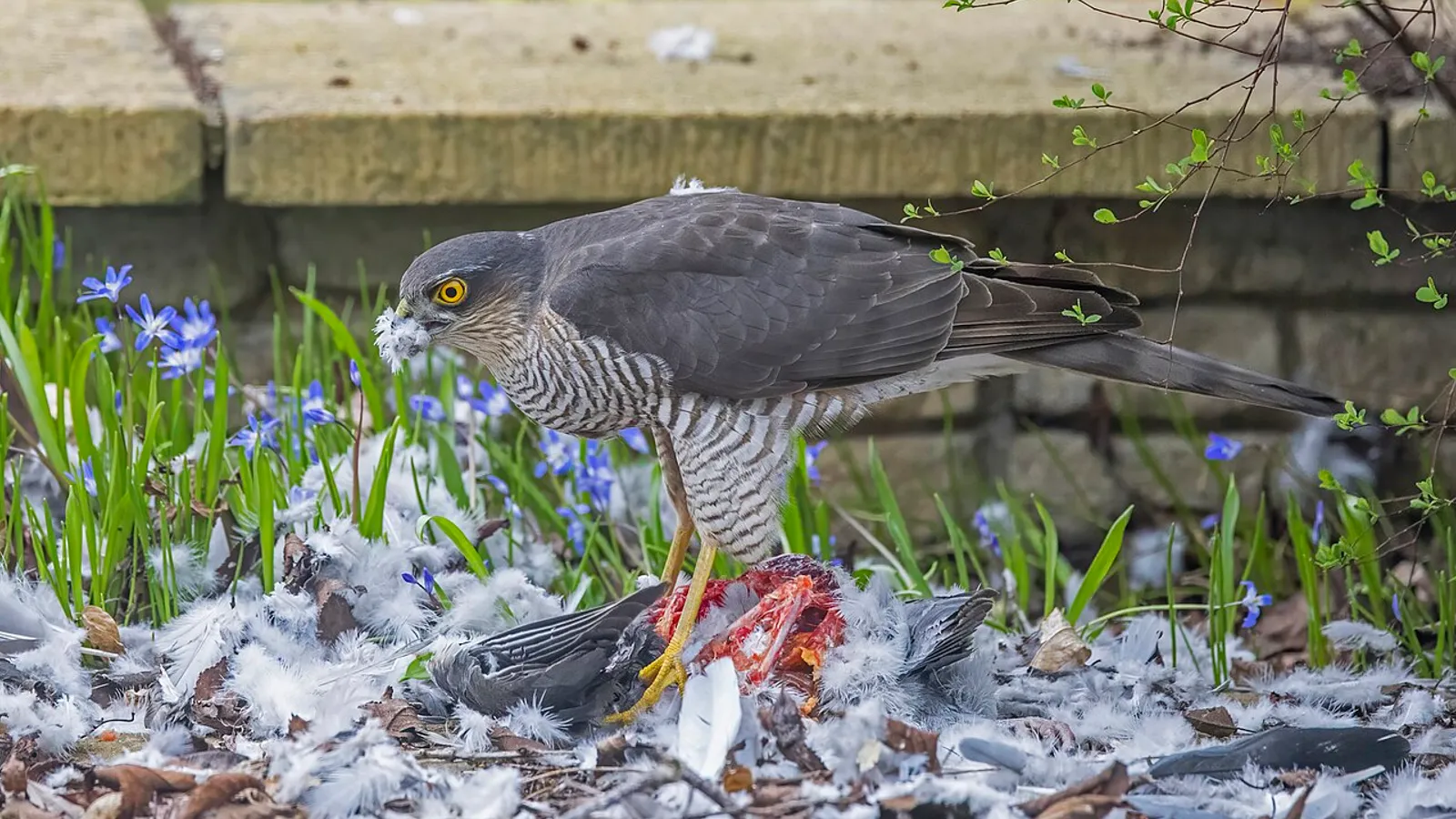
Eurasian sparrowhawk
Accipiter nisus
— Where the name comes from
Nisus is Nisus, king of Megara in Ovid’s Metamorphoses: his daughter Scylla cut the purple lock on which his kingdom depended, and the gods turned him into a bird of prey and her into a bird he pursues forever. Accipiter is Latin for hawk, an old word the Romans heard as close to accipere, “to seize”. The Italian sparviere comes from the Germanic sparwāri, the “sparrow eagle”: the name already says what it eats.
— Facts
- Group
- Birds · Aves
- Order
- Diurnal birds of prey
- Habitat
- Woodland, hedgerows, parks and gardens, cities included
- Range
- Europe, temperate Asia to Japan, North Africa
- Size
- Male 29–34 cm and 150 g, female 35–41 cm and 260 g; wingspan 58–80 cm
- Diet
- Small birds: sparrows, tits, finches, thrushes
- Lifespan
- 4 years on average, over 20 the record
— Characteristics
- 01
The female weighs almost twice as much as the male.
- 02
It hunts by surprise, flying low and bursting out from behind a hedge or a wall.
- 03
Its legs are long and its toes slender, made for snatching birds in flight.
— What sets it apart
In the 1960s it vanished from much of eastern England, and it was by studying its nests and those of the peregrine that Derek Ratcliffe discovered why. Comparing century-old museum eggs with new ones, he found that from 1947 the shells had suddenly grown thinner, and 1947 was the year DDT came into wide use: mothers were brooding eggs that broke under their weight. The ban on organochlorine pesticides brought it back everywhere, into town gardens too, where today it is the commonest reason a bird feeder empties in an instant.