
Common sole
Solea solea
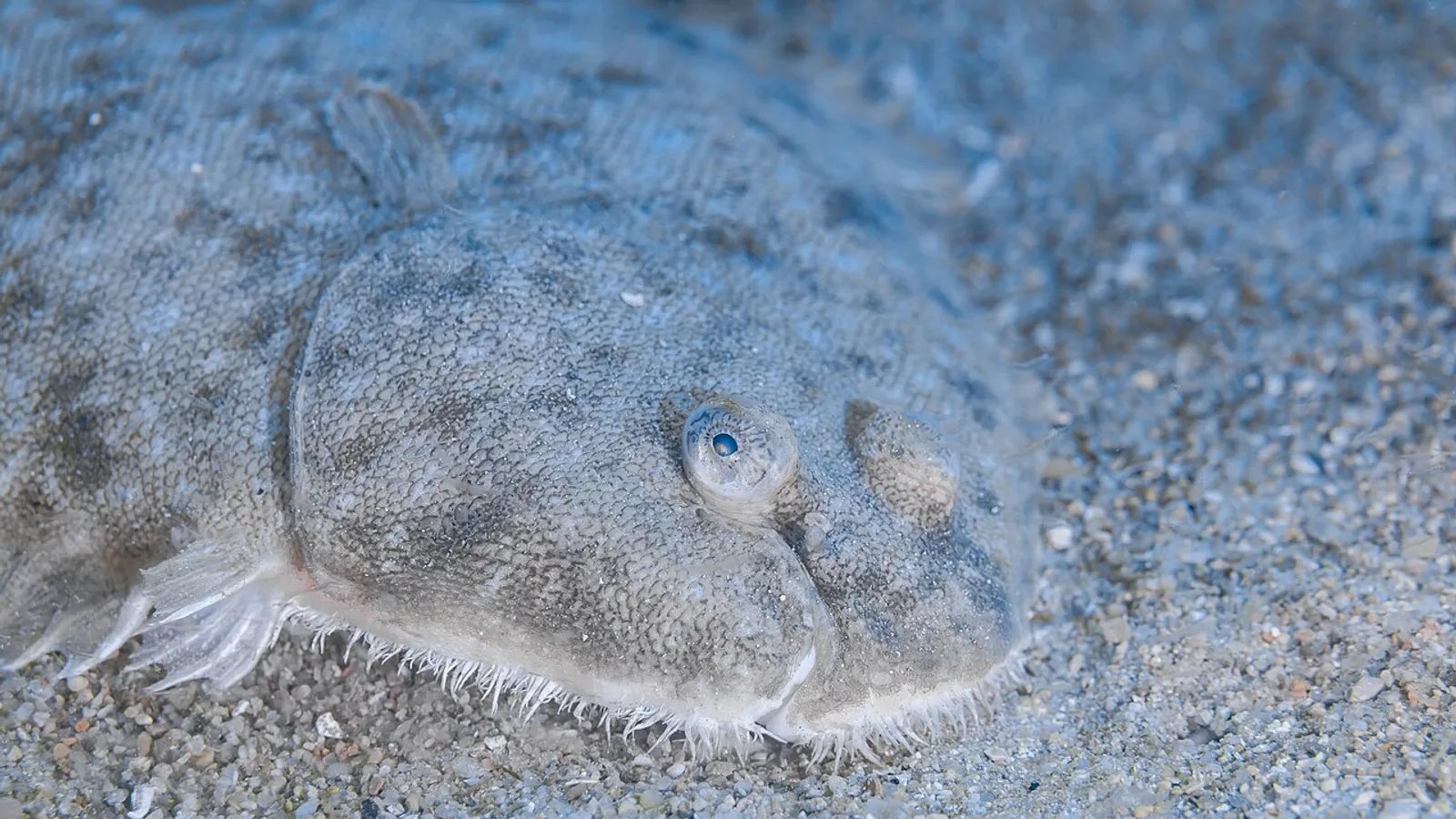
— Where the name comes from
Solea in Latin is the sandal, the sole of a shoe: the fish was named for its flat oval shape, and from that come the Italian sogliola, the French sole and the English sole. The binomial repeats the word twice. It is a rare case of a name describing an everyday object rather than a biological trait.
— Facts
- Group
- Fish · Actinopterygii · Chondrichthyes
- Order
- Flatfishes
- Habitat
- Sandy and muddy bottoms between 10 and 150 metres
- Range
- The eastern Atlantic from Norway to Senegal, and the Mediterranean
- Size
- 25–40 cm, up to 70 cm; 200–800 g
- Diet
- Worms, molluscs, bottom crustaceans
- Lifespan
- 25 years
— Characteristics
- 01
It buries itself in sand leaving only its eyes showing.
- 02
It hunts at night, feeling the bottom with sensory papillae round the mouth.
- 03
The blind side is white and without pigment.
— What sets it apart
It is born symmetrical. The larva has one eye on each side and swims upright like any fish; then, over a few weeks, the skull deforms, the left eye migrates across the head to join the right, the mouth twists and the animal lies down on its side for good. It is one of the most radical metamorphoses among vertebrates, and in recent years it has become clear that it is driven by the same thyroid hormones that in tadpoles order the move to life on land.
