
Hummingbird hawk-moth
Macroglossum stellatarum
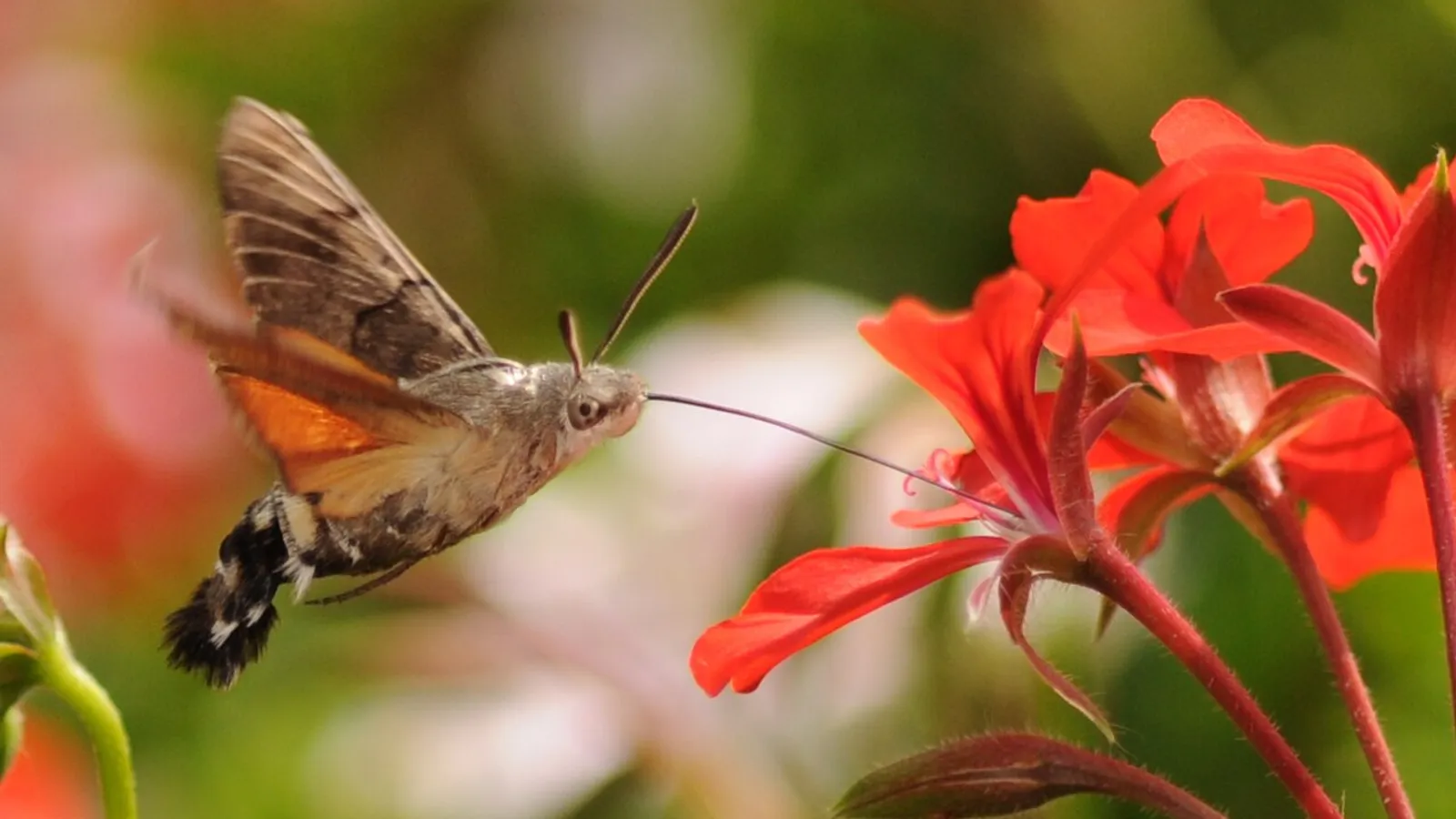
— Where the name comes from
Macroglossum is “long tongue”, from makrós and glôssa: unrolled, the proboscis is over two and a half centimetres and reaches the bottom of flowers no other day-flying butterfly can exploit. Stellatarum means “of the stitchworts”, the star-flowered plants it lays on. The name of the family, Sphingidae, comes instead from the pose the caterpillar takes when disturbed: reared on its hind legs, motionless, with the air of an Egyptian sphinx.
— Facts
- Group
- Insects · Insecta
- Order
- Butterflies and moths
- Habitat
- Gardens, flowering meadows, sunlit walls
- Range
- Europe, Asia, North Africa; it migrates as far as Scandinavia
- Size
- 4–5 cm wingspan
- Diet
- Nectar, taken hovering before the flower
- Lifespan
- Several months; it overwinters as an adult in crevices
— Characteristics
- 01
It beats its wings seventy to eighty times a second, with an audible hum.
- 02
It hangs still before the flower and never lands on it.
- 03
It flies by day, unlike almost all other hawk-moths.
— What sets it apart
It is mistaken for a hummingbird by anyone seeing it for the first time, and the confusion has reached the newspapers more than once — impossible in Europe, where hummingbirds do not exist. The resemblance is a textbook case of convergence: two remote animals solving the same problem — staying still in front of a flower while drinking — and arriving at the same shape. It also has a surprising memory for places: it returns to the same flowerbeds at the same hour for days, and recognises learned flowers even when the light changes, which means it possesses a form of colour constancy.
