
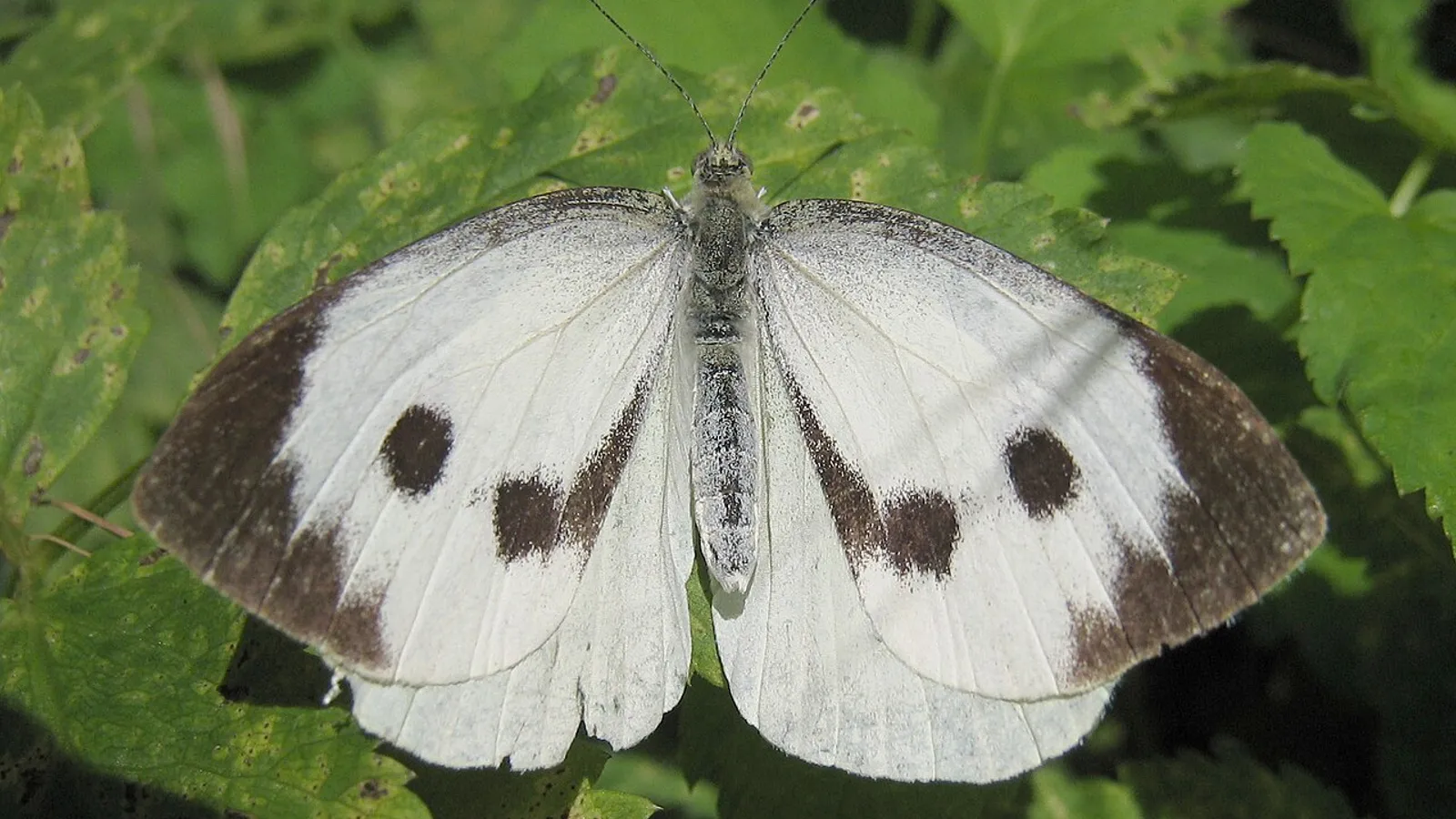
Large white butterfly
Pieris brassicae
— Where the name comes from
Pieris is the name of the Pierides, that is, the Muses, who took their epithet from Macedonian Pieria. Brassicae means “of the cabbage”. The binomial therefore sets the goddesses of poetry beside the most prosaic vegetable there is: the Muse of the cabbage. It is one of the finest contrasts in zoological nomenclature, and it comes of the eighteenth-century habit of giving butterflies mythological names and plants names from the pantry.
— Facts
- Group
- Insects · Insecta
- Order
- Butterflies and moths
- Habitat
- Vegetable plots, cultivated fields, gardens
- Range
- Europe, Asia, North Africa; introduced to South America
- Size
- 5.5–7 cm wingspan
- Diet
- Nectar as an adult; brassica leaves as a caterpillar
- Lifespan
- Several weeks; two or three generations a year
— Characteristics
- 01
The caterpillars live in groups and are yellow and black, not camouflaged.
- 02
They store the cabbage’s mustard oils and become unpalatable.
- 03
Females recognise leaves already occupied and do not lay twice.
— What sets it apart
The plant calls for reinforcements. When the caterpillars begin to feed, the cabbage releases a blend of volatile compounds that attracts a parasitoid wasp, which lays its eggs inside them: the plant cannot defend itself and hires an assassin. The butterfly has answered by making itself toxic — the caterpillars store the cabbage’s sulphur compounds, the ones that give it its smell, and use them against birds — and the wasps have answered in turn by specialising. It is one of the best-studied three-level chains in biology, and it plays out entirely in an ordinary vegetable patch.
