
Common egg eater
Dasypeltis scabra
— Where the name comes from
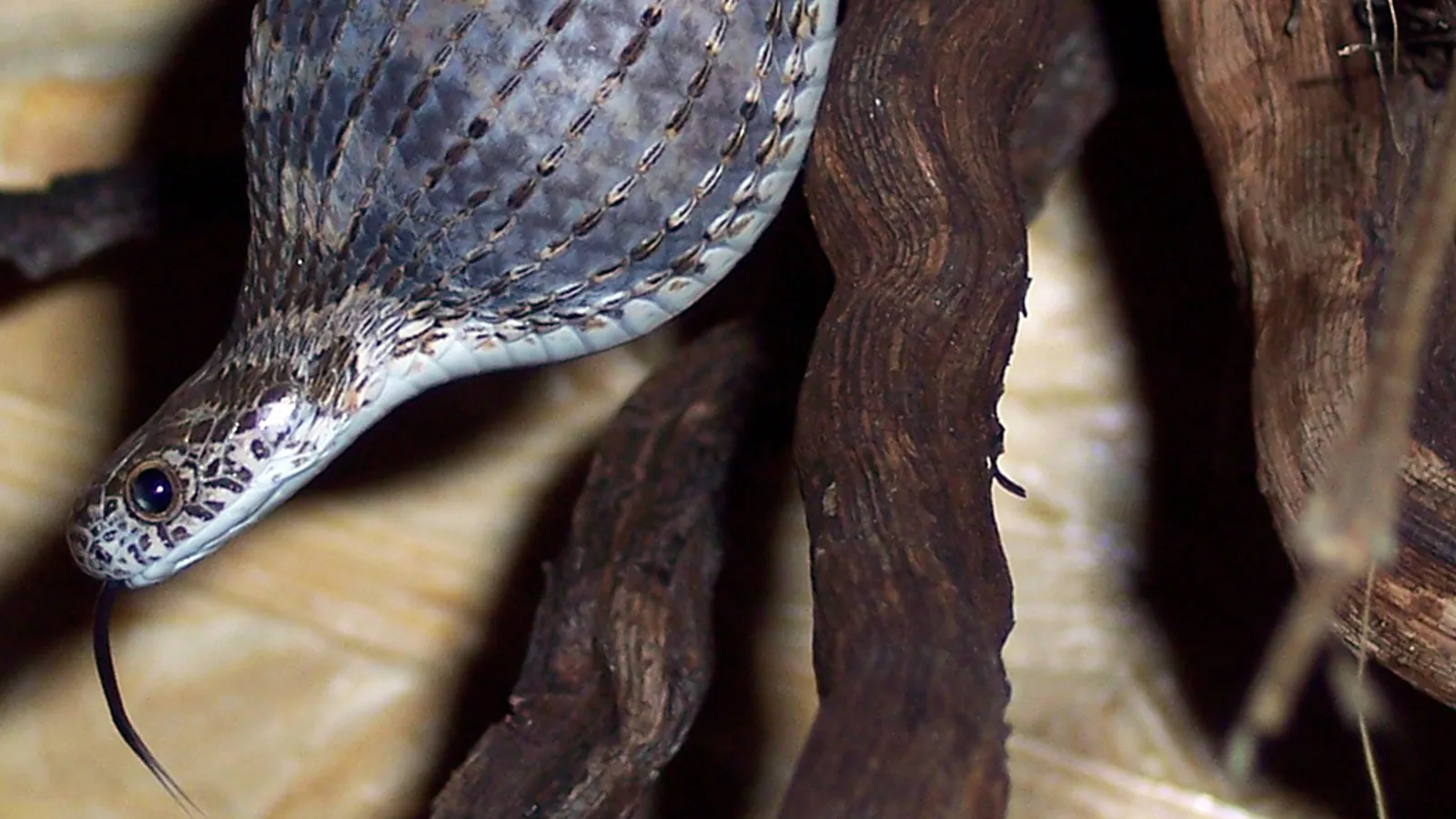
Dasypeltis is “rough shield”, from dasýs and péltē, for the keeled scales of the flanks; scabra says the same thing again in Latin. That roughness is not incidental: it exists to make a noise, and it is the first of the two inventions that make this snake one of the most specialised animals on the African continent.
— Facts
- Group
- Reptiles · Reptilia
- Order
- Squamates
- Habitat
- Savannah, scrub, farmland, gardens
- Range
- Sub-Saharan Africa and south-western Arabia
- Size
- 60–90 cm, 40–120 g
- Diet
- Exclusively birds’ eggs
- Lifespan
- 10 years
— Characteristics
- 01
It has practically no teeth and cannot bite.
- 02
It swallows eggs three times as wide as its own head.
- 03
Threatened, it rubs its coils and imitates the sound of a saw-scaled viper.
— What sets it apart
It has a saw inside its neck. The vertebrae of the front of the body carry bony processes that project into the oesophagus, capped with enamel: the snake swallows the egg whole, pushes it against those points until the shell gives, squeezes out the contents and then brings the crushed shell back up, folded like crumpled paper. Everything else about it — the missing teeth, the stretchable throat skin, the acoustic imitation of a viper — serves this one trade.
