
Giant vinegaroon
Mastigoproctus giganteus
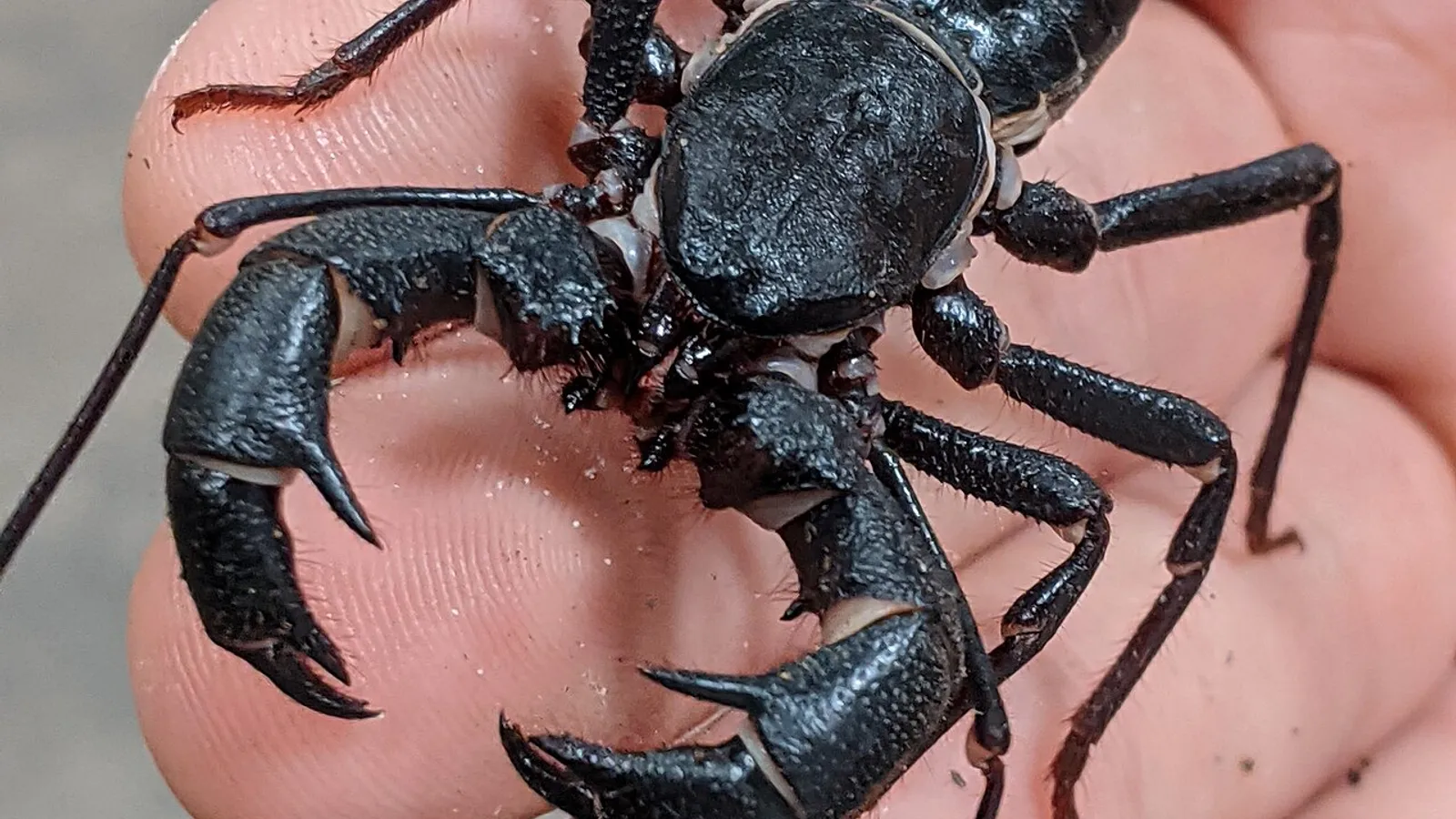
— Where the name comes from
Mastigoproctus is an anatomically explicit name: mástix, mastigos, the whip, and prōktós, the anus. It says “whip above the anus”, which is exactly where the long sensory filament sits at the end of the body, right beside the openings of the glands the animal defends itself with. English preferred the flavour: vinegaroon, “the vinegar one”.
— Facts
- Group
- Arachnids · Arachnida
- Order
- Whip scorpions
- Habitat
- Deserts and dry scrub, in burrows dug under stones
- Range
- Southern United States and Mexico
- Size
- 4–8 cm, excluding the whip
- Diet
- Insects, millipedes, small amphibians
- Lifespan
- 7 years
— Characteristics
- 01
It sprays a jet that is 84% acetic acid, that is, concentrated vinegar.
- 02
The terminal whip does not sting: it is a sense organ.
- 03
It aims the jet in almost any direction by rotating its abdomen.
— What sets it apart
It defends itself with vinegar. From glands at the base of the whip it sprays a jet that is eighty-four per cent acetic acid — stronger than kitchen vinegar — mixed with a solvent that drives it into the cuticle of insects: for an ant or a spider it is lethal, for a mammal it means burning eyes and a salad smell that lingers for hours. It can aim by rotating the tip of its abdomen, and hits precisely whatever has just grabbed it. It has no venom and does not bite: its entire defence rests on a gland that manufactures a condiment.
