
Lord Derby's scaly-tailed squirrel
Anomalurus derbianus
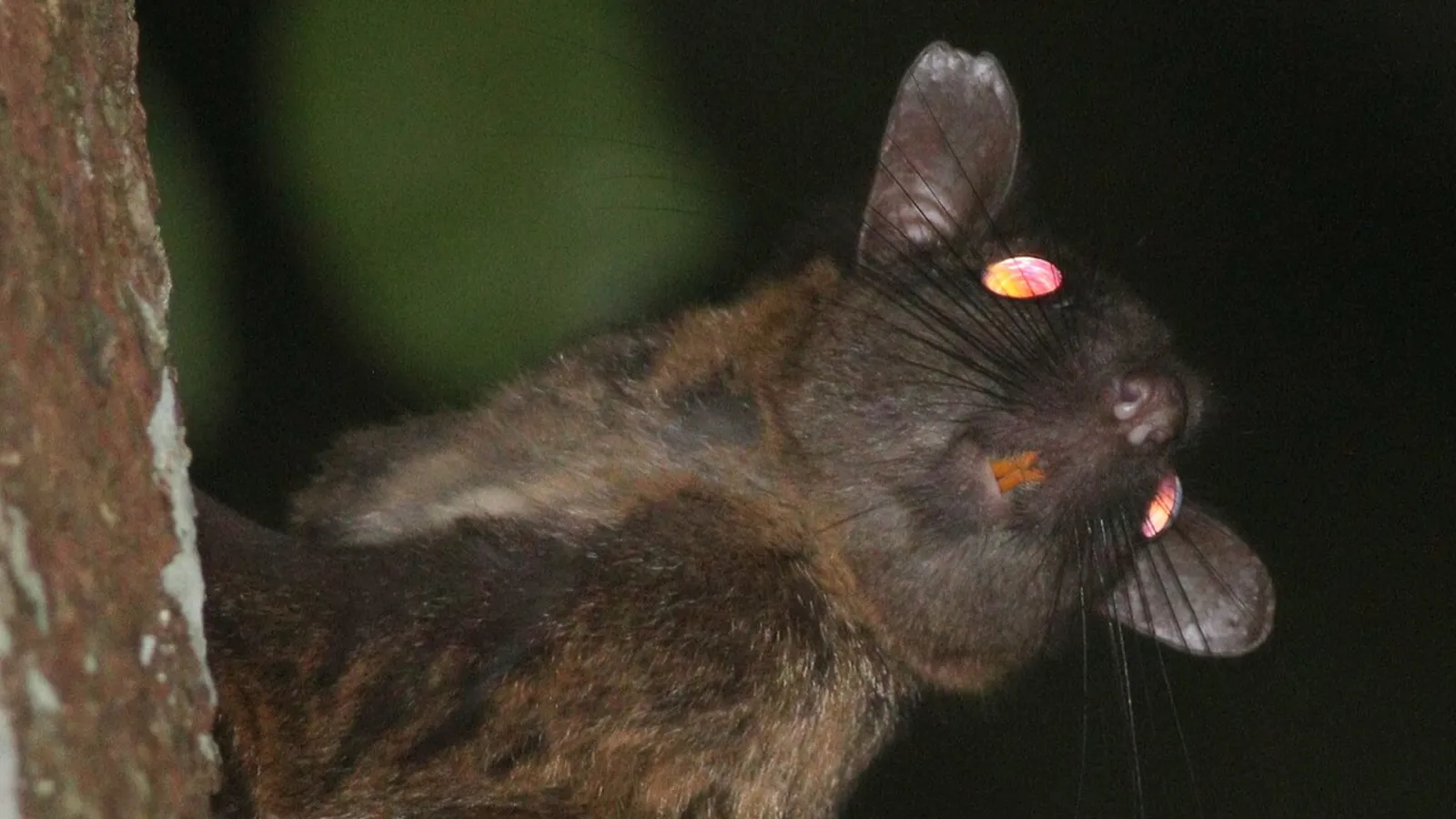
— Where the name comes from
Anomalurus is “anomalous tail”, from anṓmalos and ourá: beneath the base of the tail it carries two rows of large horny scales pointing backwards, found in no other mammal. The epithet recalls Edward Smith Stanley, thirteenth Earl of Derby, who kept at Knowsley Hall one of the greatest private menageries of the nineteenth century.
— Facts
- Group
- Mammals · Mammalia
- Order
- Rodents
- Habitat
- Rainforest with very tall, hollow trees
- Range
- Central and West Africa, from Sierra Leone to Mozambique
- Size
- 25–45 cm of body, tail 22–30 cm, 450–1,000 g
- Diet
- Bark, leaves, flowers, fruit, insects
- Lifespan
- 5 years
— Characteristics
- 01
It is not related to flying squirrels: it evolved its gliding membrane on its own.
- 02
The scales under the tail work as crampons when it climbs smooth trunks.
- 03
It glides as far as a hundred metres from tree to tree, at night.
— What sets it apart
The gliding membrane has appeared among mammals at least six separate times: in flying squirrels, in colugos, in the marsupial gliders, in the extinct volaticotherians and in this African family, which is close kin to none of them. Each time the anatomy differs in the details — here the membrane is held out by a cartilage springing from the elbow, not the wrist — but from a distance the result is the same animal. It is one of the most elegant cases of convergence among mammals.
