
Southern flying squirrel
Glaucomys volans
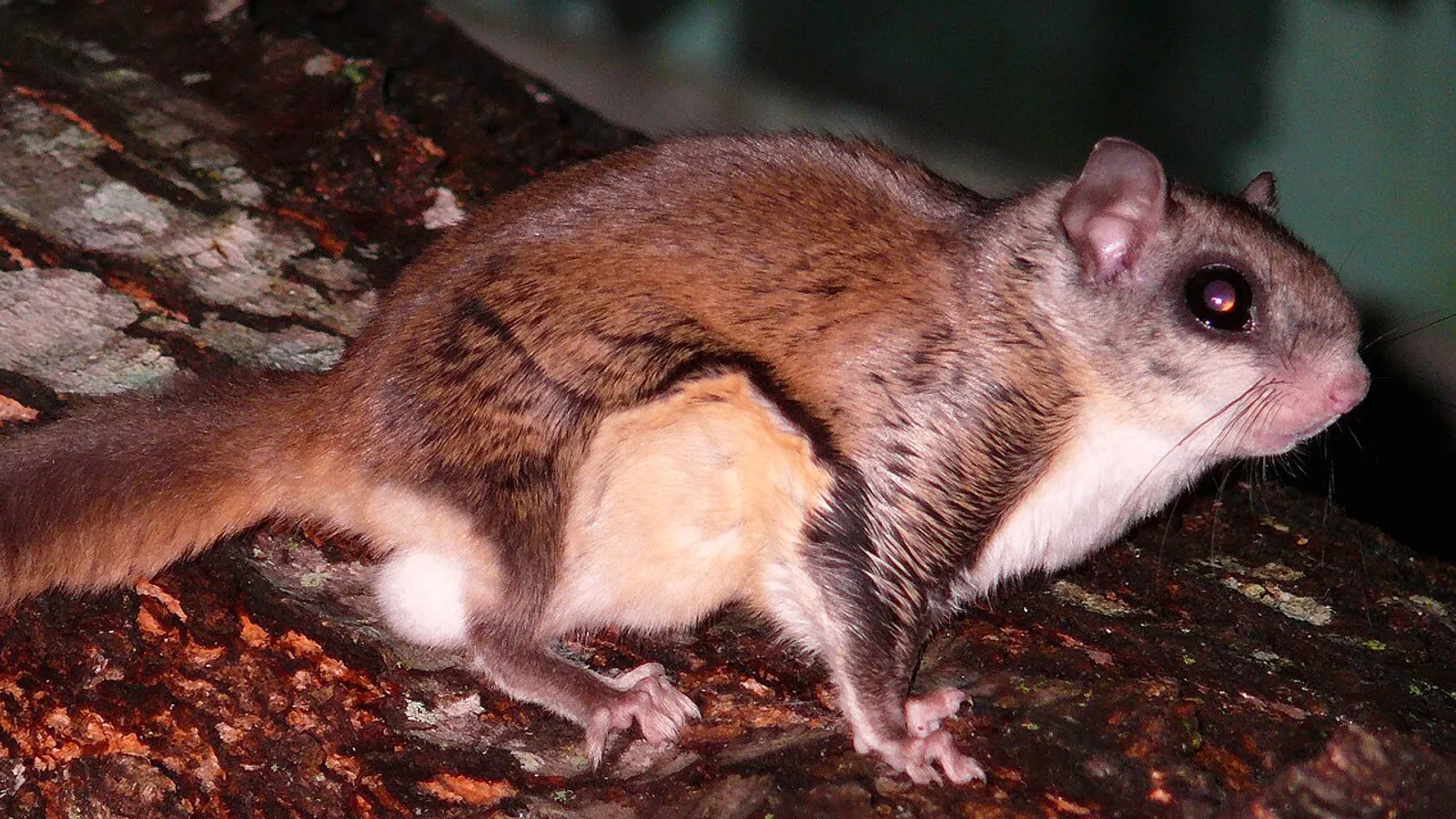
— Where the name comes from
Glaucomys is “shining grey mouse”, from the Greek glaukós — the same adjective used of Athena’s eyes, meaning a bright bluish grey — and mŷs. Volans, “flying”, is generous: the animal beats no wings, it glides. But anyone who saw it come out of the dark of a trunk and cross the clearing had no reason to make the distinction.
— Facts
- Group
- Mammals · Mammalia
- Order
- Rodents
- Habitat
- Mature broadleaf woodland with hollow trees
- Range
- The eastern United States, Mexico and Central America as far as Honduras
- Size
- 21–26 cm including tail, 45–85 g
- Diet
- Acorns, nuts, fungi, lichens, insects, eggs
- Lifespan
- 5 years in the wild
— Characteristics
- 01
It glides up to fifty metres on the patagium stretched from wrist to ankle.
- 02
It uses its flat tail as a rudder and as an air brake.
- 03
In winter dozens of them sleep piled together in the same cavity.
— What sets it apart
In 2019 it was found to be fluorescent. Under an ultraviolet lamp the fur of the belly turns hot pink, and this holds for all the flying squirrels of North America — the researcher who noticed was pointing his lamp at lichens, at night, and one flew past him. Nobody yet knows what it is for: the suspicion is recognition between individuals in the dark, or a masking against nocturnal raptors, which do see ultraviolet.
