
Eastern gray squirrel
Sciurus carolinensis
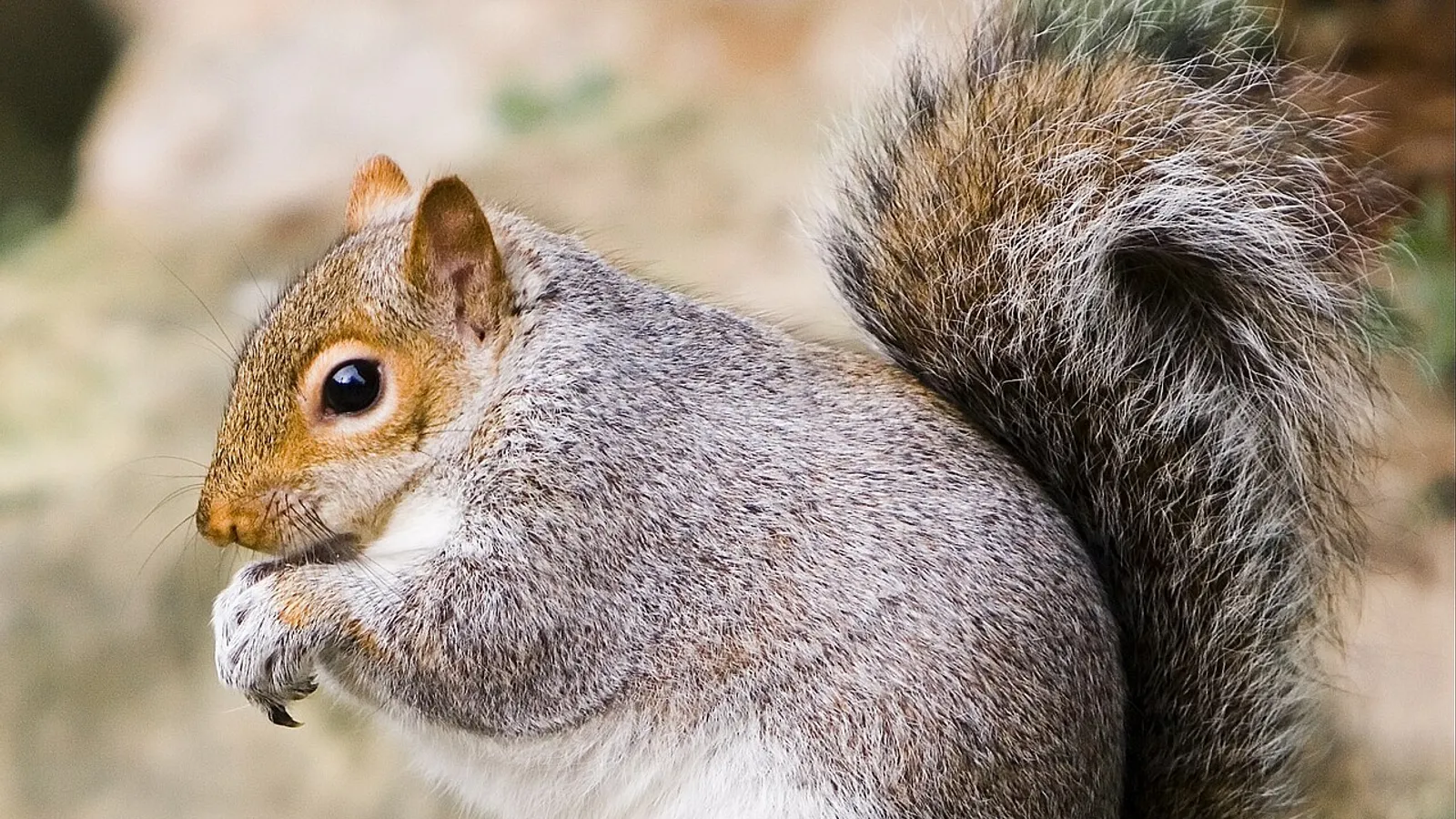
— Where the name comes from
Sciurus comes from the Greek skíouros, made of skiá, “shade”, and ourá, “tail”: the animal that shades itself with its tail. It is one of the finest etymologies in zoology, and it describes exactly what one sees when a squirrel crouches and lifts its tail over its back. Carolinensis points to the Carolinas, in the United States, whence came the described specimens.
— Facts
- Group
- Mammals · Mammalia
- Order
- Rodents
- Habitat
- Broadleaf woodland, city parks, gardens
- Range
- Eastern North America; introduced to Britain, Ireland and northern Italy
- Size
- 23–30 cm long plus 19–25 of tail, 400–600 g
- Diet
- Omnivore — acorns, nuts, seeds, buds, eggs, fungi
- Lifespan
- 6–12 years
— Characteristics
- 01
It hides thousands of seeds in separate holes and finds most of them again by memory and smell.
- 02
It pretends to bury food when it feels watched, to fool would-be thieves.
- 03
The acorns it forgets sprout: it is one of the chief planters of oaks across its range.
— What sets it apart
It reached Italy in 1948, with four animals released in the garden of a villa in Piedmont. From there it has spread through Lombardy, Liguria and Emilia, and where it arrives the European red squirrel disappears — not through direct aggression, but because the grey exploits acorns better and carries a parapoxvirus harmless to itself and lethal to the red. It is the textbook case of biological invasion in Europe, and the starting point was a handful of animals brought in as garden ornaments.
