
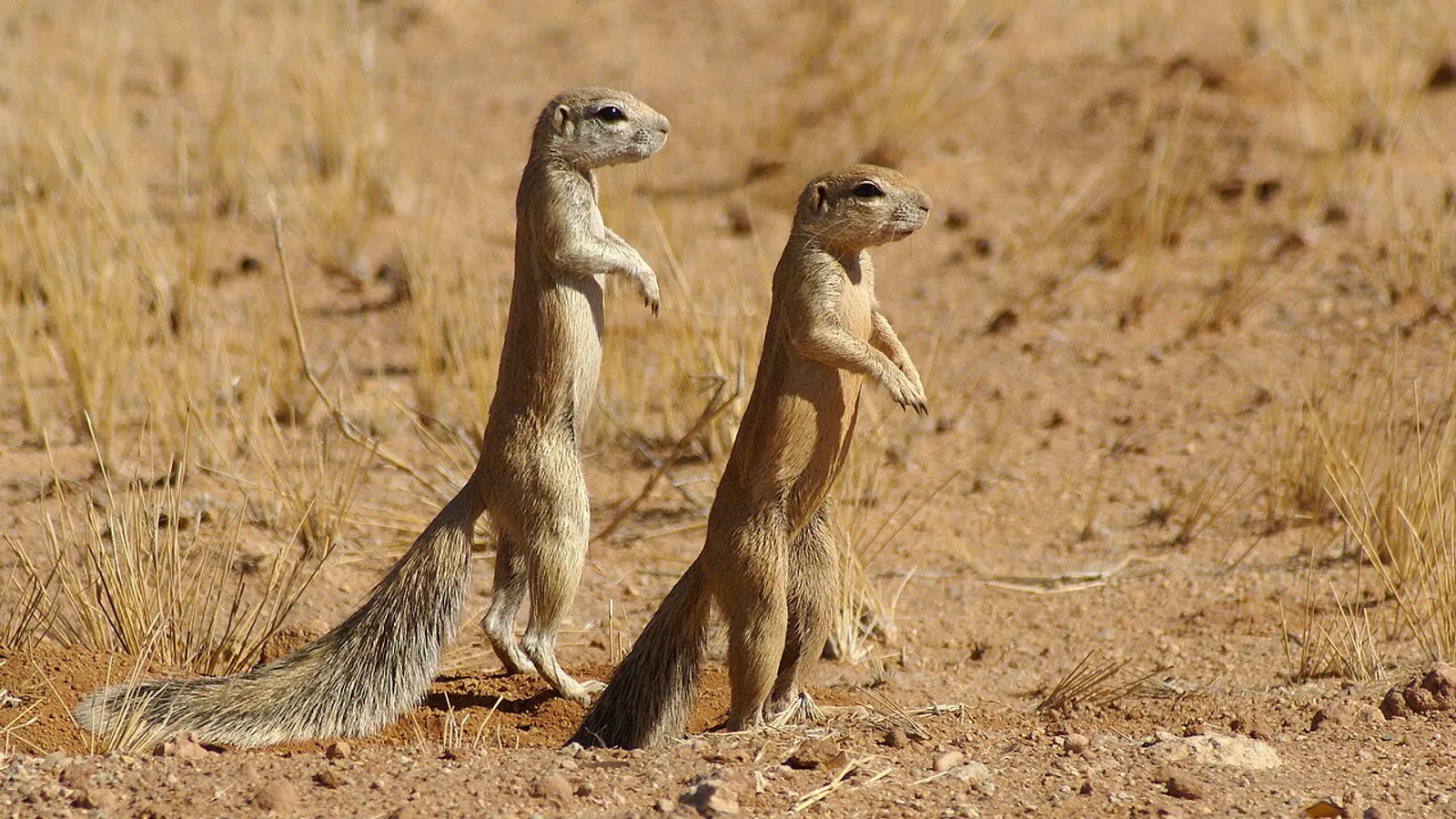
Cape ground squirrel
Xerus inauris
— Where the name comes from
Xerus is the Greek xērós, “dry”: the squirrel of arid lands, the one that gave up trees because where it lives there are none. Inauris, in Latin, is the earring — the epithet alludes to an ear reduced almost to a ring of skin, an adaptation against sand that recurs in ground squirrels on every continent.
— Facts
- Group
- Mammals · Mammalia
- Order
- Rodents
- Habitat
- Arid savannah, semi-desert, sandy grassland of the Kalahari
- Range
- South Africa, Namibia, Botswana, southern Angola
- Size
- 20–30 cm of body, tail 20–25 cm, 400–1,000 g
- Diet
- Bulbs, roots, seeds, grasses, insects
- Lifespan
- 11 years in captivity
— Characteristics
- 01
It lives in colonies of related females; the males roam in separate bands.
- 02
It neither hibernates nor stores food: in the Kalahari there is no dead season.
- 03
It shares its burrows with meerkats and yellow mongooses without conflict.
— What sets it apart
It shades itself, and it does so in earnest: when the ground passes forty degrees it spreads its tail like a parasol over its back and angles it towards the sun while foraging, shifting it as the hours pass. Field measurements show the sunshade lowers the temperature of its back by five degrees and adds hours to its useful feeding time. It is the literal translation of the Greek name for squirrels, skíouros, “shade-tail”, in an animal that never sees a tree.
