
Prevost's squirrel
Callosciurus prevostii
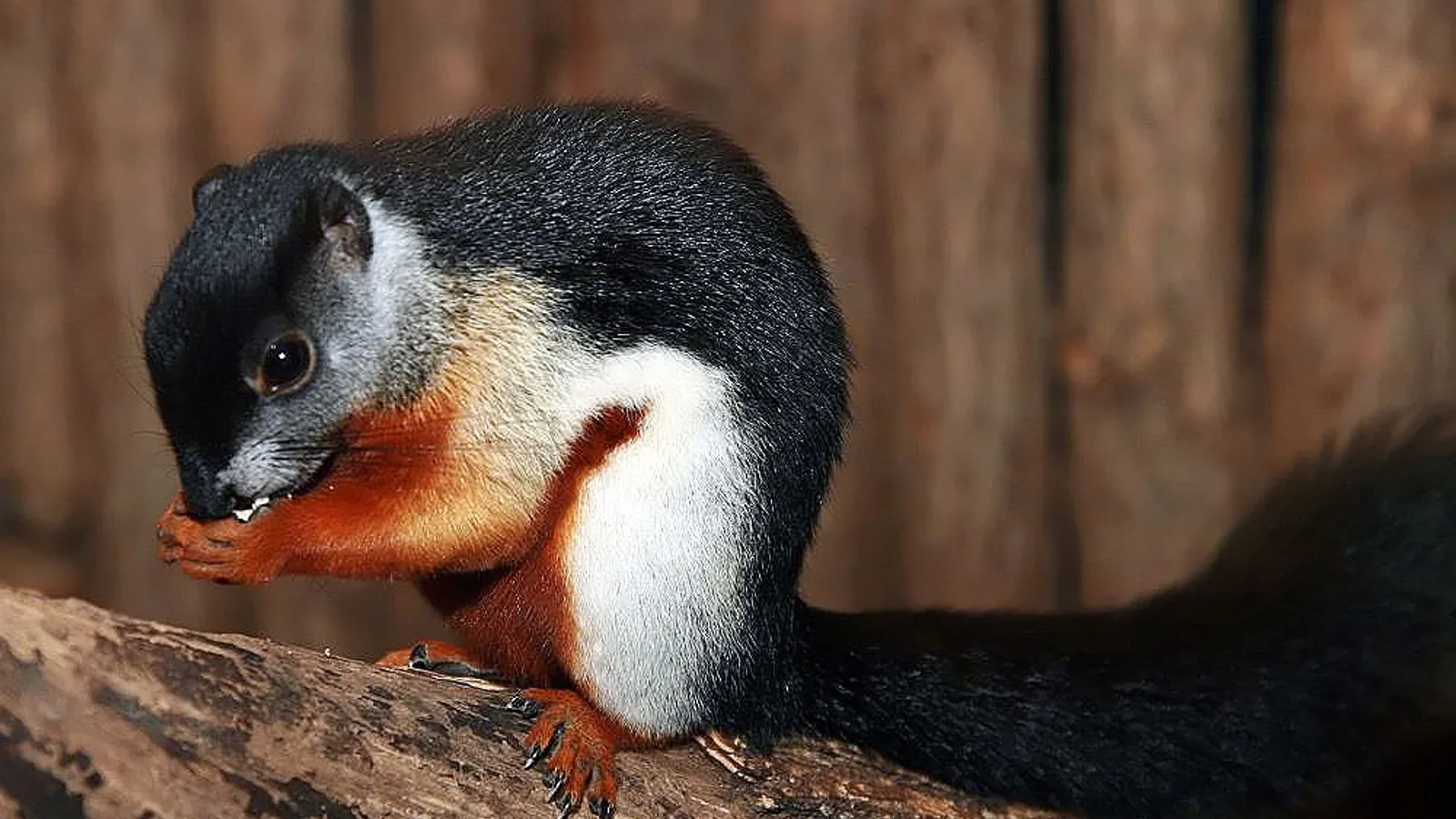
— Where the name comes from
Callosciurus is “beautiful squirrel”, from the Greek kalós: an aesthetic judgement placed inside a scientific name, something taxonomists rarely allow themselves. In this species it is deserved — black above, white in the middle, bright chestnut below, three bands as clean as a flag. The epithet recalls Florent Prévost, a curator at the Paris museum in the 19th century.
— Facts
- Group
- Mammals · Mammalia
- Order
- Rodents
- Habitat
- Primary and secondary rainforest, wooded plantations
- Range
- The Malay peninsula, Sumatra, Borneo, nearby islands
- Size
- 20–27 cm of body, tail as long again, 250–500 g
- Diet
- Fruit, seeds, flowers, insects, eggs
- Lifespan
- 10 years in captivity
— Characteristics
- 01
Over thirty subspecies have been described, many with different colourings.
- 02
It lives in the middle layer of the forest, below the canopy and above the understorey.
- 03
It also frequents coconut and rubber plantations, if fruit trees remain.
— What sets it apart
Its colouring changes from island to island in a mosaic nobody has yet fully explained: subspecies separated by a strait a few kilometres wide have orange or white bellies, the lateral band present or absent. No climatic gradient follows those differences, and natural selection, if it is involved, does not show. It is one of the cases geneticists use to argue how much visible variation is adaptation and how much is simply drift.
