
Indian palm squirrel
Funambulus palmarum
— Where the name comes from
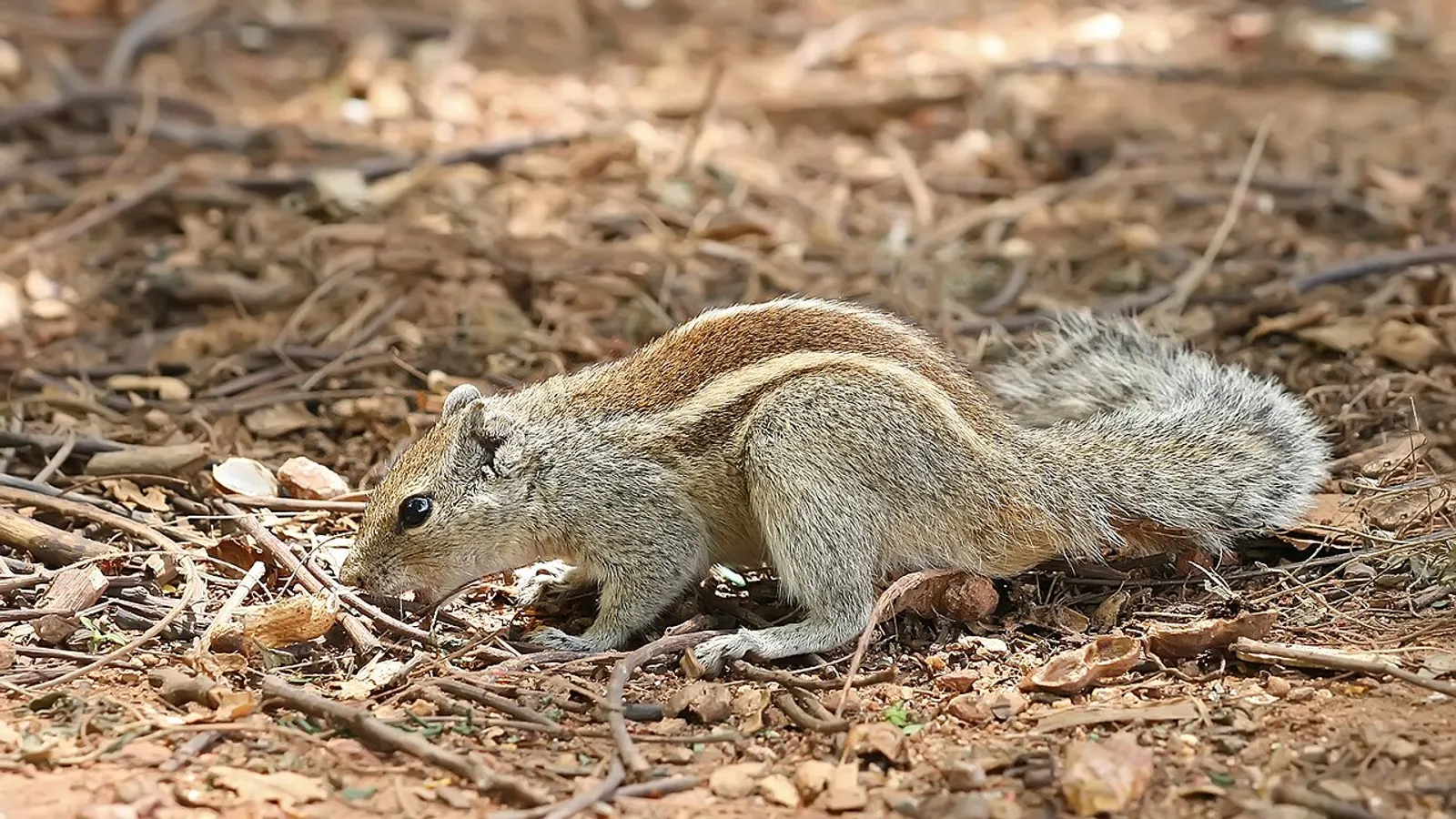
Funambulus is the Latin tightrope walker, from funis, the rope, and ambulare, to walk: the one who walks on a rope. Palmarum, “of the palms”, says where its balancing act is seen. In Hindu tradition the three pale stripes down its back are the fingers of Rāma, who stroked the squirrel to thank it for carrying pebbles to build the bridge to Lanka.
— Facts
- Group
- Mammals · Mammalia
- Order
- Rodents
- Habitat
- Open woodland, palm groves, gardens, cities
- Range
- Peninsular India and Sri Lanka
- Size
- 13–15 cm of body, tail as long again, 100 g
- Diet
- Fruit, seeds, nuts, flowers, insects, human scraps
- Lifespan
- 5 years in the wild
— Characteristics
- 01
It is diurnal and lives quite happily among people, in courtyards and markets.
- 02
It gives a sharp repeated chirp when it spots a raptor or a snake.
- 03
It builds spherical nests of plant fibre in the crowns of palms.
— What sets it apart
Its alarm call is studied because others understand it too: birds, deer and other monkeys of the same forest react to the palm squirrel’s cry as to their own. It works as a shared warning system, and the species giving it gains little — it is an almost free service rendered to a whole community, and one of the clearest cases of communication between species that are neither prey nor predator to one another.
