
Golden jackal
Canis aureus
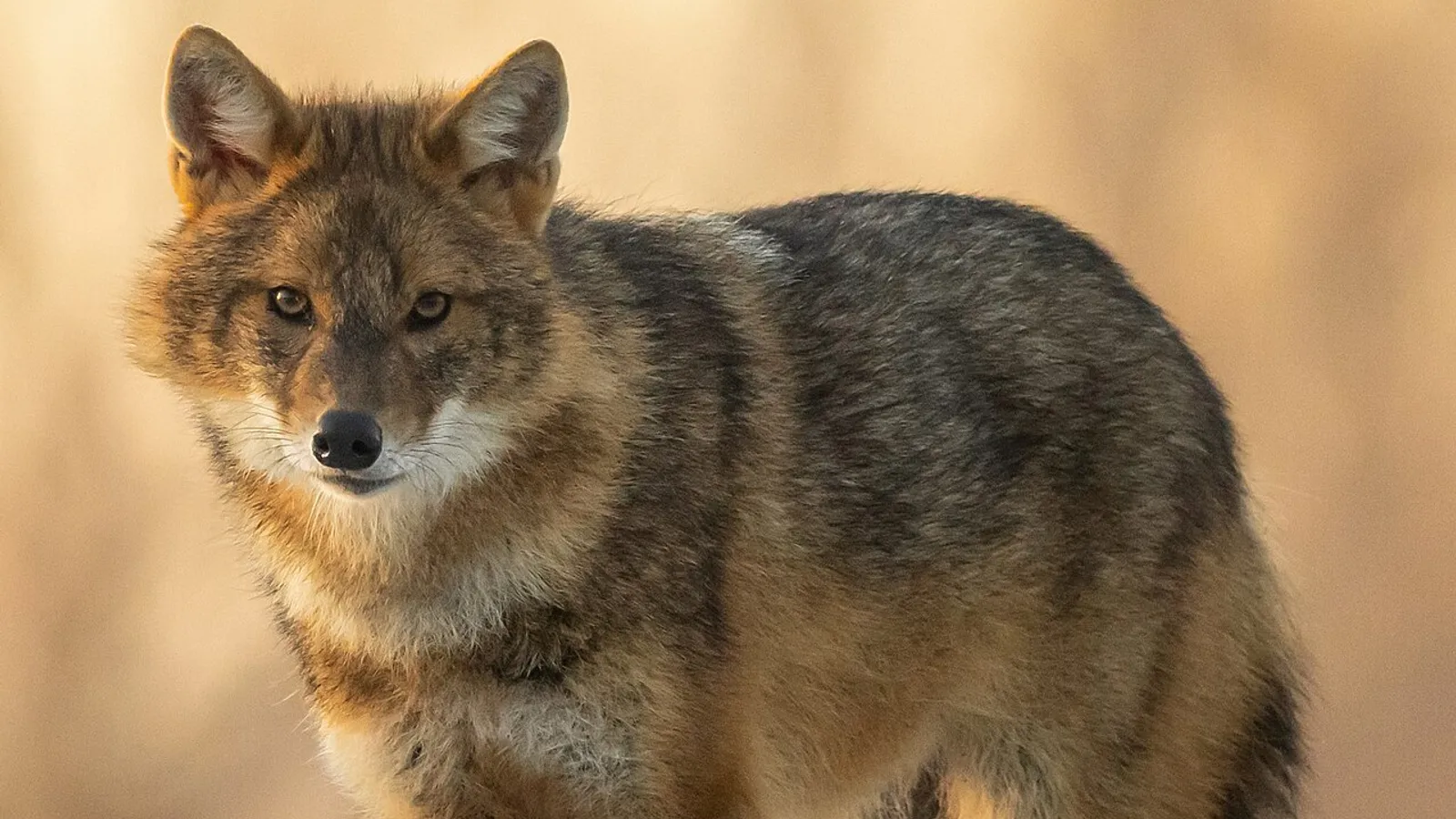
— Where the name comes from
Jackal travelled across half the world before reaching us: from the Sanskrit sṛgāla to the Persian šagāl, then to the Turkish çakal and finally into European languages through Ottoman trade. Aureus is Latin, “golden”, for the colour of the coat. In Italian the word later took on the figurative sense of someone who preys on others’ misfortune — a moral judgement pinned on an animal that merely eats what it finds.
— Facts
- Group
- Mammals · Mammalia
- Order
- Carnivores
- Habitat
- Open bushland, scrub, farmland, city outskirts
- Range
- From north-eastern Africa to South-East Asia; spreading through Europe, Italy included
- Size
- 70–85 cm long, 6–14 kg
- Diet
- Omnivore — small mammals, insects, fruit, carrion, refuse
- Lifespan
- 8–9 years in the wild
— Characteristics
- 01
It lives in stable pairs that stay together for years and defend a territory jointly.
- 02
The young of the previous litter often stay on to help their parents raise the next.
- 03
It howls in chorus with its mate: the duet announces that the territory is taken.
— What sets it apart
It is colonising Europe on its own, with nobody having introduced it. Setting out from the Balkans, it has in recent decades reached north-eastern Italy, Germany, the Netherlands and even Finland, filling the ecological space left empty by the extermination of the wolf. It is one of the fastest expansions ever observed in a European carnivore, and it is happening before our eyes: in Friuli and the Veneto it was absent until the 1980s, and today it breeds there regularly.
