
Scarabaeus sacer
Scarabaeus sacer
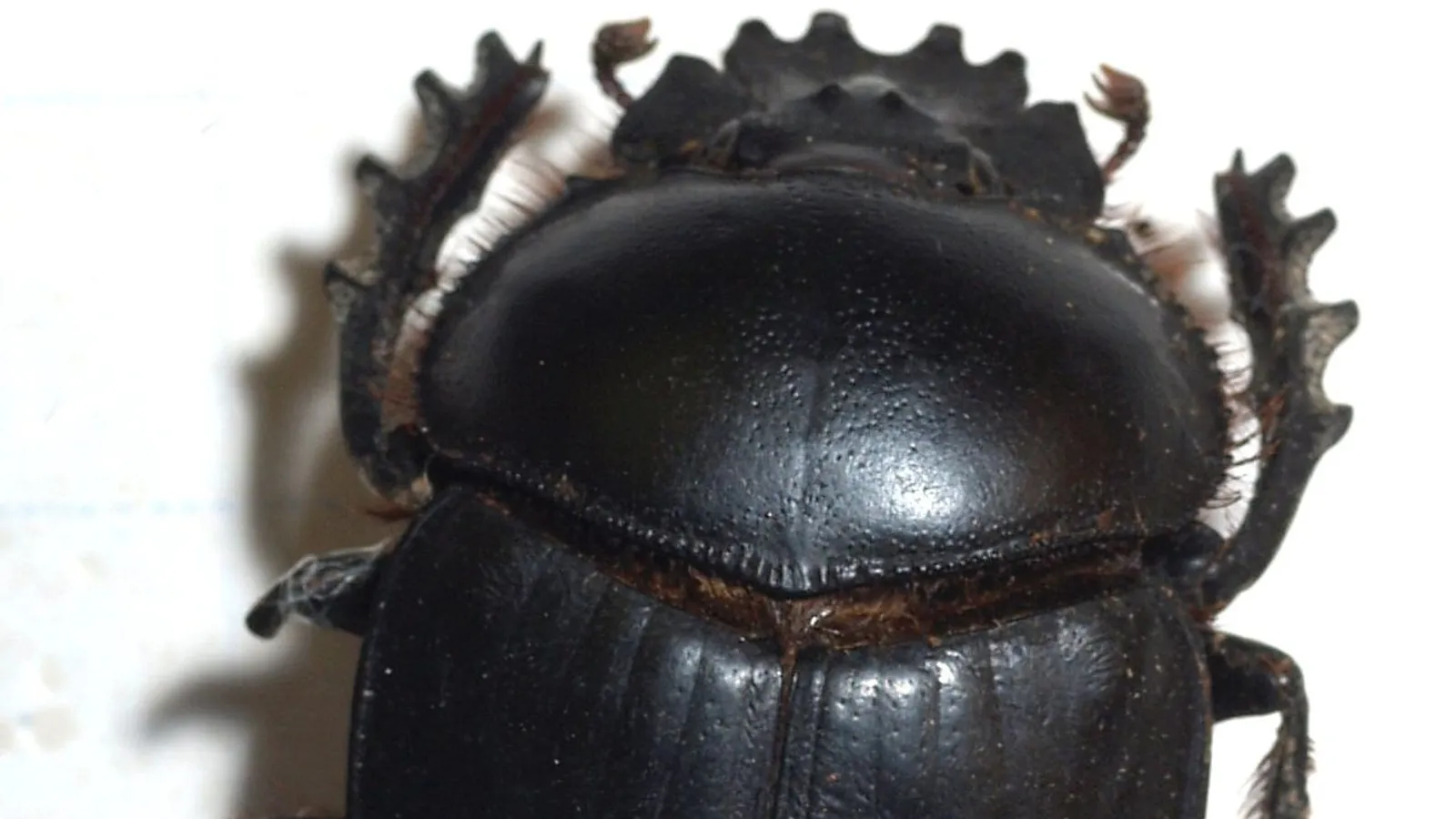
— Where the name comes from
From the Latin scarabaeus, from the Greek kárabos. Sacer, “sacred”: to the Egyptians the ball of dung pushed along at dawn was the disc of the sun pushed across the sky by the god Khepri, whose name means “he who comes into being”.
— Facts
- Group
- Insects · Insecta
- Order
- Beetles
- Habitat
- Open country, dunes, pasture
- Range
- The Mediterranean basin, North Africa
- Size
- 2.5–3.5 cm
- Diet
- Dung feeder
- Lifespan
- about 2 years
— Characteristics
- 01
Shapes a sphere of dung and pushes it backwards, walking on its front legs.
- 02
The flattened, toothed head works as a shovel.
- 03
Buries the sphere and lays an egg inside it.
— What sets it apart
To carry its ball off before anyone steals it, the beetle has to hold a straight line. At night, with no sun, it climbs on top of the sphere, performs an orientation dance and lines itself up with the bright band of the Milky Way. In a planetarium, under a simulated sky with no galaxy, it loses its way. It is the first animal shown to navigate by the light of our galaxy.
