
Hercules beetle
Dynastes hercules
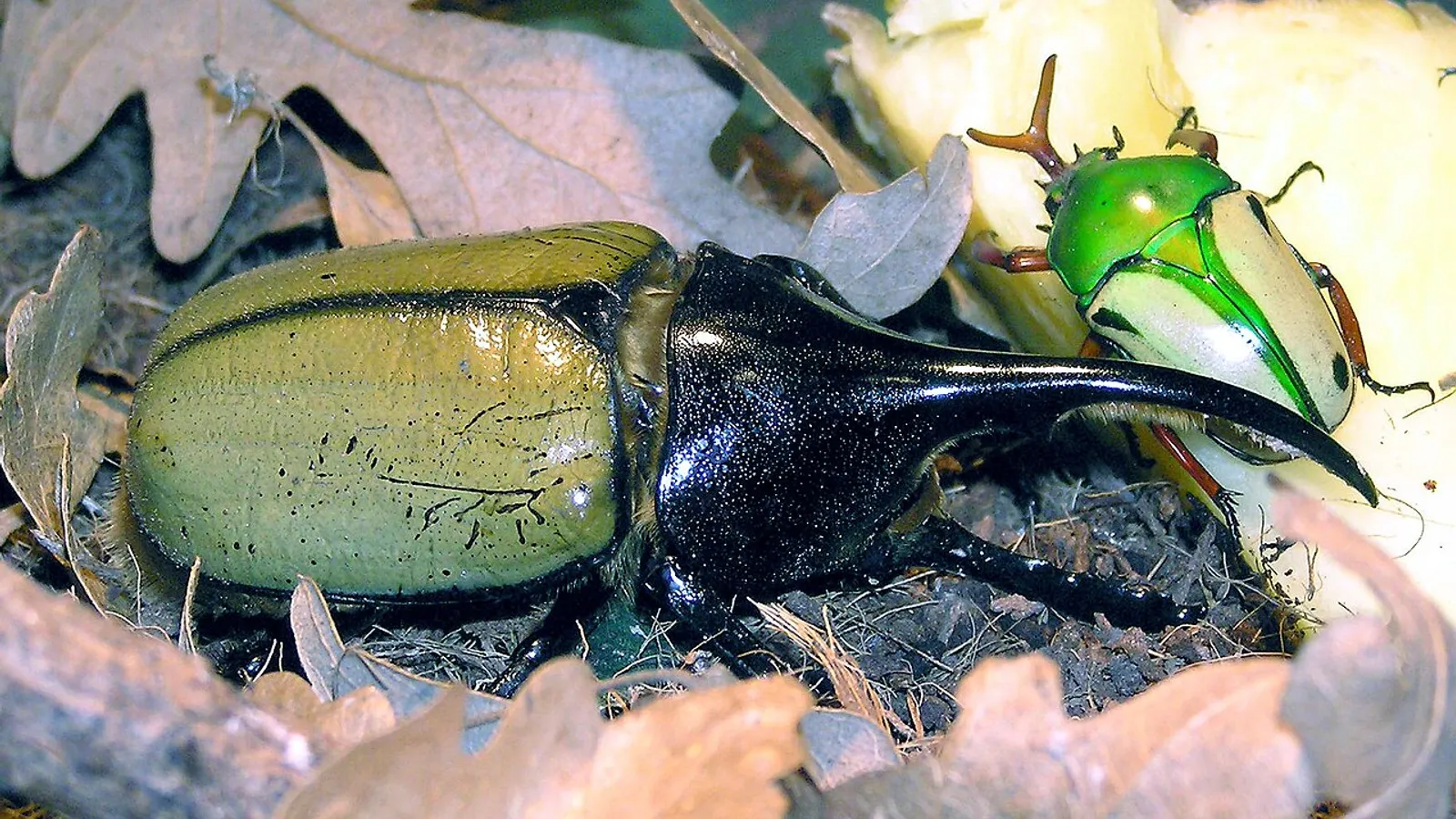
— Where the name comes from
Dynastes is Greek for “ruler, lord”, from dynástēs; hercules recalls the hero of superhuman strength. The name celebrates the insect’s power, able to lift enormous weights relative to its own. It is one of the largest beetles in the world, the male dominated by a long horn.
— Facts
- Group
- Insects · Insecta
- Order
- Beetles
- Habitat
- Tropical rainforest
- Range
- Central and South America, the Lesser Antilles
- Size
- Up to 17 cm for the male, horn included
- Diet
- Ripe fruit as an adult; rotting wood as a larva
- Lifespan
- The larva up to two years; the adult a few months
— Characteristics
- 01
The male has a long thoracic horn used to lift and hurl rivals.
- 02
It is among the strongest animals in the world for its weight: it lifts many times its own mass.
- 03
The shell changes colour, from black to olive, with the humidity of the air.
— What sets it apart
The Hercules beetle is one of the proportionally strongest animals on the planet: it can shift objects weighing dozens of times more than itself. But it also conceals an optical trick: its shell contains a porous microscopic structure which, when dry, reflects light and looks olive-green, while with humidity it fills with water and turns black. In the rainforest, where nights are damp and days drier, the same beetle changes colour with the weather: a living hygrometer.
