
Rose chafer
Cetonia aurata
— Where the name comes from
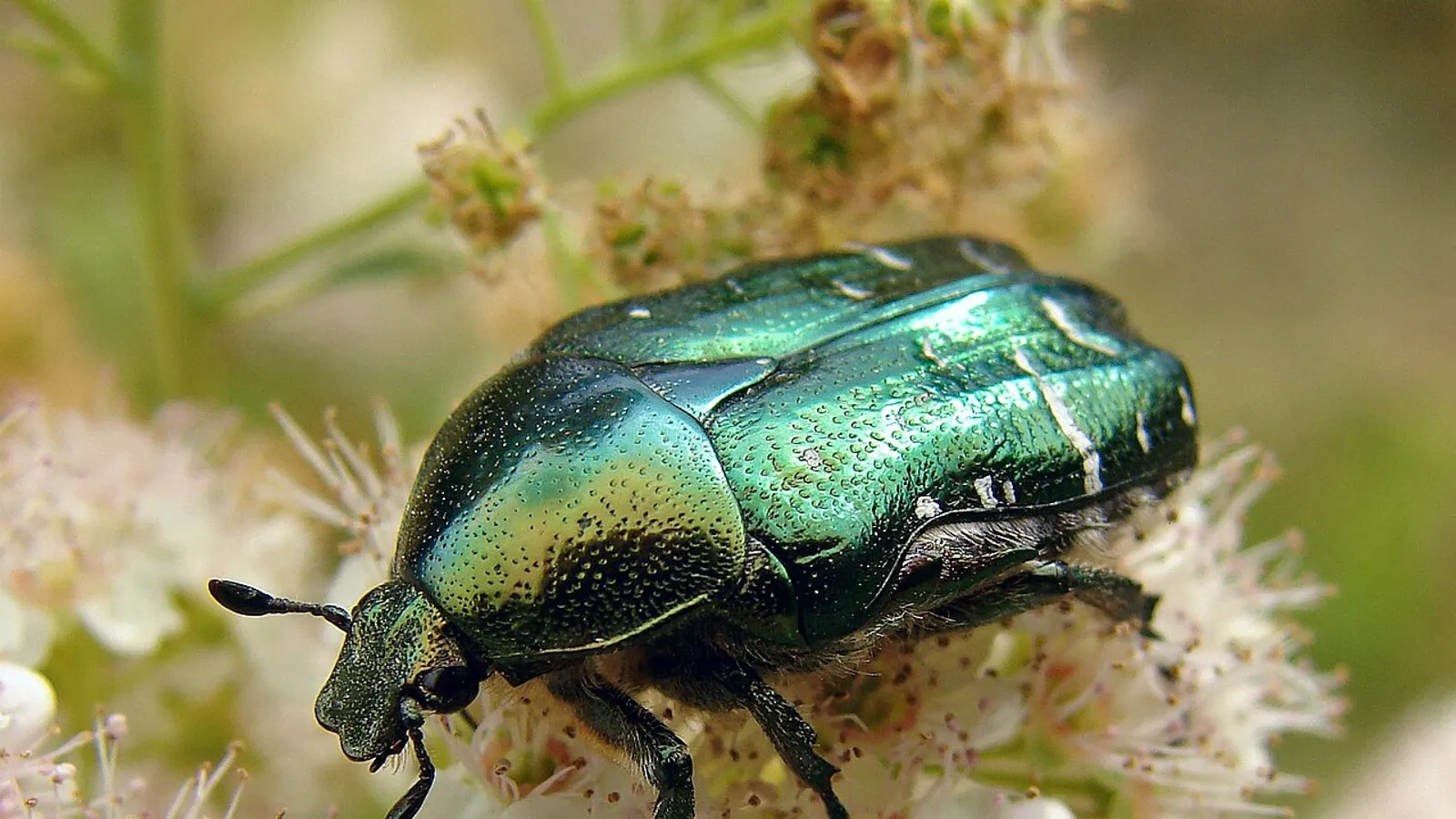
Cetonia derives perhaps from the Greek kḗtōn, “creature”; aurata is Latin, “gilded”, from the metallic green flecked with gold of the wing cases. It is the common rose chafer of European gardens, one of the most iridescent insects to be met among flowers.
— Facts
- Group
- Insects · Insecta
- Order
- Beetles
- Habitat
- Gardens, flowery meadows, woodland edges
- Range
- Europe, western Asia, North Africa
- Size
- 1.4–2 cm
- Diet
- Pollen, nectar and petals as an adult; roots and humus as a larva
- Lifespan
- The larva nearly two years; the adult a few months
— Characteristics
- 01
The metallic green is structural colour: it comes from microstructure, not from a pigment.
- 02
It flies with its wing cases closed, sliding the wings out through side slots: rare among beetles.
- 03
The larva, a fat white grub, recycles organic matter in the soil.
— What sets it apart
The rose chafer reflects only left-polarised light: its green shell has a helical structure that selects one particular “rotation” of light, a phenomenon extremely rare in nature and long studied on this very insect. Seen through the right filter, the glittering chafer turns dull and dark, as if it had vanished. It also flies oddly for a beetle: it keeps its wing cases shut and pushes the wings out through two side notches, so it can take off without flinging its armour open.
