
Giant peacock moth
Saturnia pyri
— Where the name comes from
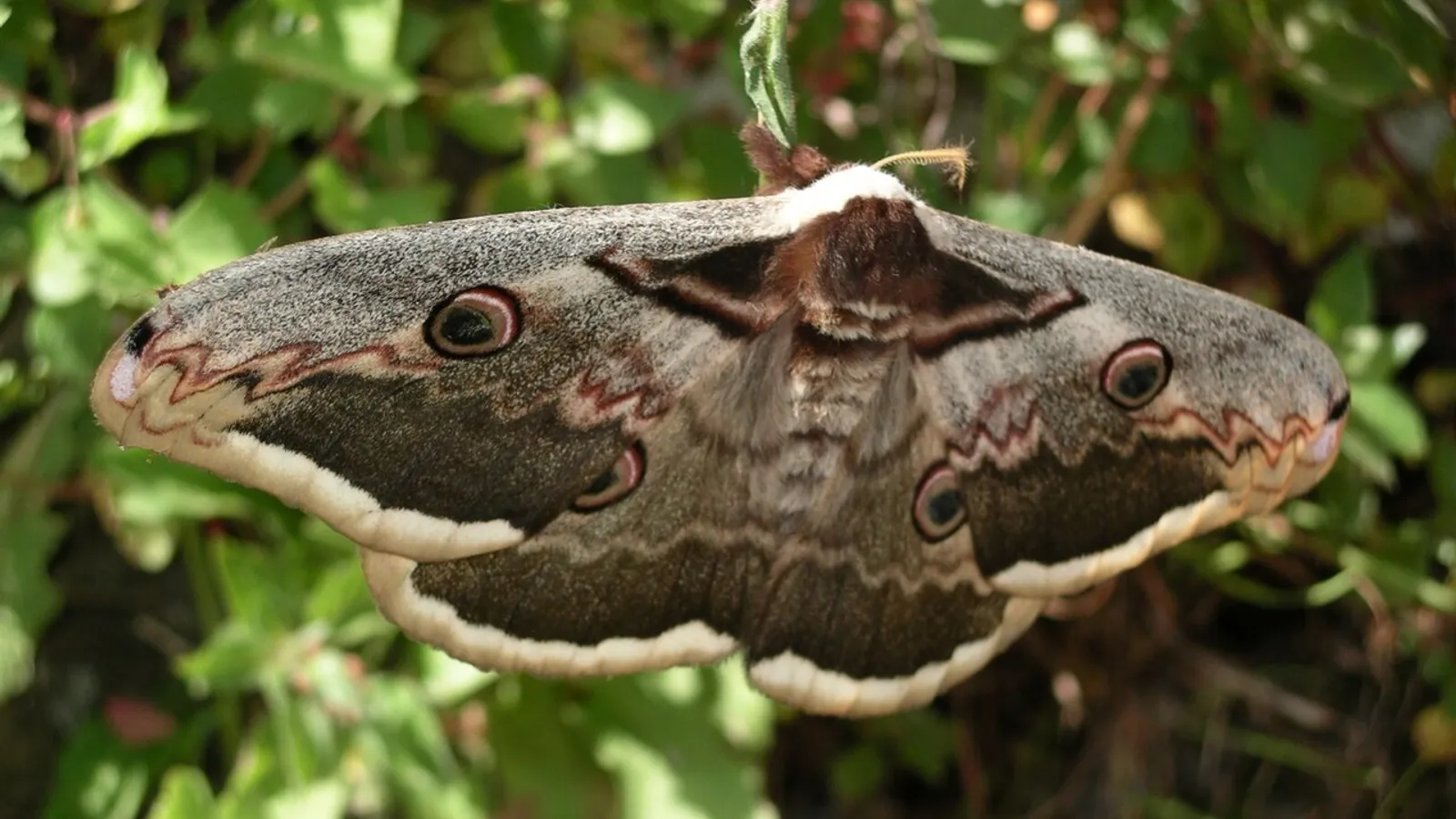
Saturnia comes from Saturn: the eyes on the wings, with their concentric rings of black, white and rust, reminded eighteenth-century naturalists of the ringed planet, and from that image the name of the whole family was born. Pyri is “of the pear tree”, the tree the caterpillar is most often found on. It is the largest moth in Europe, and its name holds together a planet and an orchard.
— Facts
- Group
- Insects · Insecta
- Order
- Butterflies and moths
- Habitat
- Orchards, tree lines, open broadleaf woodland
- Range
- Southern and central Europe, western Asia, North Africa
- Size
- 12–16 cm wingspan, the largest in Europe
- Diet
- Pear, apple and plum leaves as a caterpillar; nothing as an adult
- Lifespan
- 4–5 days as an adult
— Characteristics
- 01
The caterpillar, green with blue tubercles, reaches twelve centimetres.
- 02
The adult has no mouth: it lives four or five days and does not eat.
- 03
The male reaches a female from as far as eight kilometres away.
— What sets it apart
It was on this species that the sexual calling of insects was worked out. Jean-Henri Fabre, in his garden at Sérignan, shut a newly emerged female under a wire dome and in the night some forty males arrived in his house; he tried covering her, moving her, washing the table, and understood that it was neither sight nor sound but something the air carried. It would take another half-century to isolate the first molecule of that kind — a pheromone, from the Greek for “to carry” and “to excite” — and to give a name to what Fabre had demonstrated with a wire dome.
