
White-faced saki
Pithecia pithecia
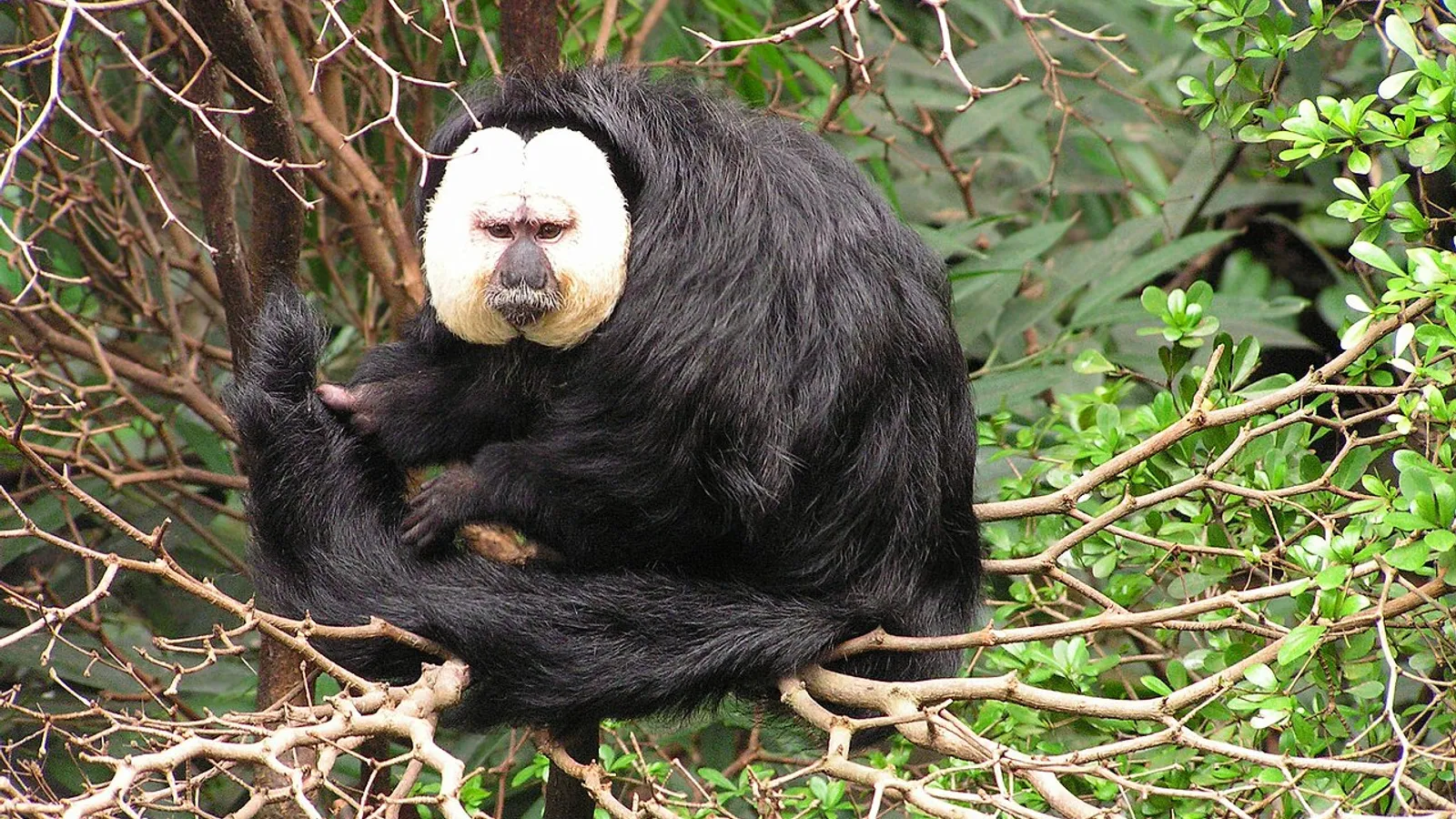
— Where the name comes from
Pithecia, doubled in the binomial, is simply the Greek píthēkos, “monkey”, latinised: whoever described it found nothing more specific to say. Saki comes from Tupi. In English it is also called the flying monkey, for leaps of ten metres from tree to tree, made with the body stretched and the arms along the flanks.
— Facts
- Group
- Mammals · Mammalia
- Order
- Primates
- Habitat
- Lowland rainforest, middle and lower levels of the vegetation
- Range
- The Guianas, southern Venezuela, northern Brazil
- Size
- 30–48 cm of body, 1.5–2.1 kg
- Diet
- Seed eater — the seeds of unripe fruit, plus fruit and insects
- Lifespan
- 14 years in the wild, over 36 in captivity
— Characteristics
- 01
Male and female look like two different species: he black with a white face, she mottled brown.
- 02
It opens woody shells that ordinary fruit eaters cannot dent.
- 03
It leaps between trees covering up to ten metres horizontally.
— What sets it apart
It eats the seeds instead of the pulp, and that puts it at war with the plants rather than in partnership. Almost all tropical fruit eaters are allies of the trees: they eat the fruit and disperse the seed intact. The saki does the opposite — it discards the pulp, opens the shell and destroys the embryo — and so is a seed predator, not a disperser. The plants answer with ever harder shells and with toxins, and it answers with jutting incisors and outsized jaws: it is an arms race between a monkey and some trees.
