
Lesser horseshoe bat
Rhinolophus hipposideros
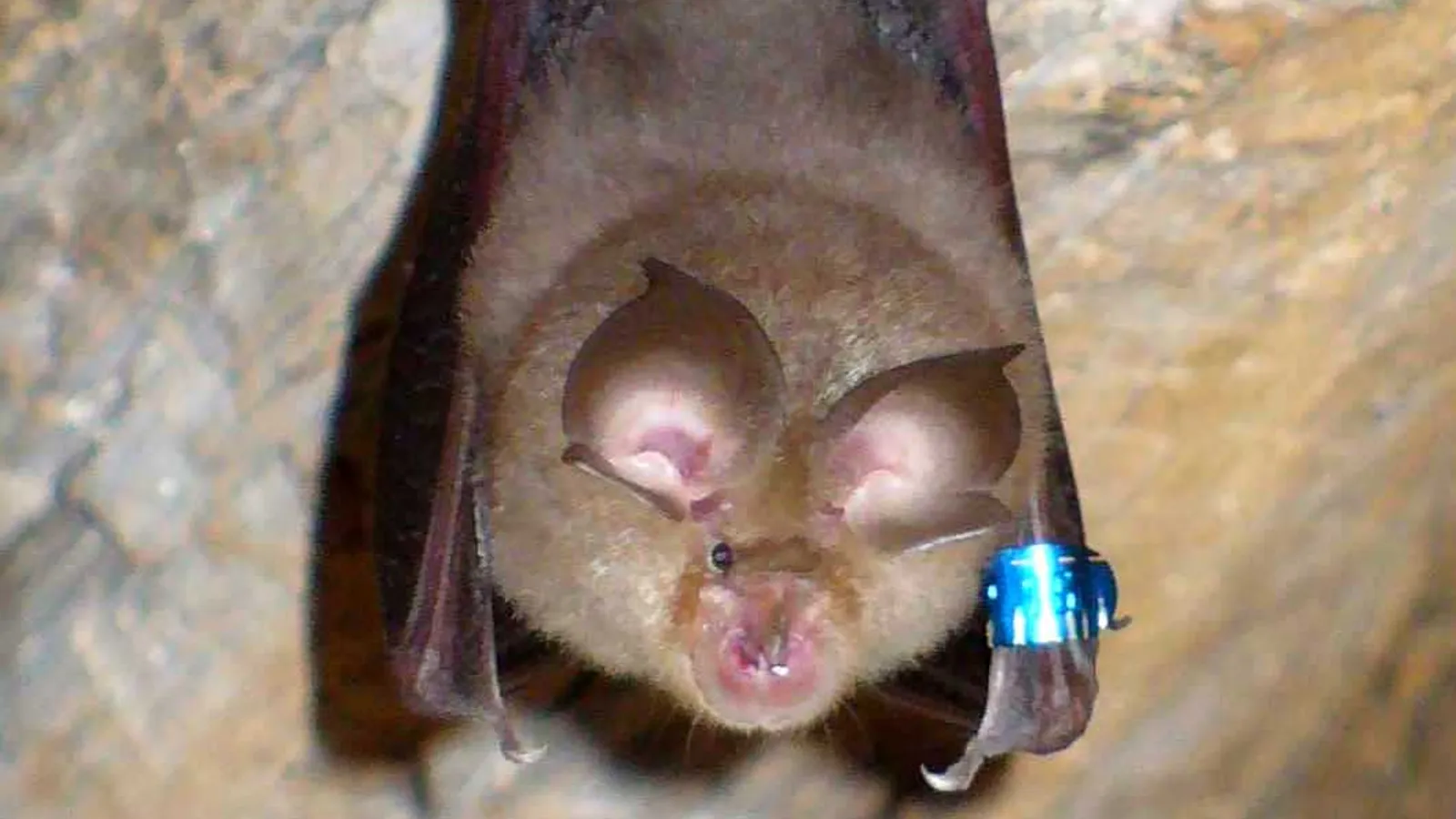
— Where the name comes from
Rhinolophus is “crested nose”, from the Greek rhís, rhinós, and lóphos, the plume of a helmet: the elaborate nose leaf these bats carry on the face. Hipposideros is “horseshoe”, from híppos and sídēros, and describes the lower part of that leaf, a semicircle surrounding the nostrils. The Italian rinolofo renders the Greek directly, and for once the translation has lost nothing.
— Facts
- Group
- Mammals · Mammalia
- Order
- Bats
- Habitat
- Caves, attics, warm ruins; hunting along hedgerows and woodland edges
- Range
- Europe, North Africa, western Asia as far as Kashmir
- Size
- 3.5–4.5 cm of body, 19–25 cm wingspan, 4–10 g
- Diet
- Insectivore — small flies, moths, spiders picked off foliage
- Lifespan
- 4 years on average, with a record of 21
— Characteristics
- 01
It is the smallest European horseshoe bat: it weighs as much as a two-euro coin.
- 02
At rest it wraps itself entirely in its wings, as in a closed cloak.
- 03
It emits ultrasound through the nostrils, not the mouth, and the nose leaf focuses it.
— What sets it apart
The nose leaf is an aerial. The folds of skin around the nostrils are nothing to do with smell: they shape the beam of ultrasound as the reflector of a dish would, narrowing it into a tight cone ahead of the animal. That is why horseshoe bats call through the nose instead of the mouth — the mouth stays free, and the sonar becomes directional. The exact shape of the leaf differs from species to species, and together with the frequency of the call it is what lets different horseshoe bats hunt the same wood without jamming one another.
