
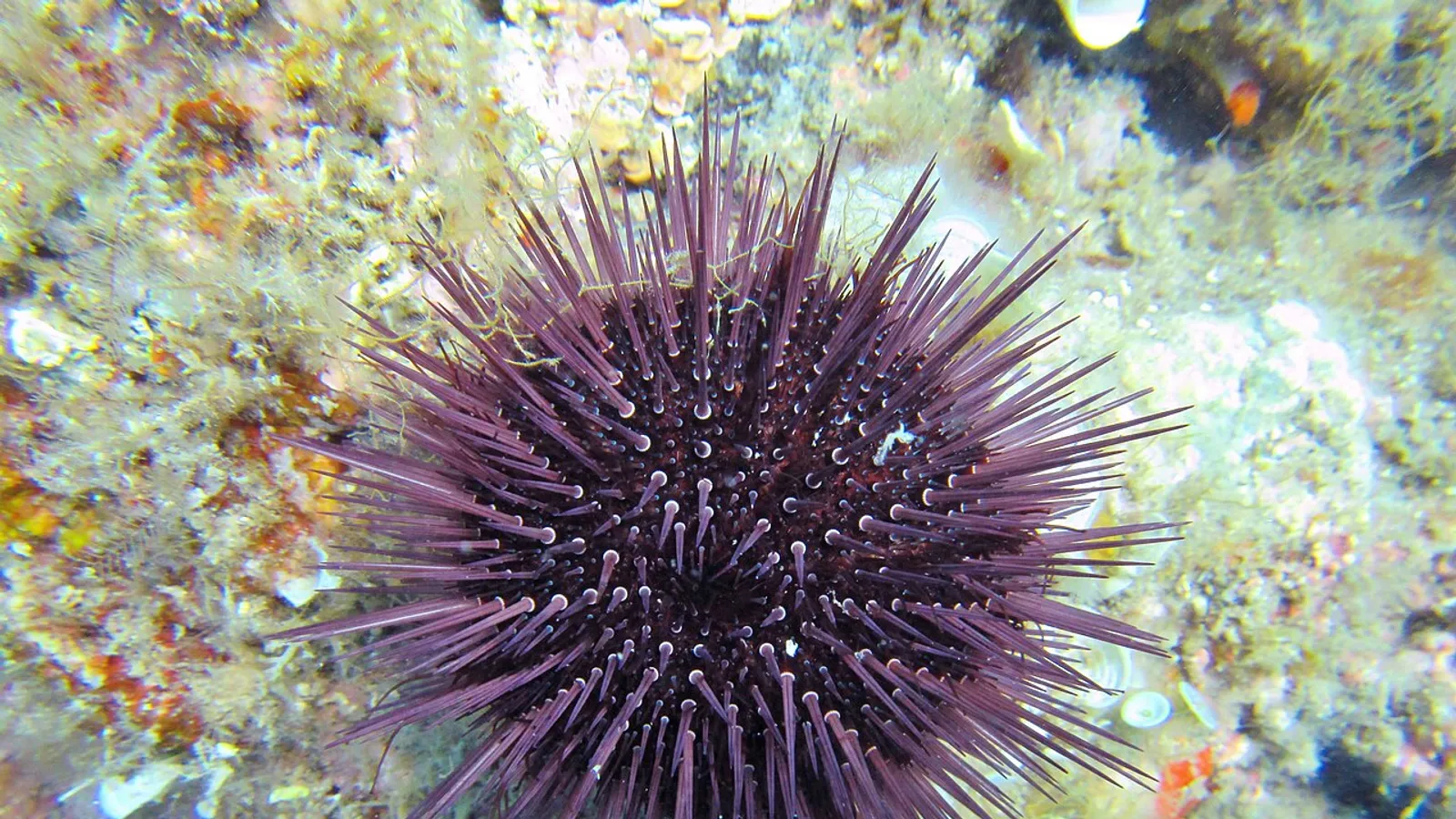
Purple sea urchin
Paracentrotus lividus
— Where the name comes from
Paracentrotus is built on kéntron, the sting, the point — the same word that gives “centre”, because the kéntron was originally the point of a compass. Lividus is the colour, a dark purple verging on black. The phylum name, Echinodermata, means “hedgehog skin”, from echînos: and in Greek echînos was both the land hedgehog and the sea urchin, exactly as in Italian.
— Facts
- Group
- Echinoderms · Echinodermata
- Order
- Sea urchins
- Habitat
- Rocky bottoms and posidonia meadows, down to 30 metres
- Range
- Mediterranean and eastern Atlantic
- Size
- 4–7 cm across
- Diet
- Algae rasped from the rock
- Lifespan
- 8–12 years
— Characteristics
- 01
It covers itself with fragments of algae and shell held by its tube feet.
- 02
It carves a niche in the rock with its teeth and wedges itself in.
- 03
The mouth has five teeth worked by an apparatus called Aristotle’s lantern.
— What sets it apart
The apparatus it chews with is called “Aristotle’s lantern” because of a misunderstanding that lasted centuries: in the History of Animals Aristotle compares the emptied shell of the urchin to a lantern, not the dental structure, but translators shifted the comparison and the name stayed attached to the wrong part. It is a machine of forty bony pieces and as many muscles driving five continuously growing teeth, capable of carving rock. Where urchins become too numerous — because their predators are missing — they shave off the algae and leave stretches of bare rock that biologists call “urchin barrens”.
