
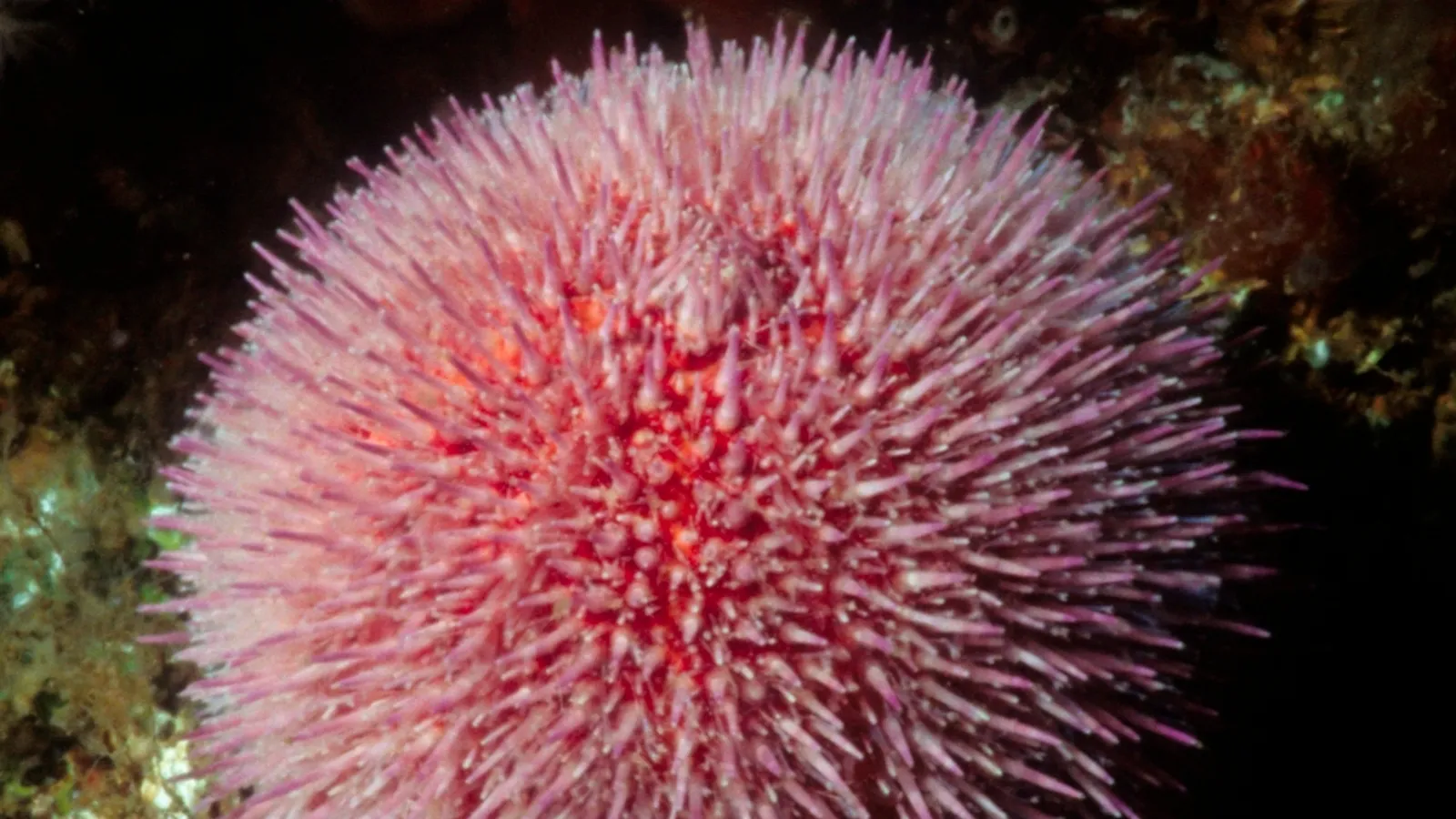
European edible sea urchin
Echinus esculentus
— Where the name comes from
Echinus is the Greek echînos, which meant the land hedgehog and from there passed to the sea urchin: the same word, in Italian, made the same journey. Esculentus means edible, the adjective naturalists added to tell readers what could be done with the thing. Many eighteenth-century scientific names contain, at bottom, a culinary note.
— Facts
- Group
- Echinoderms · Echinodermata
- Order
- Sea urchins
- Habitat
- Rocky bottoms between 0 and 1,200 metres
- Range
- North-eastern Atlantic, from Norway to Portugal
- Size
- Up to 17 cm across
- Diet
- Algae, bryozoans, barnacles and small fixed invertebrates
- Lifespan
- Up to 16 years
— Characteristics
- 01
It walks on hundreds of extensible hydraulic tube feet.
- 02
The test is made of fused plates and stays intact after death.
- 03
Among its spines it carries three-jawed pincers that constantly clean it.
— What sets it apart
It moves by hydraulic pressure. Beneath its spines are hundreds of extensible feet connected to an internal water circuit — the water vascular system, which no other phylum possesses: the animal extends them, sticks them down, pulls itself along, releases them, and so walks, anchors and prises shells open. It has no muscles to do this in the way we have them, but a network of canals and ampullae pushing water. Among its spines it also carries pedicellariae, minute three-valved pincers on stalks, which seize and remove larvae trying to settle: permanent maintenance carried out by hundreds of autonomous tweezers.
