
Rakali
Hydromys chrysogaster
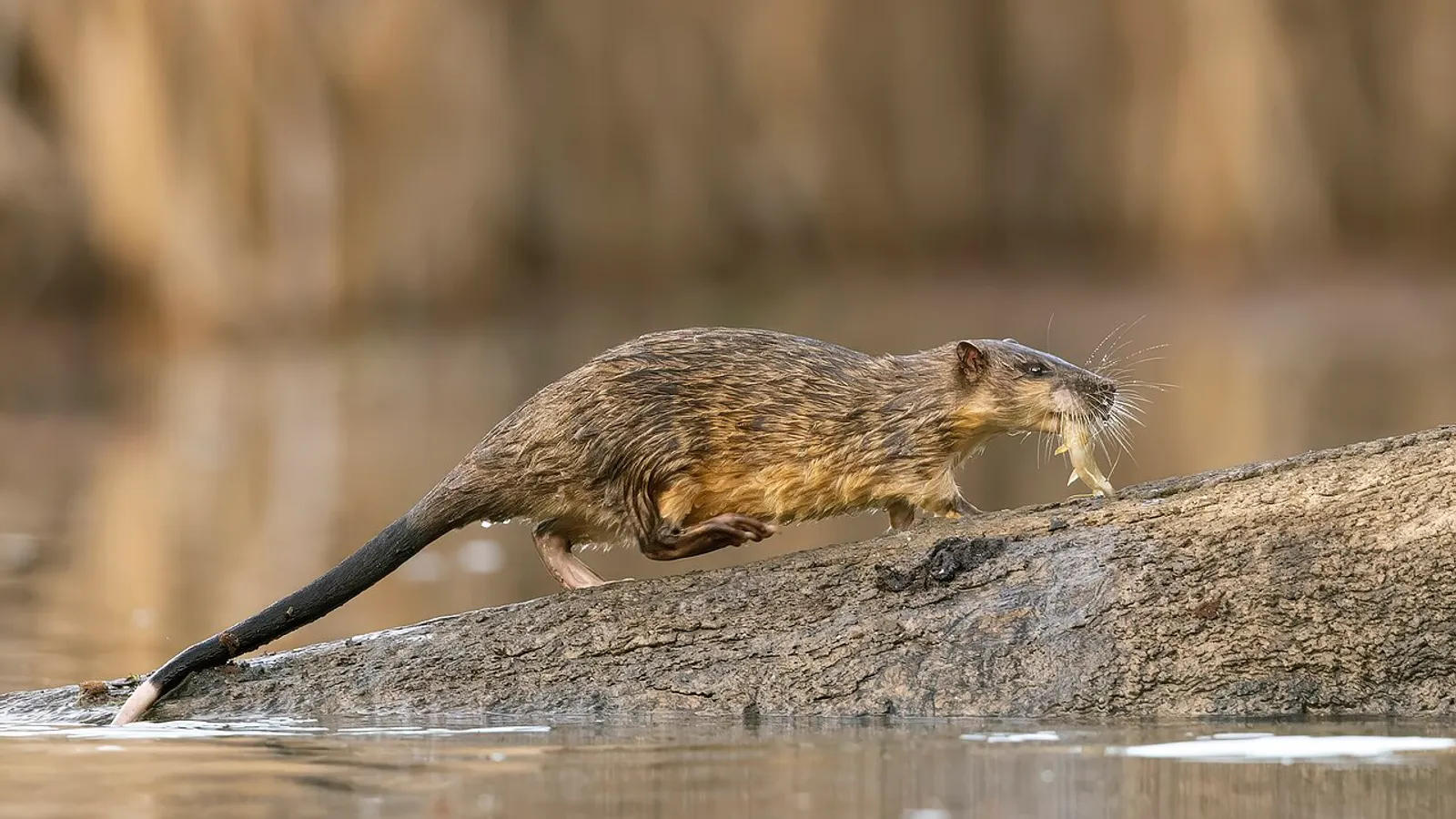
— Where the name comes from
Hydromys is “water mouse”, from hýdōr and mŷs; chrysogaster is “golden belly”, from chrysós and gastḗr, for the orange fur of the underside. The Ngarrindjeri people call it rakali, and that is the name Australia officially adopted in the 1990s in order to stop calling it a rat: a change of name decided deliberately to save an animal’s reputation.
— Facts
- Group
- Mammals · Mammalia
- Order
- Rodents
- Habitat
- Rivers, lakes, estuaries, coasts, urban canals
- Range
- Australia, Tasmania, New Guinea
- Size
- 23–39 cm of body, tail 23–33 cm, 340–1,300 g
- Diet
- Fish, crustaceans, molluscs, water insects, waterbirds
- Lifespan
- 3–4 years
— Characteristics
- 01
It has webbed hind feet and waterproof fur: a fully semi-aquatic rodent.
- 02
Its tail has a white tip, a recognition mark at a distance.
- 03
It carries its prey to a fixed stone or log, its “dining table”.
— What sets it apart
It has learnt within a few years to eat the cane toad without poisoning itself. The toad, introduced in 1935, has killed nearly every Australian predator that tried to eat it, because the venom glands sit on its shoulders. The rakali flips it onto its back, opens the chest and eats heart and liver, leaving the glands untouched: in areas where the toads have been present longest the technique is widespread and toads found gutted with surgical precision are counted by the dozen. It is behavioural adaptation observed live, in under a century.
