
Common Surinam toad
Pipa pipa
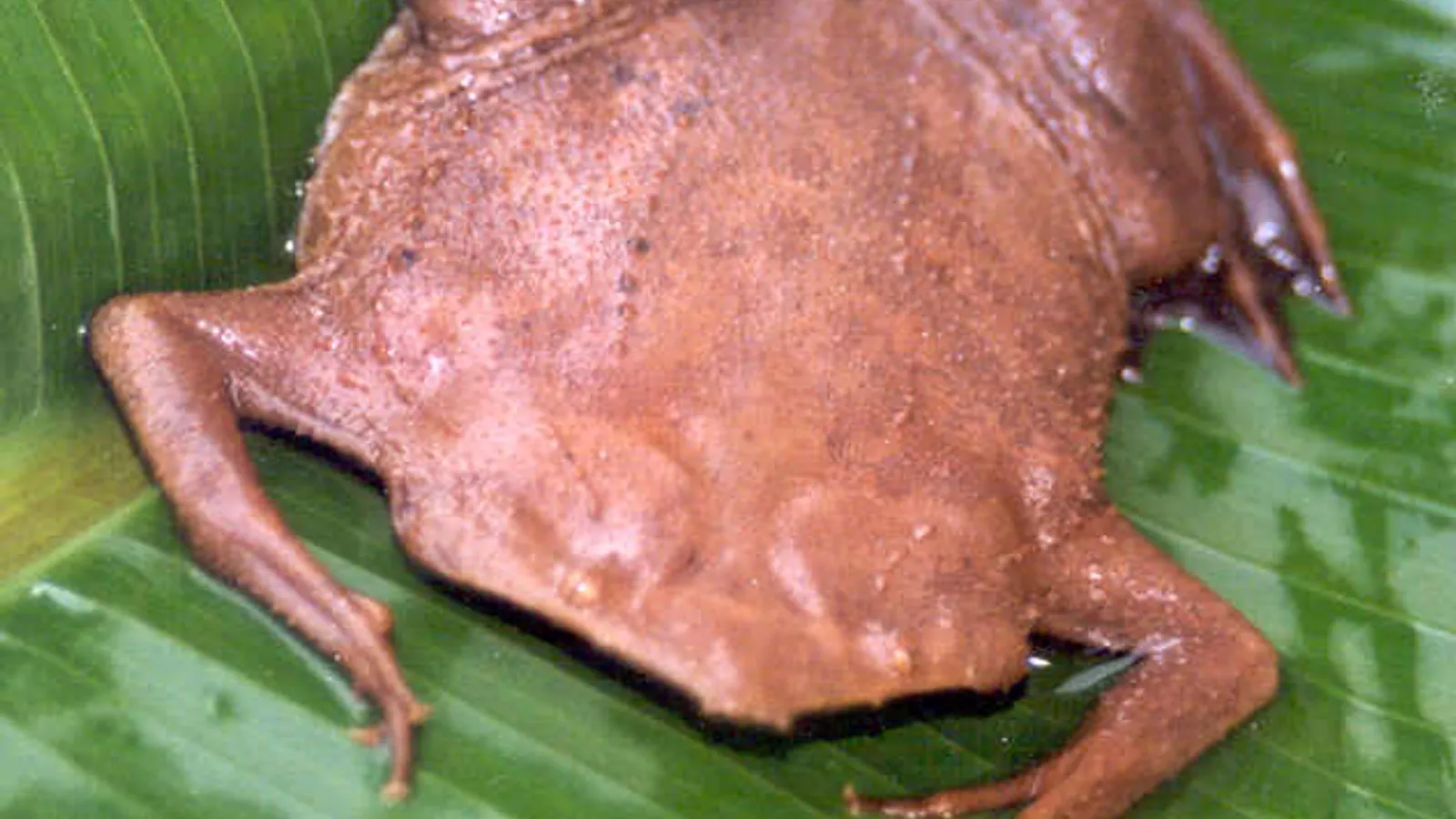
— Where the name comes from
Pipa is the animal’s name in one of the indigenous languages of Guiana, adopted untranslated and repeated twice in the binomial. It is one of the few amphibians whose scientific name contains not a single Greek or Latin word, and that is fitting: it is also one of the few that resembles no other animal at all.
— Facts
- Group
- Amphibians · Amphibia
- Order
- Frogs and toads
- Habitat
- Turbid still water, muddy bottoms, forest swamps
- Range
- The Amazon basin and the Guianas
- Size
- 10–17 cm, 100–170 g
- Diet
- Small fish, worms, invertebrates picked off the bottom
- Lifespan
- 8 years
— Characteristics
- 01
It is flat as a fallen leaf and has neither tongue nor teeth.
- 02
On its front fingers it carries star-shaped tips with which it feels the mud.
- 03
It has no vocal cords: the male makes clicks with a bone in the larynx.
— What sets it apart
It gives birth from its back. During mating the male presses the eggs onto the female’s back, and within hours her skin grows over each one, forming a closed cell: inside it the embryo completes its whole development, tadpole stage included, without ever seeing water. After three or four months the back opens in dozens of places and out come complete frogs a centimetre long. The mother then rubs against rocks and sheds that layer of skin, returning smooth.
