
Desert rain frog
Breviceps macrops
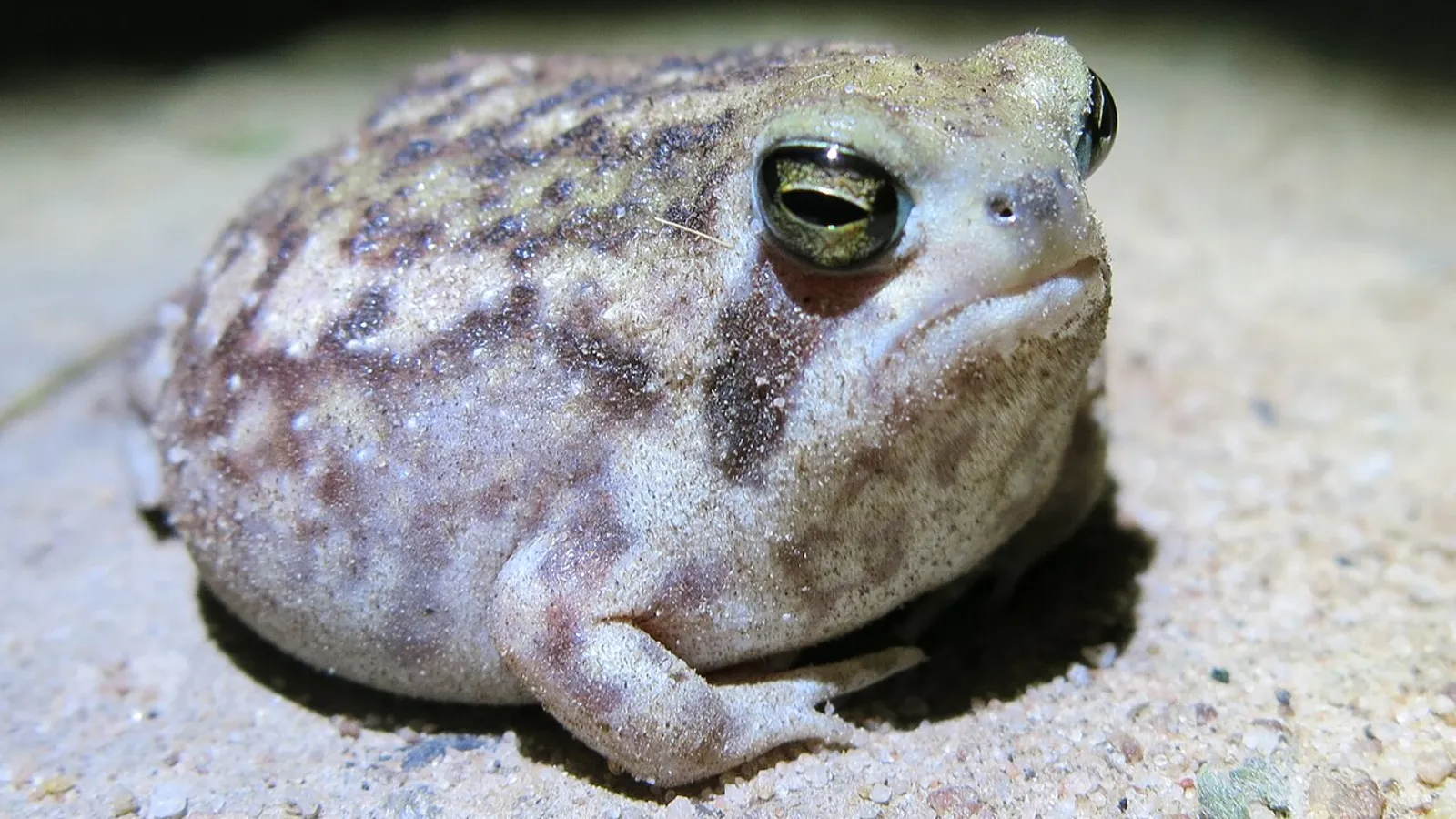
— Where the name comes from
Breviceps is “short head”, from brevis and caput: the snout is so flattened that the animal looks like a ball with eyes stuck on the front. Macrops means “large-eyed”, and that is an understatement: the eyes are enormous, protruding and take up much of the face. The common name, in every language, looks at when it comes out — after fog and rain.
— Facts
- Group
- Amphibians · Amphibia
- Order
- Frogs and toads
- Habitat
- Sand dunes of the fog belt along the Namib coast
- Range
- The coast between Namibia and South Africa, in a strip a few kilometres wide
- Size
- 4–6 cm, 10–20 g
- Diet
- Beetles, larvae, termites, moths
- Lifespan
- unknown
— Characteristics
- 01
It neither hops nor swims: it walks over the sand in short steps.
- 02
It has spade-shaped feet and burrows backwards to twenty centimetres.
- 03
It has no tadpole stage: a complete little frog hatches from the egg.
— What sets it apart
Disturbed, it inflates, stands up on its legs and shrieks — a high, indignant squeak that in 2013 went round the world in a video with tens of millions of views. It is probably the most famous amphibian on the planet among people with no interest in amphibians. Meanwhile it lives only along a coastal strip a few hundred kilometres long where the only water is fog off the ocean, and that same strip is being dug over for diamonds.
