
Common pill woodlouse
Armadillidium vulgare
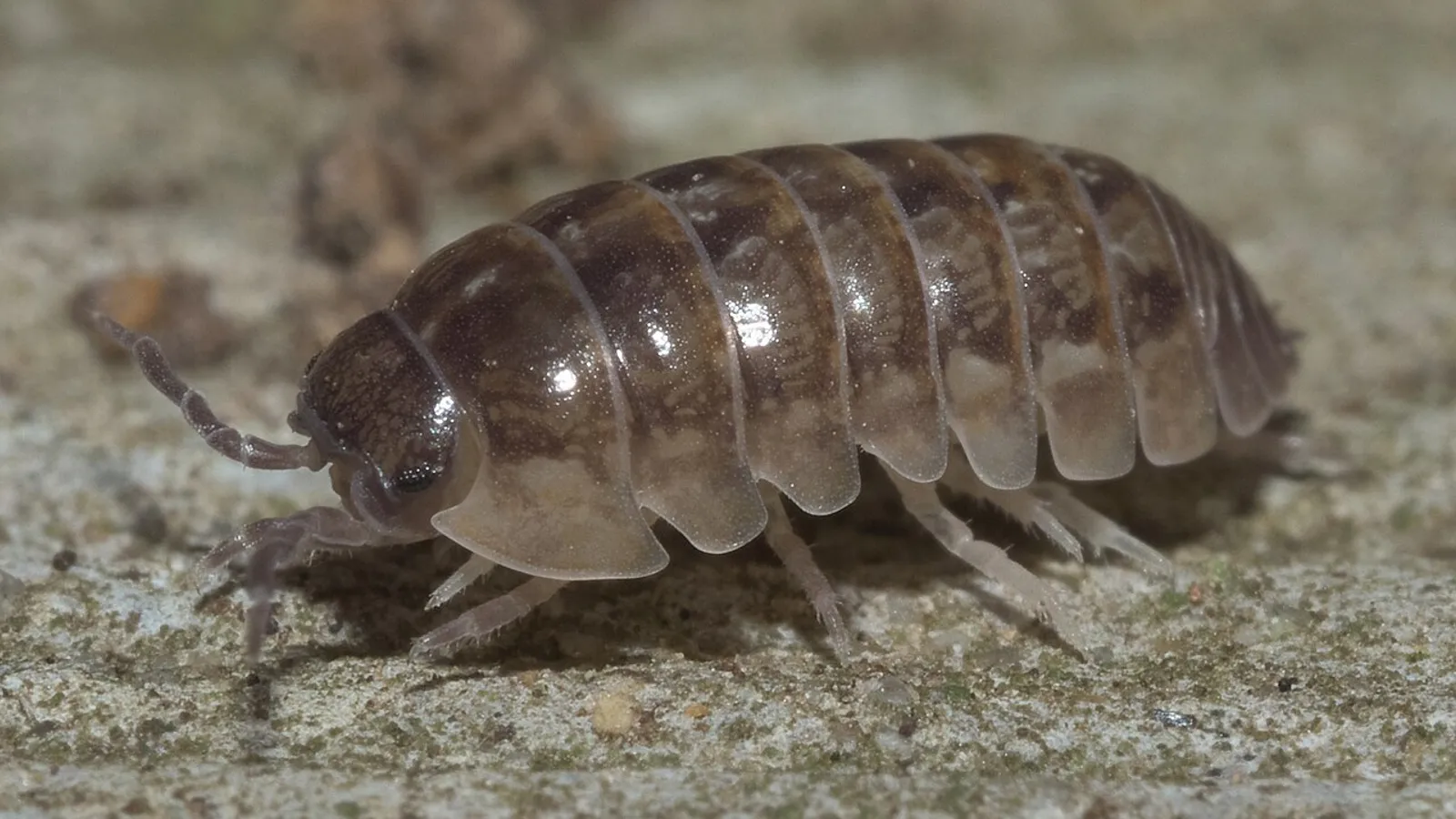
— Where the name comes from
Armadillidium is the diminutive of armadillo, Spanish for “little armed one” — the name the conquistadores gave the armoured mammal of South America. A European crustacean therefore bears, by way of Spain, the name of an American animal it resembles only in the act of rolling up. The Italian name looks elsewhere again, and across half of Europe it is called with words from pigs: porcellino, cochinilla, Kellerassel.
— Facts
- Group
- Crustaceans · Malacostraca · Maxillopoda
- Order
- Isopods
- Habitat
- Under stones, bark and pots; anywhere damp and dark
- Range
- Mediterranean in origin; today throughout the temperate world
- Size
- 8–18 mm
- Diet
- Dead leaves, decaying wood, droppings
- Lifespan
- 2–3 years
— Characteristics
- 01
It is a land crustacean: it breathes through pseudotracheae, not lungs.
- 02
It rolls into a perfect sphere when disturbed.
- 03
The female carries her eggs in a ventral pouch full of fluid.
— What sets it apart
It is a sea animal that never went back. It still breathes through structures derived from gills, which must stay moist — hence life under stones, and death in the dry — and the female carries her eggs in a ventral pouch filled with fluid, a portable pool in which the young develop as though still in water. It also drinks through its anus, drawing up moisture from the ground. And it often harbours a bacterium, Wolbachia, that turns males into functioning females in order to spread better: in some populations genetic males have nearly vanished.
