
Common buzzard
Buteo buteo
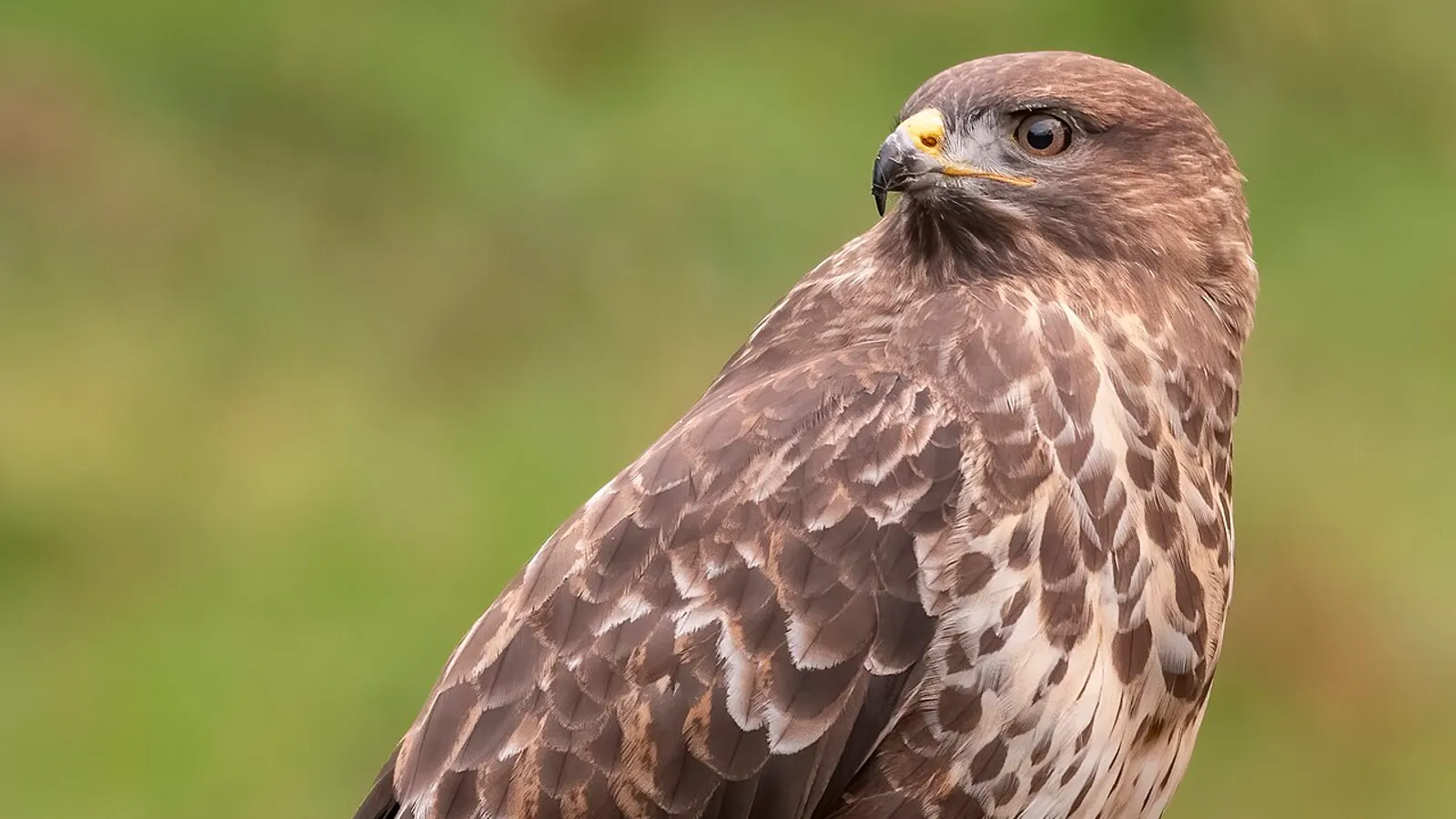
— Where the name comes from
Buteo was already the Latin name of a bird of prey, perhaps imitating its plaintive, mewing call; Linnaeus took it over unchanged, doubling it in the binomial Buteo buteo. The Italian poiana instead goes back to a vulgar Latin pulliana, from pullus, “chick”: the bird that preys on the young of the farmyard. Two names, then, one built on the voice and the other on a reputation for raiding.
— Facts
- Group
- Birds · Aves
- Order
- Diurnal birds of prey
- Habitat
- A mosaic of woodland and open fields, with perching trees.
- Range
- Europe and western Asia, with migratory populations wintering in Africa.
- Size
- 40–58 cm, wingspan 110–140 cm; 550–1,300 g
- Diet
- Carnivore — small mammals, birds, reptiles and earthworms
- Lifespan
- Up to over 25 years in the wild
— Characteristics
- 01
The plumage is extremely variable, from dark brown to almost white forms.
- 02
It is the most widespread and common raptor across much of Europe.
- 03
The call, a drawn-out mew, is often heard as it circles on broad wings.
— What sets it apart
For all its size as a raptor, the buzzard spends much of its time on the ground or on a post, waiting patiently, and does not disdain earthworms at all, gathering them as it walks the fields after rain. That modest, opportunistic diet is one reason for its success: where more specialised hunters struggle, it adapts to whatever the land offers. Its stocky silhouette wheeling in circles, wings raised in a shallow V, is perhaps the most familiar raptor in European skies.
