
Spotted-winged fruit bat
Balionycteris maculata
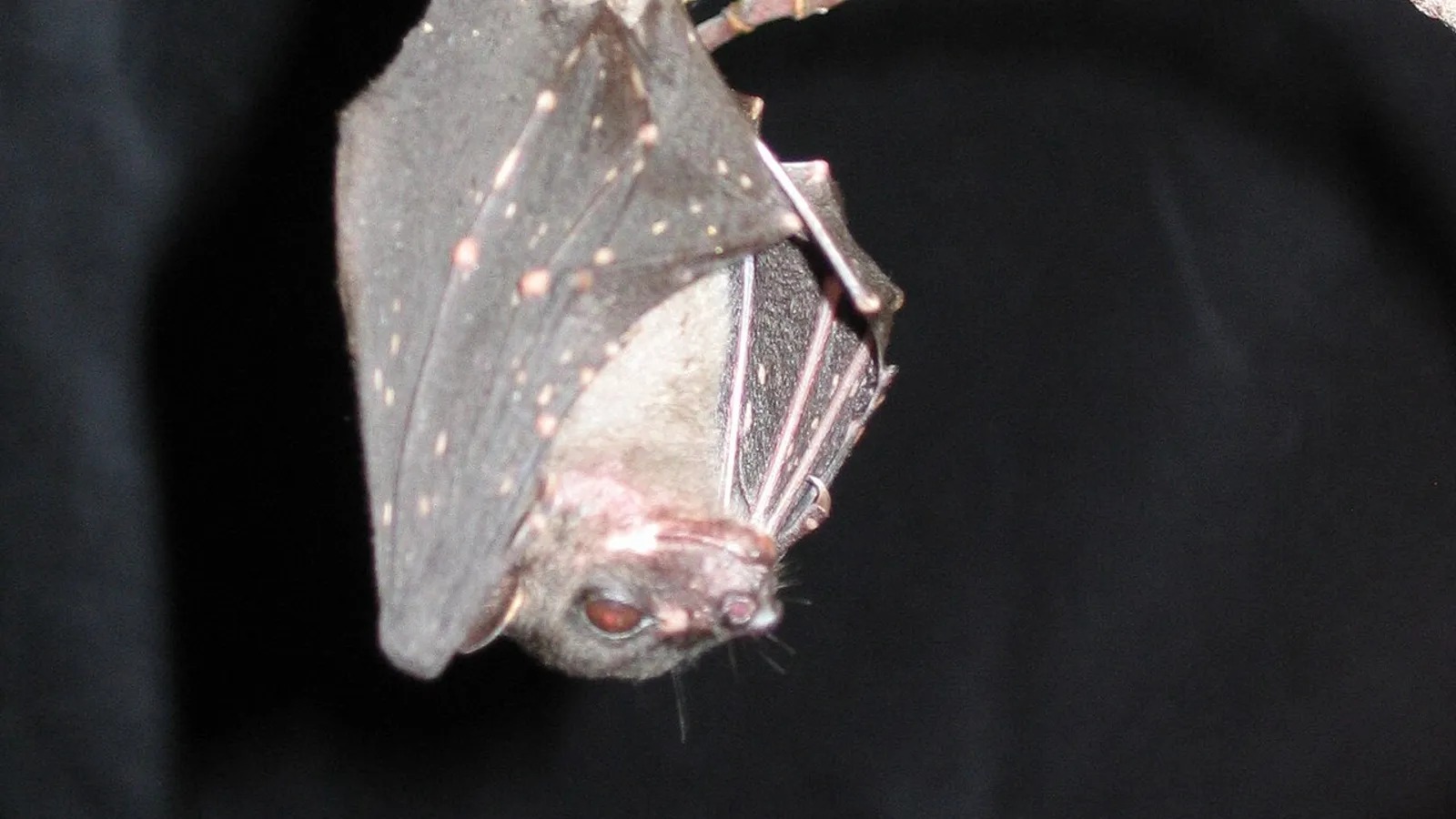
— Where the name comes from
Balionycteris is “dappled bat”, from the Greek baliós, “spotted, piebald” — the adjective Homer uses of horses — and nykterís. Maculata repeats the idea in Latin. The redundancy is deliberate: the wing membranes and the fingers are scattered with pale spots on a dark ground, and it is the only feature visible at a distance in an animal the size of a mouse.
— Facts
- Group
- Mammals · Mammalia
- Order
- Bats
- Habitat
- Lowland rainforest, forested peat swamp, secondary forest
- Range
- The Malay peninsula, Borneo, Sumatra and nearby islands
- Size
- 5.5–7 cm of body, 25 cm wingspan, 10–15 g
- Diet
- Frugivore — small figs and epiphytes
- Lifespan
- Little known
— Characteristics
- 01
It is among the smallest fruit bats in the world: a dozen grams.
- 02
It shelters inside the nests of epiphytic ants and in bird’s-nest ferns.
- 03
It lives in small family parties of a few individuals, not in colonies.
— What sets it apart
It sleeps inside ant nests. It picks the masses of earth and root that ants of the genus Crematogaster build on tree branches, hollows out a cavity and lives there in groups of a few individuals — with the ants still inside. Why it is not attacked is unknown: the current idea is that the ants gain enough nutritional benefit from its droppings to tolerate it, and that it gains a fortress no predator wants to open. Of all the places a mammal might choose to sleep, this is among the least likely.
