
Hammer-headed bat
Hypsignathus monstrosus
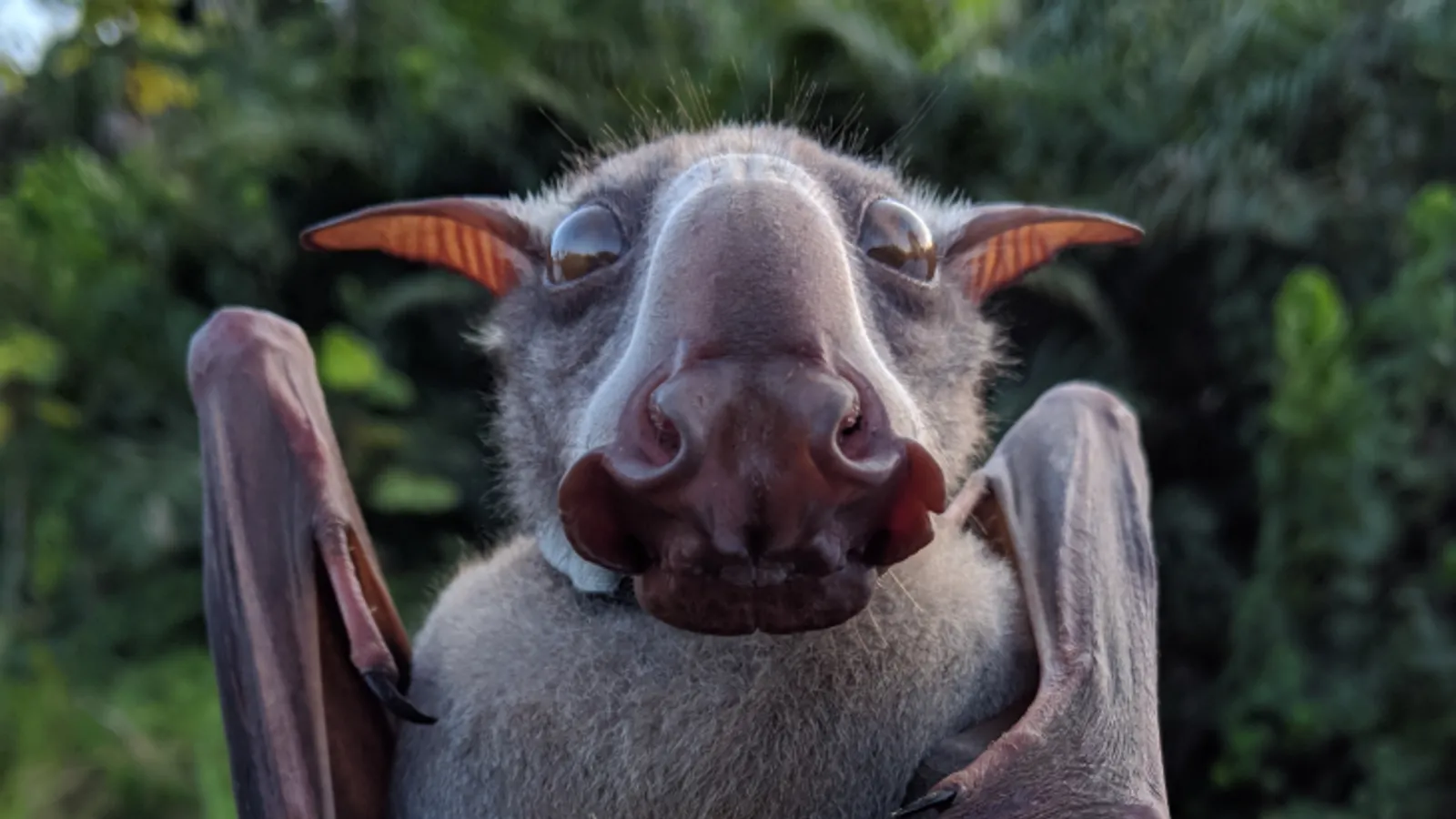
— Where the name comes from
Hypsignathus is “high-jawed”, from the Greek hypsi- and gnáthos; monstrosus is the Latin “monstrous”, and for once the adjective is less a judgement than something close to surrender. The adult male’s muzzle is a squared block with jutting nostrils and hanging lips, so unlike the female’s that the first specimens collected were described as two distinct species.
— Facts
- Group
- Mammals · Mammalia
- Order
- Bats
- Habitat
- Lowland rainforest, swamp forest, gallery forest
- Range
- Central and West Africa, from Guinea to Uganda
- Size
- 19–30 cm of body, up to 97 cm wingspan, 220–450 g
- Diet
- Frugivore — figs, mango, bananas, guava
- Lifespan
- 30 years in captivity
— Characteristics
- 01
It is the largest bat of mainland Africa.
- 02
The male’s larynx takes up about half the chest cavity.
- 03
Male and female are so unalike as to look like two species.
— What sets it apart
The male’s head is, in its entirety, a musical instrument. The larynx fills half his chest and pushes heart and lungs back, the throat sacs act as resonators, the squared muzzle as a horn: it all serves to produce a repeated, deafening honk. It is one of the very few mammals that lek — dozens of males line up along a river and blare for hours while the females fly past appraising them. About six per cent of them get nearly all the matings: the others have built that absurd body for nothing.
