
Wrinkle-faced bat
Centurio senex
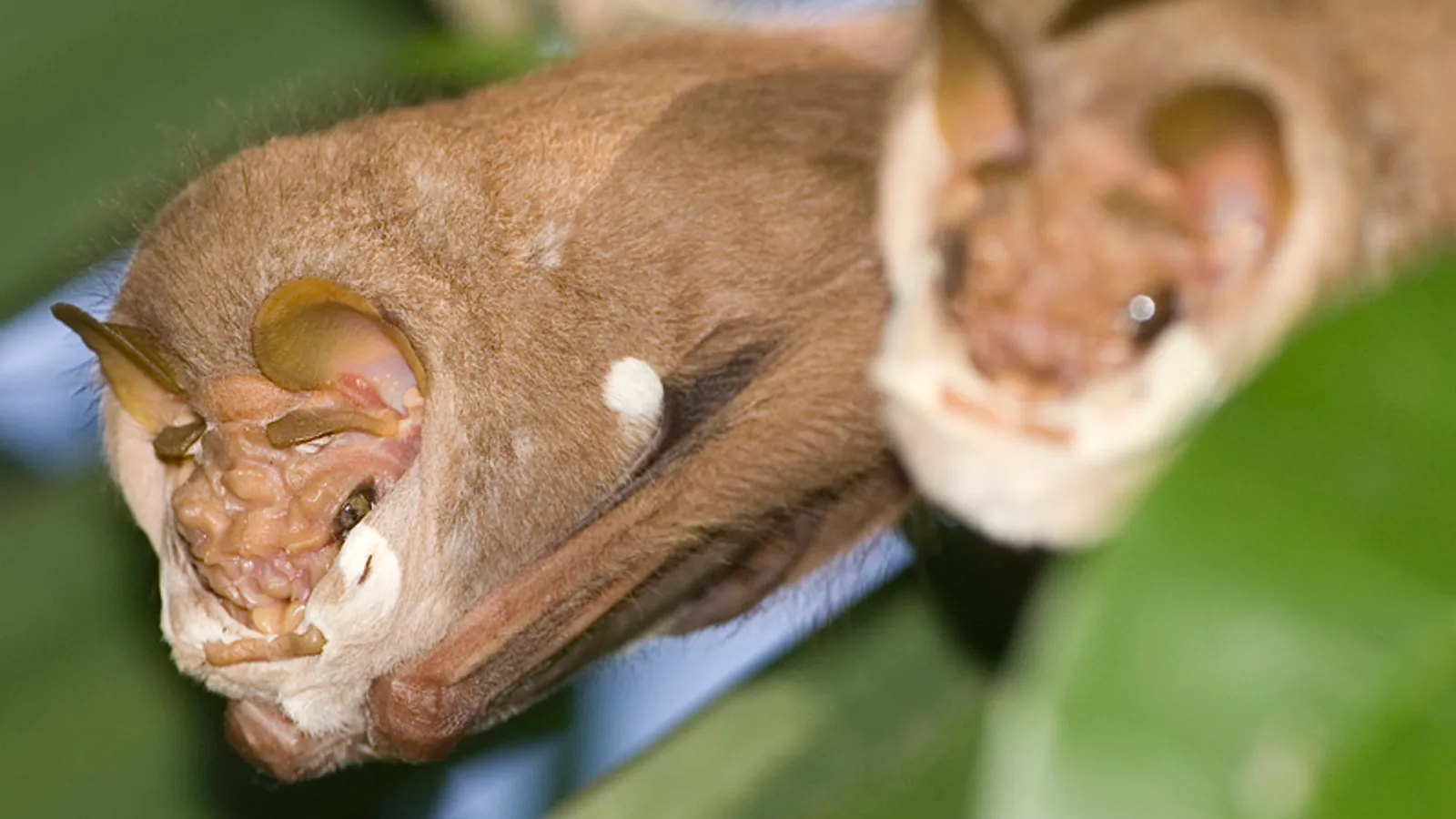
— Where the name comes from
Centurio is the Roman centurion and senex is the old man: “the old centurion”. The 19th-century describer found himself facing a face with no nose leaf, reduced to a mass of fleshy folds, lumps and ridges, and read it as the lined face of a legionary in retirement. It is one of the most literary scientific names there is, and one of the few that describes an expression rather than an anatomical feature.
— Facts
- Group
- Mammals · Mammalia
- Order
- Bats
- Habitat
- Rainforest and deciduous forest, plantations, gardens
- Range
- From northern Mexico to Venezuela and Trinidad
- Size
- 5.3–7 cm of body, 30 cm wingspan, 17–28 g
- Diet
- Frugivore — hard ripe fruit, squeezed rather than chewed
- Lifespan
- Little known
— Characteristics
- 01
It has no nose leaf: the face is a relief of fleshy folds and ridges.
- 02
The male has a flap of skin under the chin which he raises to cover his own eyes.
- 03
It opens its mouth wider than almost any other bat, to bite into hard fruit.
— What sets it apart
The male sleeps behind a mask. Beneath his chin he has a flap of skin which by day he pulls up over the whole face, eyes included, hooking it behind the ears: through two translucent windows he goes on seeing. When he calls to attract females, the mask stays raised and vibrates with the call. It is a structure without parallel among mammals, and for nearly two centuries it was argued whether it served for camouflage, for protection or for display — recent observations at leks say it is above all an ornament.
