Common tube-nosed fruit bat
Nyctimene albiventer
— Where the name comes from
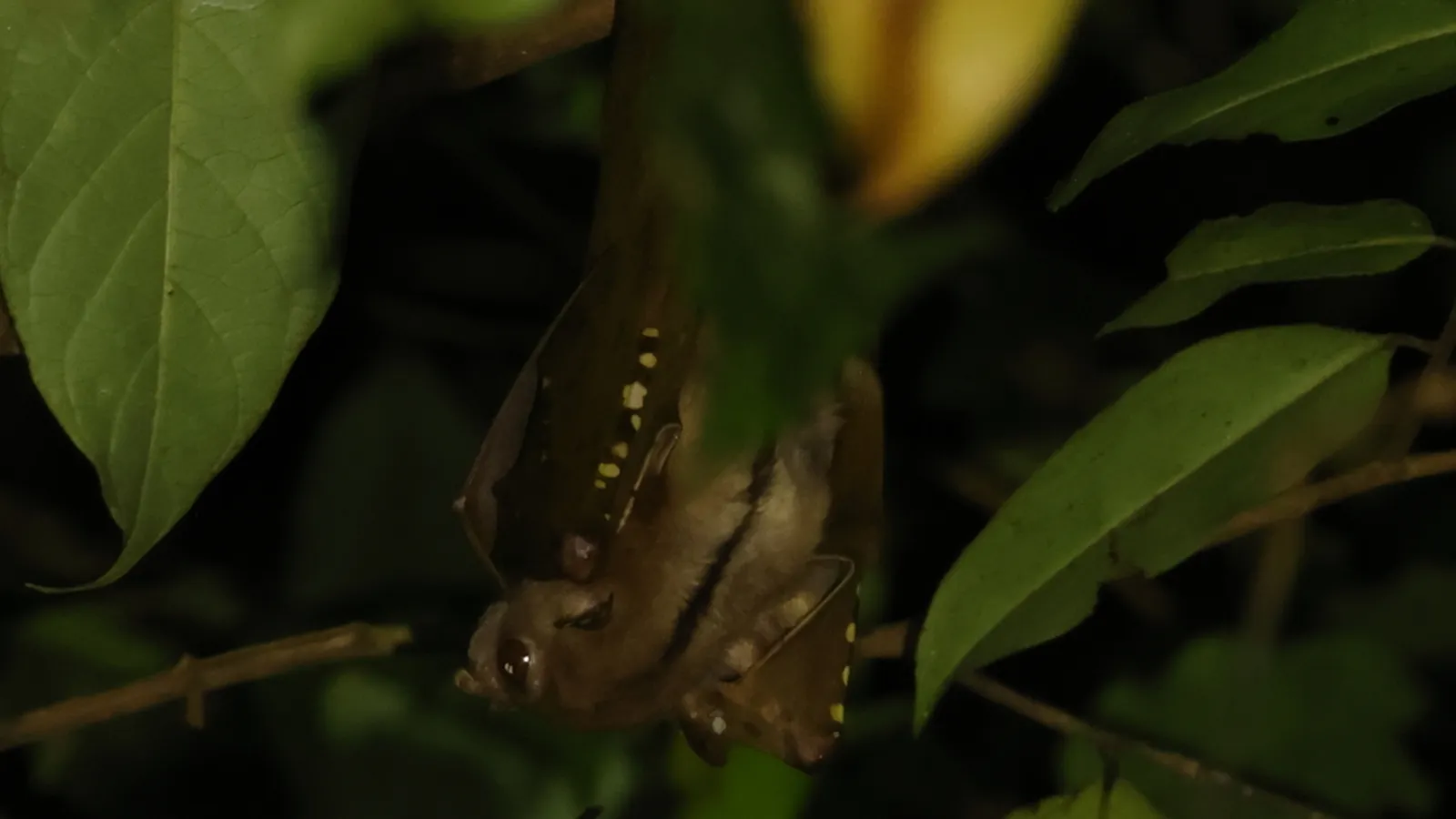
Nyctimene is a name from Greek myth: the daughter of Epopeus who, out of shame, was turned into an owl and has flown only at night ever since. Albiventer is the Latin “white-bellied”. The common name looks instead at the one thing nobody can ignore: two nostrils mounted on the ends of fleshy tubes that jut sideways from the muzzle, like small periscopes.
— Facts
- Group
- Mammals · Mammalia
- Order
- Bats
- Habitat
- Primary and secondary rainforest, village gardens
- Range
- New Guinea, the Moluccas, the Bismarck Archipelago
- Size
- 7–10 cm of body, 40 cm wingspan, 25–40 g
- Diet
- Frugivore — figs above all
- Lifespan
- Little known
— Characteristics
- 01
The nostrils are mounted on two splayed fleshy tubes, unique among mammals.
- 02
The wings are dusted with yellow-green spots that mimic blotched leaves.
- 03
It roosts alone among the foliage, not in colonies.
— What sets it apart
What those tubes are for is still unclear after two centuries, and it is one of the oldest open questions in bat biology. Three hypotheses are in play: that they let the animal breathe while its face is sunk into a fruit, that they give a stereo perception of smell — two widely spaced nostrils sample a gradient, as two ears do with sound — or that they serve for recognition between individuals. None is proven, and there exists no other mammal with anything similar to use as a comparison.