
Greater spear-nosed bat
Phyllostomus hastatus
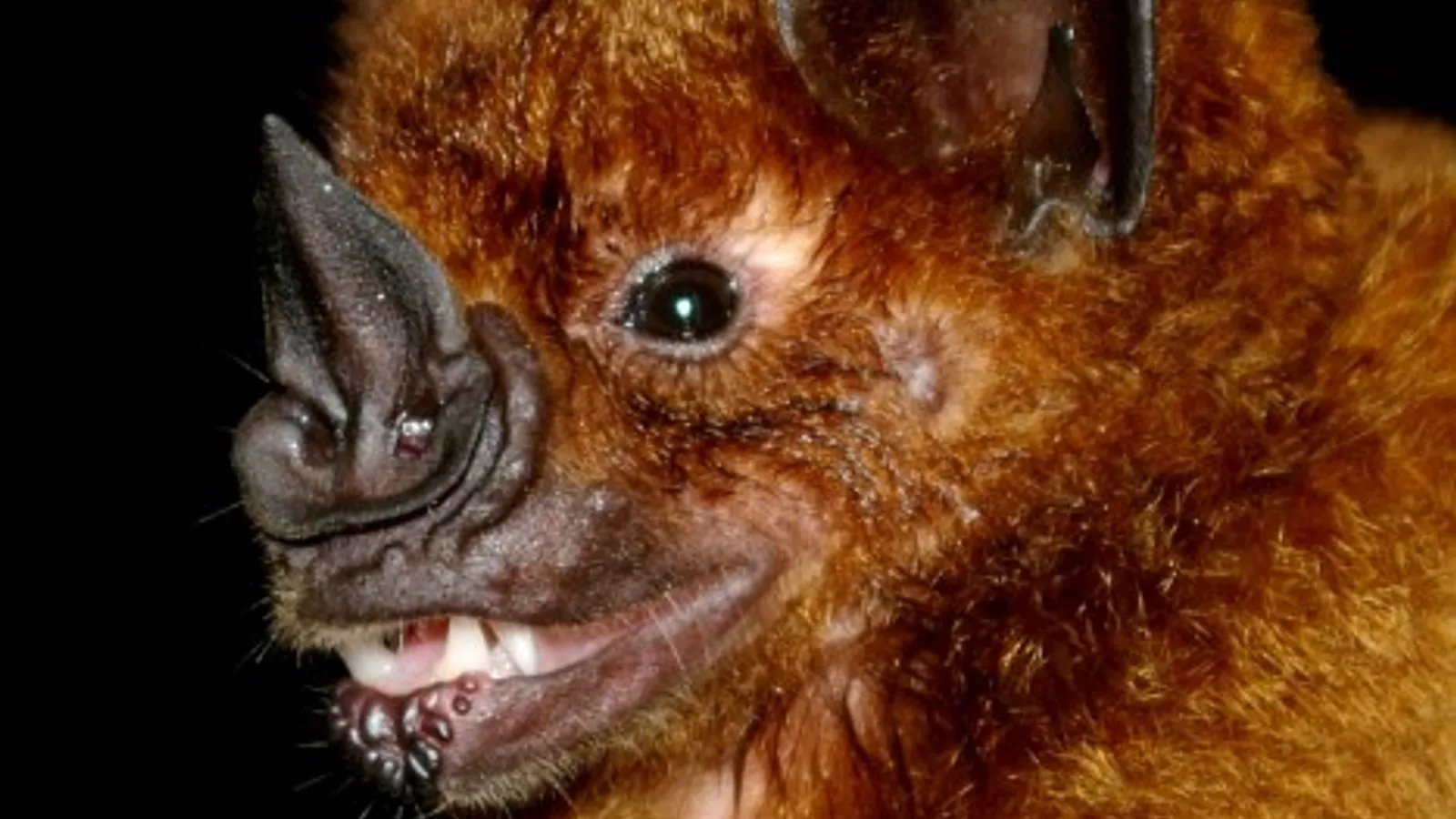
— Where the name comes from
Phyllostomus is “leaf mouth”, from the Greek phýllon and stóma, and gives its name to the whole family of the phyllostomids: the nose leaf standing above the nostrils, which in this group takes dozens of different shapes. Hastatus is the Latin “armed with a spear”, from hasta, and describes that leaf in this species — a pointed triangle like a spearhead.
— Facts
- Group
- Mammals · Mammalia
- Order
- Bats
- Habitat
- Hollows of palms and trees, caves; hunting above forest and cropland
- Range
- From Guatemala to Brazil and Bolivia, and Trinidad
- Size
- 10–13 cm of body, 45 cm wingspan, 80–100 g
- Diet
- Omnivore — large insects, fruit, nectar, small vertebrates
- Lifespan
- Up to 12 years
— Characteristics
- 01
The females form stable groups that last for years inside the same cavity.
- 02
Each group has a contact call different from those of neighbouring groups.
- 03
It goes out to hunt as a group and returns as a group, unusual among bats.
— What sets it apart
Every group of females has its own accent. Roost-mates share a contact call that distinguishes them from groups sleeping a few metres away, and a female moved into another group gradually alters her own call until it resembles the new one. It is a learnt vocal dialect, not an inherited one, and among mammals it is one of the few documented outside cetaceans, pinnipeds and elephants — and it serves for recognising one another in the dark, among hundreds of animals.
