
Honduran white bat
Ectophylla alba
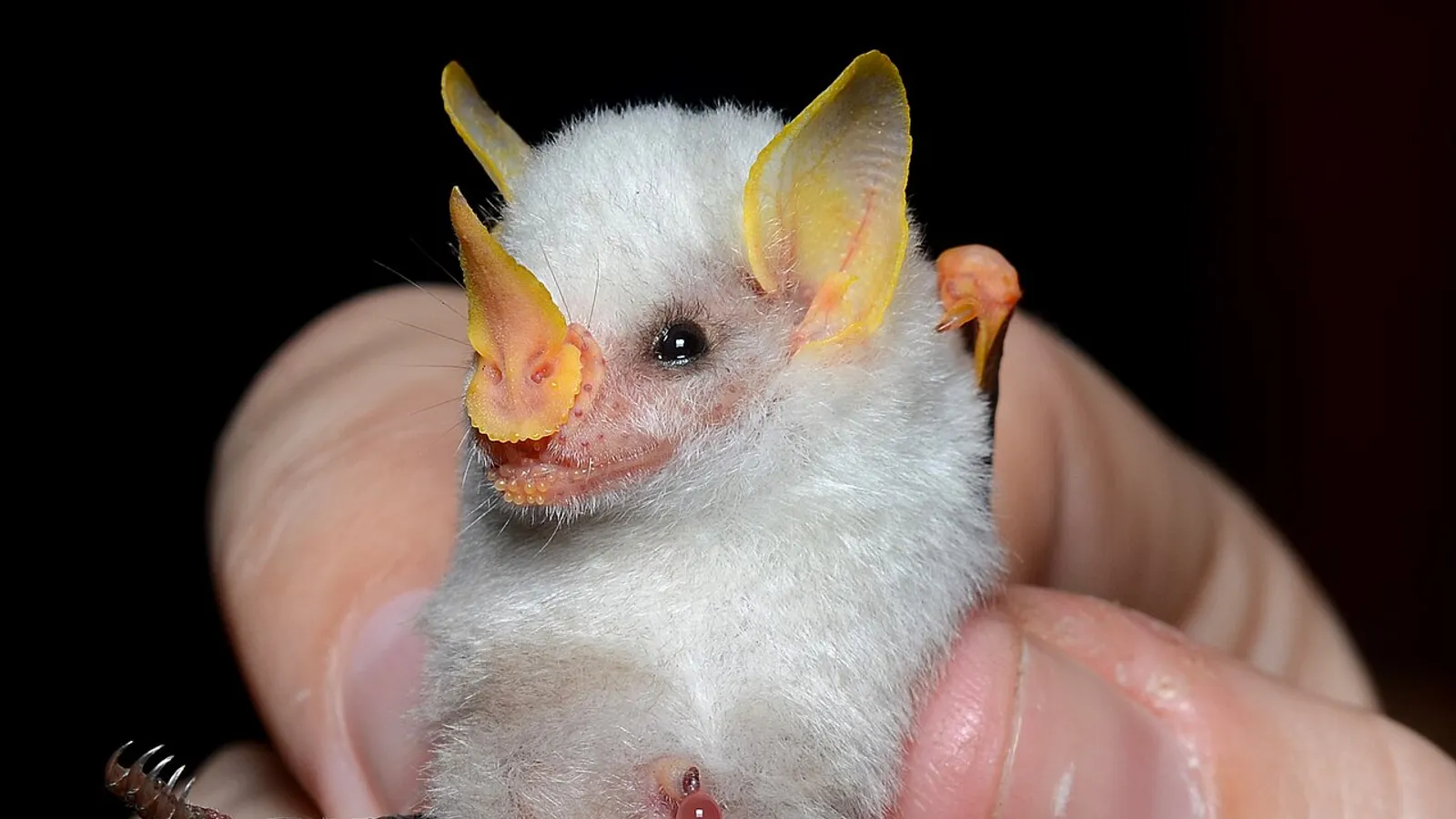
— Where the name comes from
Ectophylla is “outer leaf”, from the Greek ektós and phýllon, for the protruding nose leaf; alba is the Latin “white”. The name says everything and nothing: the white is the first thing one sees, but the remarkable thing is that this white, under a green leaf, turns green — and on that rests the animal’s survival.
— Facts
- Group
- Mammals · Mammalia
- Order
- Bats
- Habitat
- Rainforest understorey, beneath Heliconia leaves
- Range
- Honduras, Nicaragua, Costa Rica, western Panama
- Size
- 3.7–4.7 cm of body, 10 cm wingspan, 5–6 g
- Diet
- Frugivore — almost only the figs of a single species
- Lifespan
- Little known
— Characteristics
- 01
It weighs five grams and fits in a spoon: one of the smallest phyllostomids.
- 02
It builds tents by cutting the veins of Heliconia leaves.
- 03
Nose and ears are yellow from accumulated carotenoids.
— What sets it apart
Its skin holds the highest concentration of carotenoids ever measured in a mammal: nose and ears are yellow because the animal extracts lutein from figs and lays it down in the tissue, something thought to be reserved to birds and fish. And the white of the fur is not camouflage by accident: under a Heliconia leaf the light filtering through is green, and a little group of white bats hanging from the tent’s ceiling becomes a green patch indistinguishable from the leaf itself.
