
Parnell's mustached bat
Pteronotus parnellii
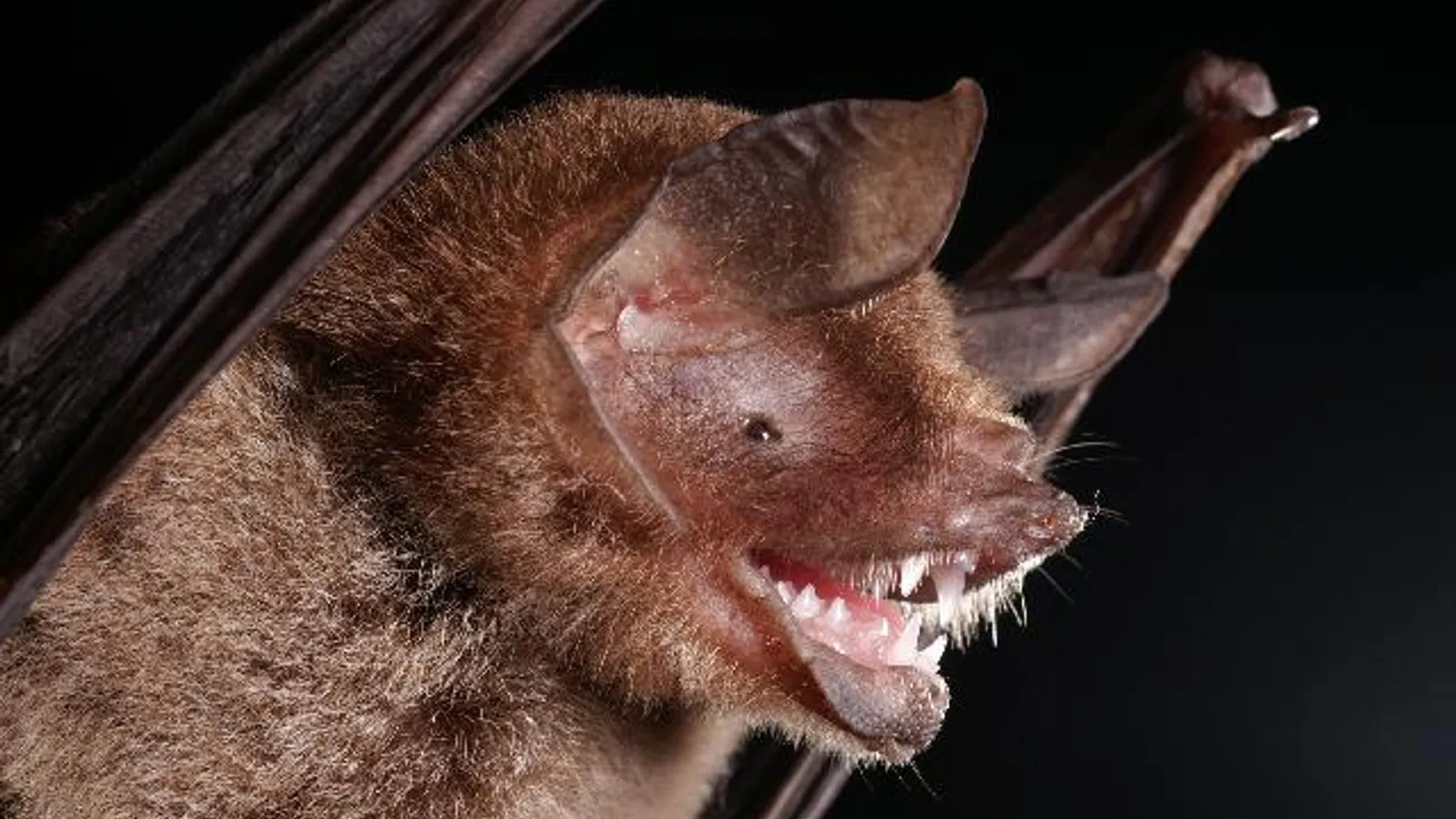
— Where the name comes from
Pteronotus is “wing on the back”, from the Greek pterón and nōton: in this genus the membranes fuse along the midline of the back, leaving the skin beneath them bare. Parnellii recalls Richard Parnell, a 19th-century Scottish physician and naturalist. The common name looks to the stiff bristles around the mouth, which form a kind of sieve in front of the muzzle.
— Facts
- Group
- Mammals · Mammalia
- Order
- Bats
- Habitat
- Hot, humid caves; hunting in dense forest understorey
- Range
- From southern Mexico to Brazil, and the Antilles
- Size
- 6–7.7 cm of body, 35 cm wingspan, 18–24 g
- Diet
- Insectivore — moths and beetles taken among vegetation
- Lifespan
- Little known
— Characteristics
- 01
It is the only American bat that uses constant-frequency calls like the horseshoe bats.
- 02
It compensates for Doppler shift by lowering its own frequency in flight.
- 03
Its cochlea has a zone hyper-specialised on an extremely narrow band.
— What sets it apart
It has an acoustic fovea: a portion of the cochlea where the sensory cells are crowded onto a frequency band just a few hundred hertz wide, with a resolution out of all proportion to the rest of the ear. It is the auditory equivalent of the eye’s fovea, the patch where sight is sharp, and it serves one purpose: to read a moth’s wingbeat in the micro-flutter of the echo. The horseshoe bats of the Old World found the same solution, entirely independently.
