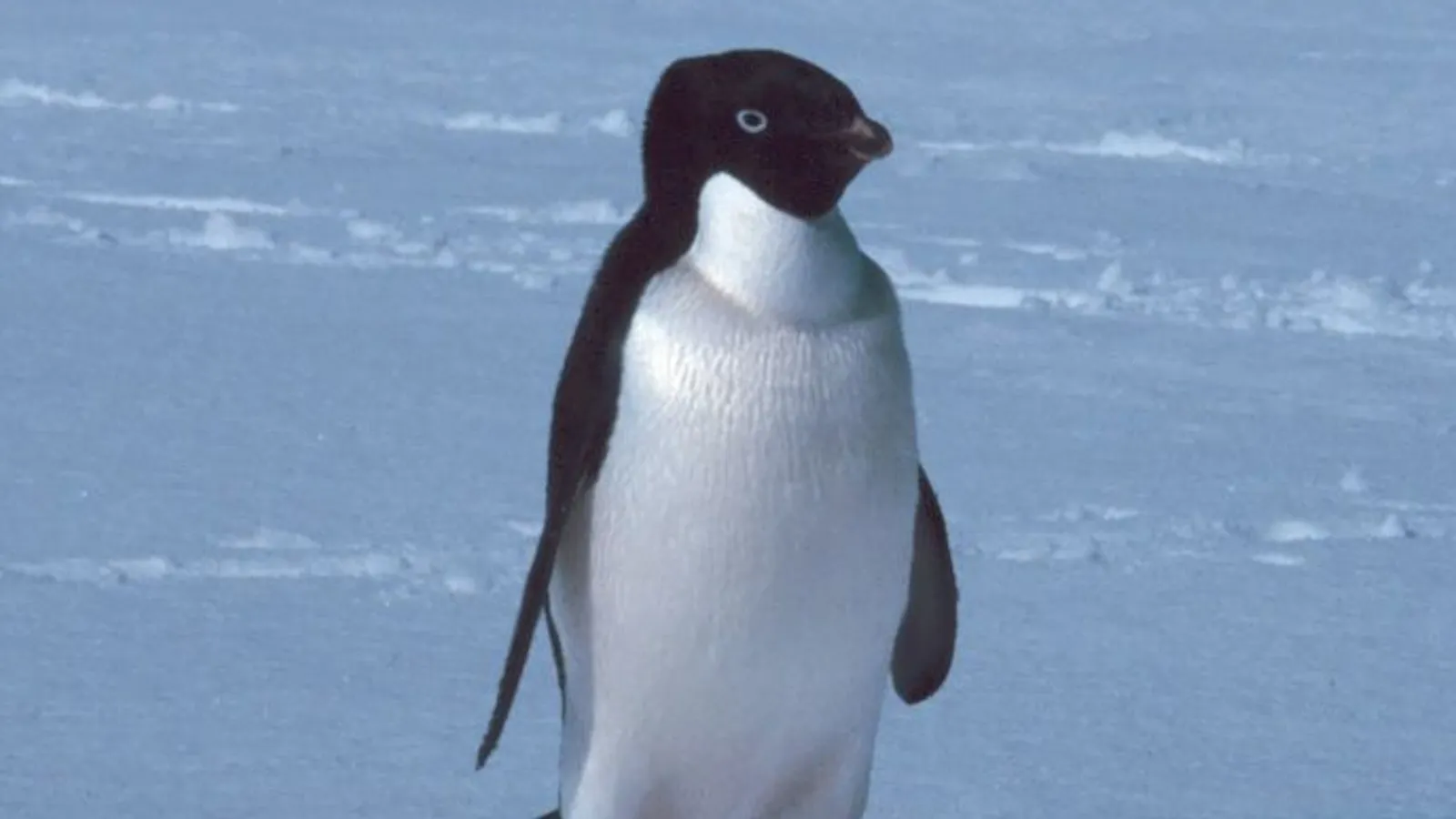
Adélie penguin
Pygoscelis adeliae
— Where the name comes from
Pygoscelis is Greek, pygḗ, “rump”, and skélos, “leg”: “legs set at the rump”, for the rear-placed legs that force it to stand upright. Adeliae comes from Adélie Land, the stretch of Antarctic coast that the French explorer Jules Dumont d’Urville named in 1840 after his wife, Adèle.
— Facts
- Group
- Birds · Aves
- Order
- Penguins
- Habitat
- Ice-free Antarctic rocky coasts and pack ice
- Range
- The whole coast of the Antarctic continent and nearby islands
- Size
- 70–73 cm, 3.8–8.2 kg
- Diet
- Mainly krill, fish, squid
- Lifespan
- 11–20 years
— Characteristics
- 01
It has a white ring round the eye in an all-black head.
- 02
It builds its nest of stones, and happily steals its neighbours’.
- 03
To feed it can swim hundreds of kilometres.
— What sets it apart
Stones are wealth. On the Antarctic coast suitable pebbles are scarce, and a raised nest keeps the eggs out of meltwater: penguins fight over them, steal them the moment a neighbour looks away, and the male brings them to his mate as a gift. Colony life shocked George Murray Levick, the doctor on Scott’s expedition, who in 1911 observed sexual behaviour he found so disturbing that he wrote it down in ancient Greek so that no one would read it. His account was found and published only a century later.