
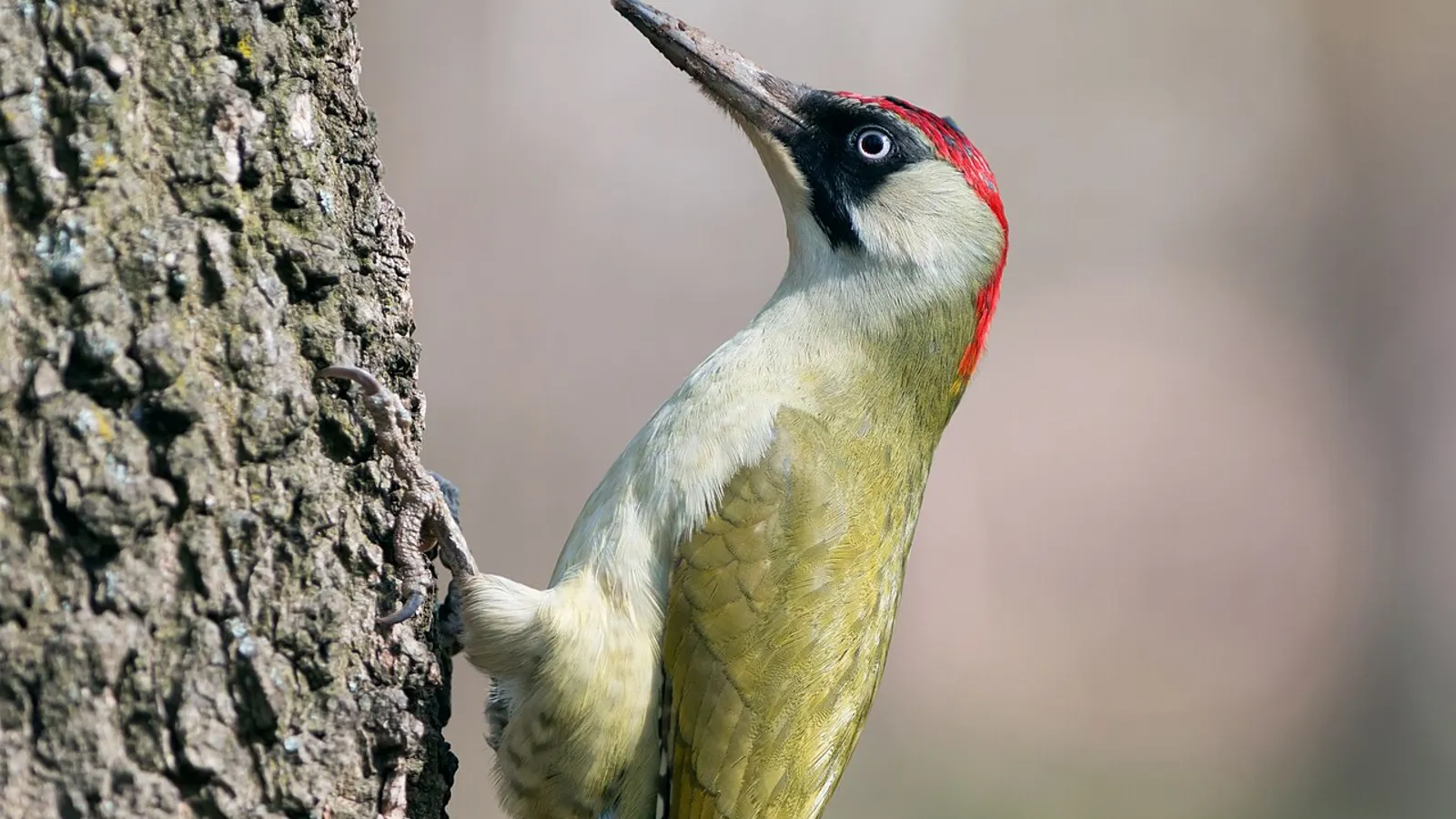
European green woodpecker
Picus viridis
— Where the name comes from
Picus, in Latin myth, was a king of Latium who refused the love of the sorceress Circe and was turned by her into a woodpecker: Ovid says he kept his red cloak, and hence the crest. To the Romans the woodpecker was a prophetic bird sacred to Mars, and by legend it brought food to Romulus and Remus alongside the she-wolf. Viridis is simply green.
— Facts
- Group
- Birds · Aves
- Order
- Woodpeckers and toucans
- Habitat
- Open woodland, parks, orchards, meadows with anthills
- Range
- Europe and western Asia
- Size
- 30–36 cm, wingspan 45–51 cm, 150–250 g
- Diet
- Ants and their larvae, almost exclusively
- Lifespan
- 7 years in the wild
— Characteristics
- 01
It spends more time on the ground than in trees, hopping across lawns.
- 02
The tongue is ten centimetres long and wraps around the skull at rest.
- 03
The call is a high falling laugh, hence its country name of “yaffle”.
— What sets it apart
It eats ants and nothing else, and winter is an engineering problem for it. When snow covers the meadows it digs vertical shafts up to half a metre deep to reach buried anthills, and into large nests it burrows almost entirely: a green woodpecker consumes tens of thousands of ants a day, drawing them up with a sticky tongue that at rest runs around the skull, over the brain, and ends inside a nostril. It is the same structure that absorbs the shock when other woodpeckers hammer wood, put here to a different trade.
