
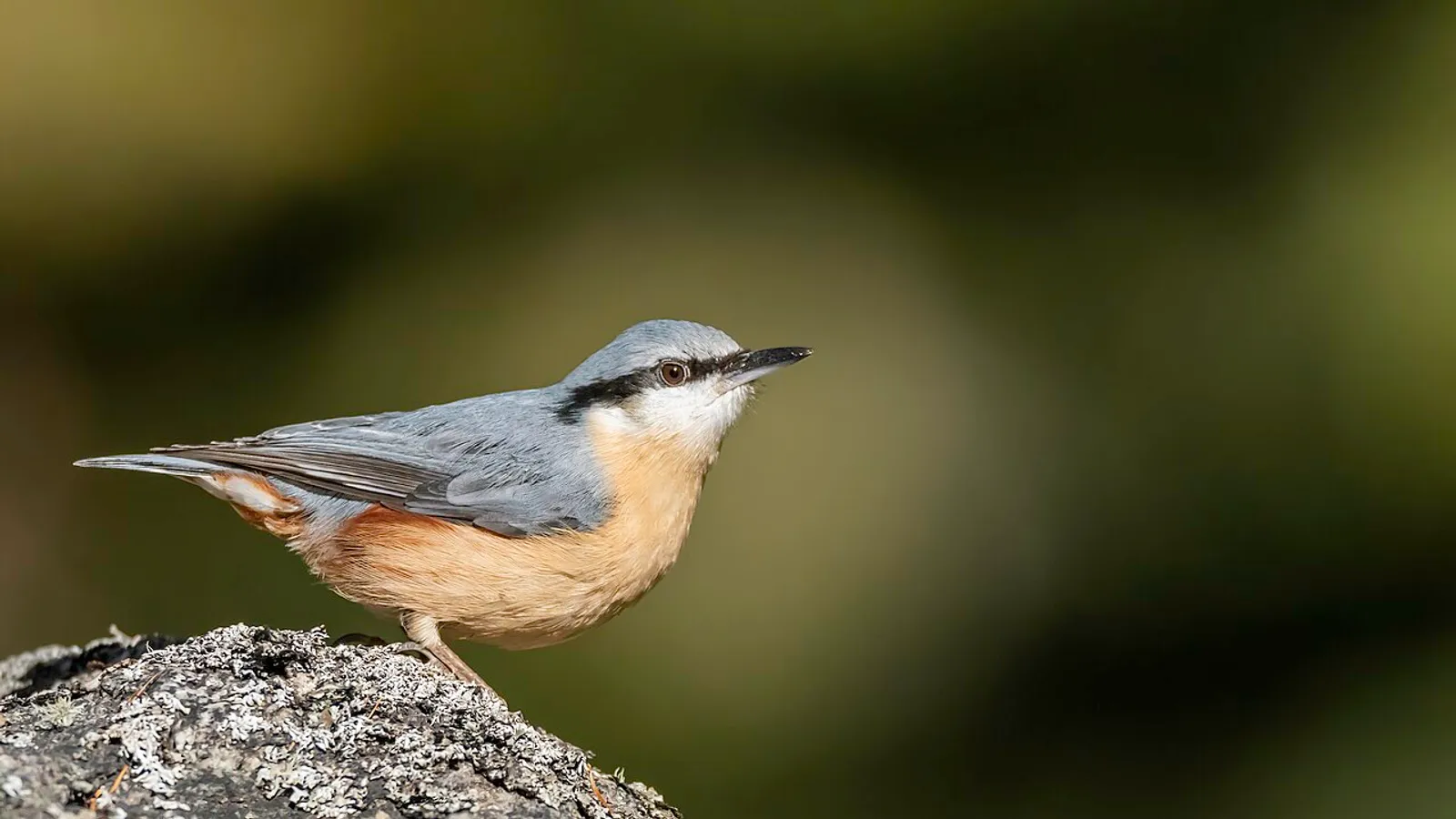
Eurasian nuthatch
Sitta europaea
— Where the name comes from
Sittē was the Greek name of a bird that went down tree trunks, cited by Aristotle and taken up by Linnaeus for this genus. The Italian name does not describe the relationship — it is no woodpecker — but the trade: it narrows the entrance of its nest hole with mud until the bird fits it exactly, walling out the rest of the wood.
— Facts
- Group
- Birds · Aves
- Order
- Passerines
- Habitat
- Mature broadleaf woodland, parks with old trees
- Range
- Europe and temperate Asia as far as Japan
- Size
- 12–15 cm, wingspan 22–27 cm, 17–28 g
- Diet
- Insects, spiders, hazelnuts, acorns, seeds
- Lifespan
- 4 years in the wild
— Characteristics
- 01
It is the only European bird that climbs down trunks head first.
- 02
It wedges hazelnuts into a crack in the bark and hammers them open.
- 03
It does not prop itself on its tail: it holds on by its claws alone.
— What sets it apart
The mud it narrows the entrance with is mixed with saliva and left to set into cement; given a woodpecker hole that is too wide, it will wall up nearly all of it, leaving an opening just big enough for its own body. The result is an armoured door made to measure, keeping out starlings, dormice and weasels, and it is still there the following year. In old woodland the nuthatch’s holes can be told at a glance: they are the only ones with a frame.
