
Sugar glider
Petaurus breviceps
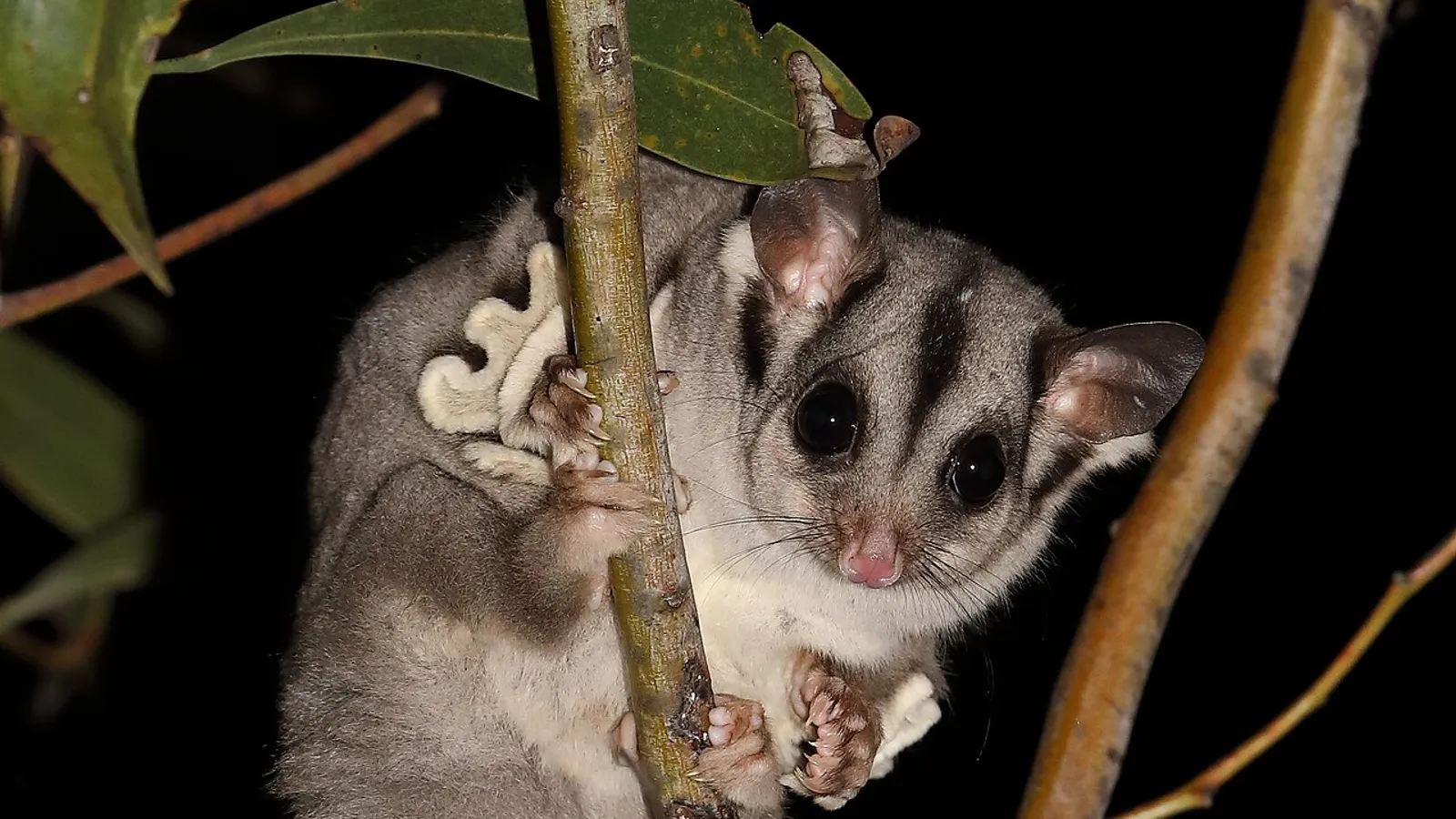
— Where the name comes from
Petaurus comes from the Greek pétauron, the acrobats’ springboard and the perch from which hens took flight: a circus name, given to an animal that throws itself into the void. Breviceps is Latin, “short-headed”. The common name joins that leap to a fondness for sugary substances — sap, nectar, honeydew — on which it lives for much of the year.
— Facts
- Group
- Mammals · Mammalia
- Order
- Diprotodont marsupials
- Habitat
- Eucalyptus and acacia forest with tree hollows
- Range
- Eastern and northern Australia, New Guinea and nearby islands
- Size
- 16–21 cm long plus as much again of tail, 90–150 g
- Diet
- Omnivore — tree sap and gum, nectar, insects
- Lifespan
- 9–12 years
— Characteristics
- 01
The patagium, the membrane between wrist and ankle, lets it glide over fifty metres.
- 02
It uses its tail as a rudder and the length of its limbs to correct course in mid-air.
- 03
It lives in groups of up to ten that sleep huddled in the same hollow.
— What sets it apart
It is not related to the American flying squirrels, and yet it has the same body: the same membrane, the same rudder tail, the same nocturnal habits. They are two lines separated by more than a hundred and fifty million years — an Australian marsupial and a placental rodent — that arrived independently at the same solution because the problem was identical: to move between distant trees without coming down to the ground, where the predators wait. It is one of the clearest examples of convergent evolution among mammals.
