
American paddlefish
Polyodon spathula
— Where the name comes from
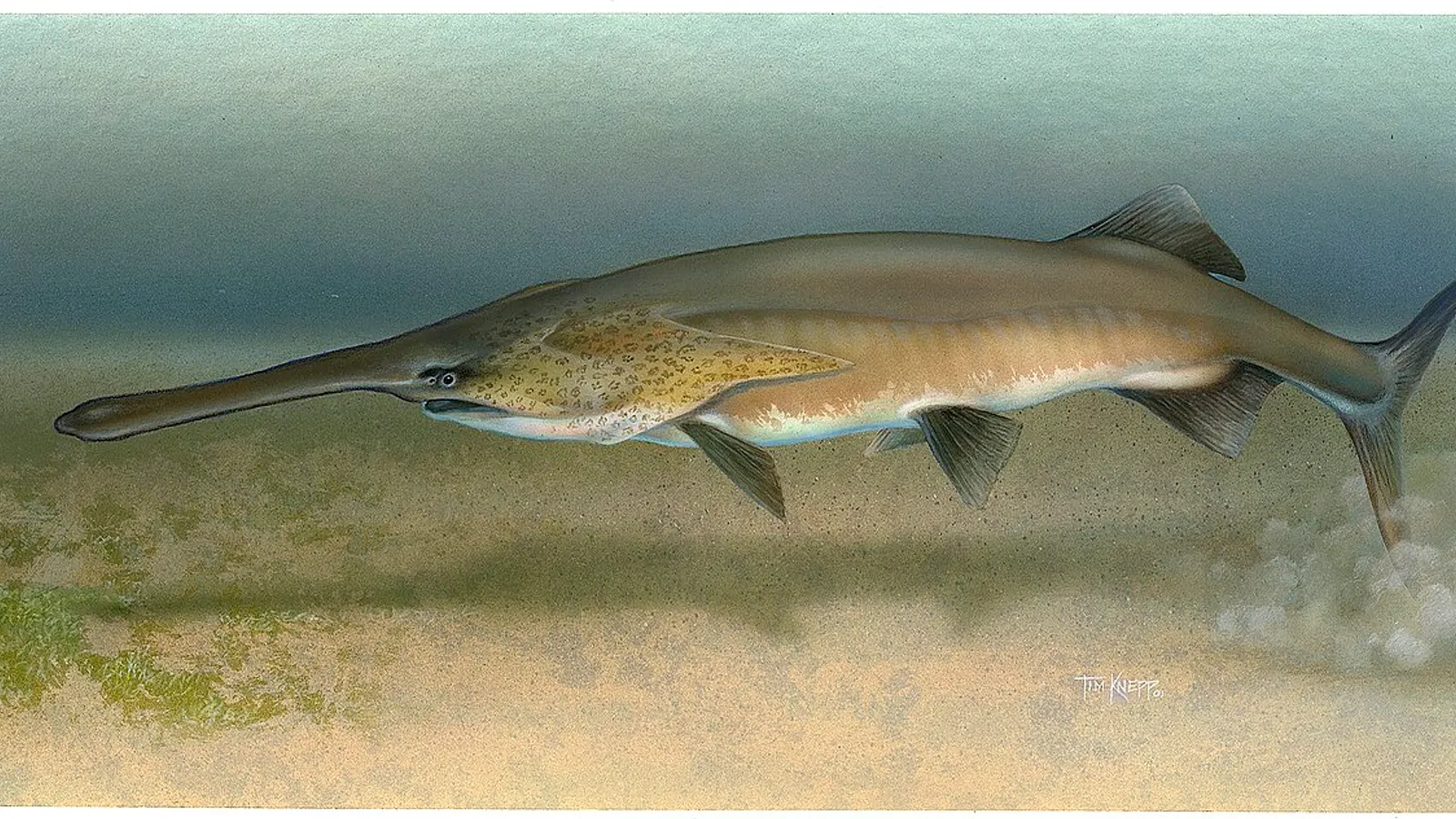
Polyodon is “many-toothed”, and for an animal that as an adult has not a single tooth it is a curious name: it refers to the tiny teeth of the young, which later vanish. Spathula is the spatula, and describes the flattened rostrum, a third of the body long, that it carries in front of its head.
— Facts
- Group
- Fish · Actinopterygii · Chondrichthyes
- Order
- Sturgeons
- Habitat
- Large slow turbid rivers, reservoirs
- Range
- The Mississippi basin, the central United States
- Size
- 1.5–2.2 m, 20–70 kg
- Diet
- Zooplankton filtered from the water with the mouth open
- Lifespan
- 30 years
— Characteristics
- 01
It swims with its mouth wide open, filtering water through its gill rakers.
- 02
The rostrum is not for digging: it is an antenna.
- 03
Its Chinese relative, the Yangtze paddlefish, was declared extinct in 2020.
— What sets it apart
The rostrum is covered by tens of thousands of ampullae sensitive to electric fields, and is probably the finest biological detector ever measured for that kind of signal: it picks up the electrical pulses produced by the movements of the minute crustaceans it feeds on, and lets the fish find plankton swarms in water where nothing is visible a hand’s breadth from its snout. It is not an oar and not a shovel: it is a half-metre antenna.
