
Largetooth sawfish
Pristis pristis
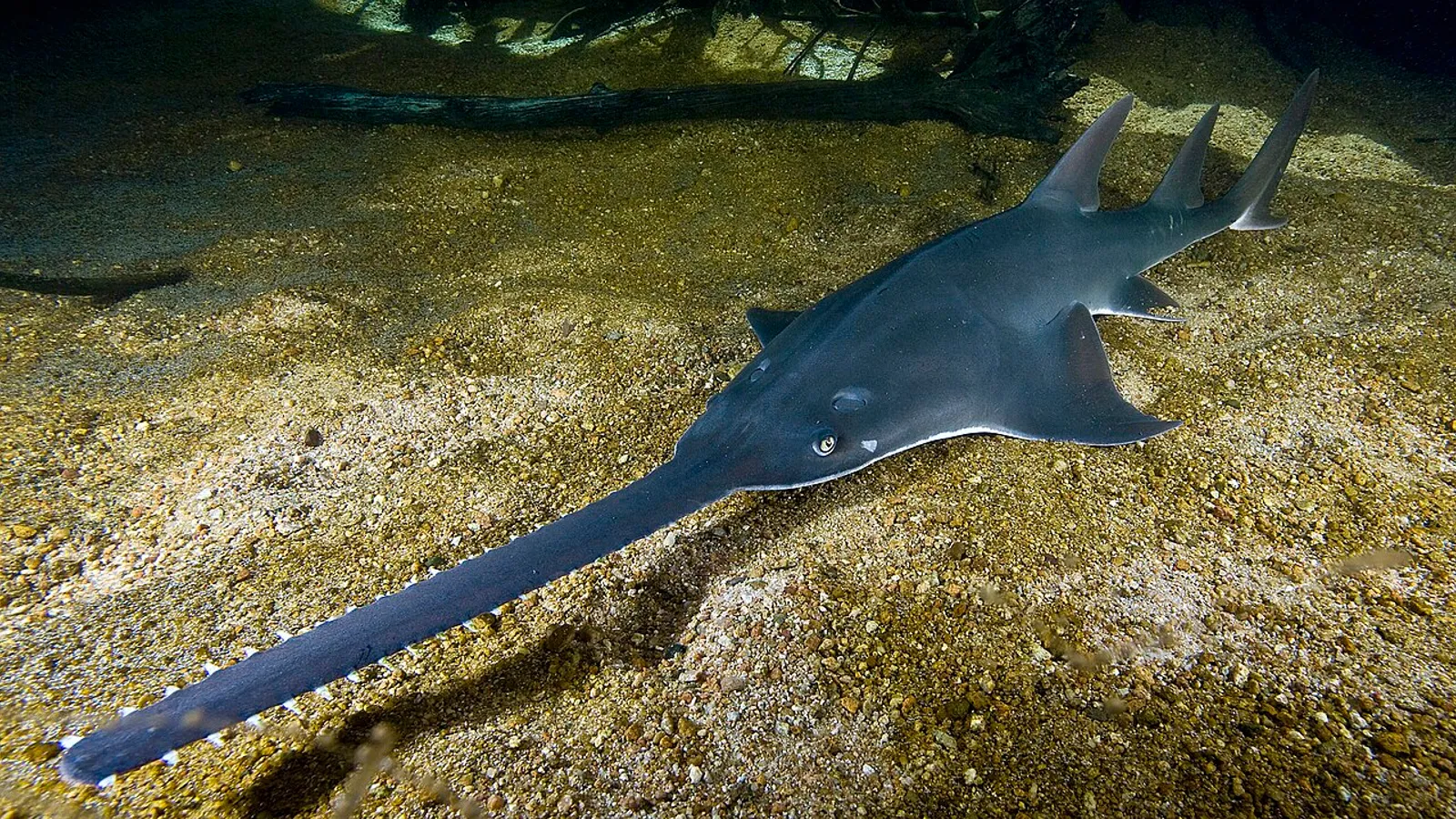
— Where the name comes from
Prístēs in Greek is the sawyer, from príō, to saw, and it is the word the ancients already used for this animal: the binomial repeats it twice. The rostrum carries no true teeth but modified dermal denticles, set in sockets and regrown — a row of twenty-two pairs of blades on a blade.
— Facts
- Group
- Fish · Actinopterygii · Chondrichthyes
- Order
- Sawfishes and allies
- Habitat
- Estuaries, lagoons, tropical rivers, muddy coasts
- Range
- Once throughout the tropics, now reduced to a few areas
- Size
- 3–5 m, up to 7 m; 300–600 kg
- Diet
- Shoaling fish, crustaceans, bottom molluscs
- Lifespan
- 30 years
— Characteristics
- 01
It runs hundreds of kilometres up rivers and the young are born in fresh water.
- 02
The rostrum is covered in thousands of electrical sensors on both sides.
- 03
It bears young whose rostrum is soft and wrapped in a sheath.
— What sets it apart
The saw is not for digging in mud, as was believed for two centuries: tank experiments showed the animal uses it like a racquet, entering a shoal of fish and delivering sideways strokes that stun several in a second, and that the electrical sensors spread above and below the rostrum let it locate prey in the dark without seeing them. It is both a radar and a club, and it belongs to the most threatened family of marine fish on the planet: four species out of five are endangered.
