
Freshwater angelfish
Pterophyllum scalare
— Where the name comes from
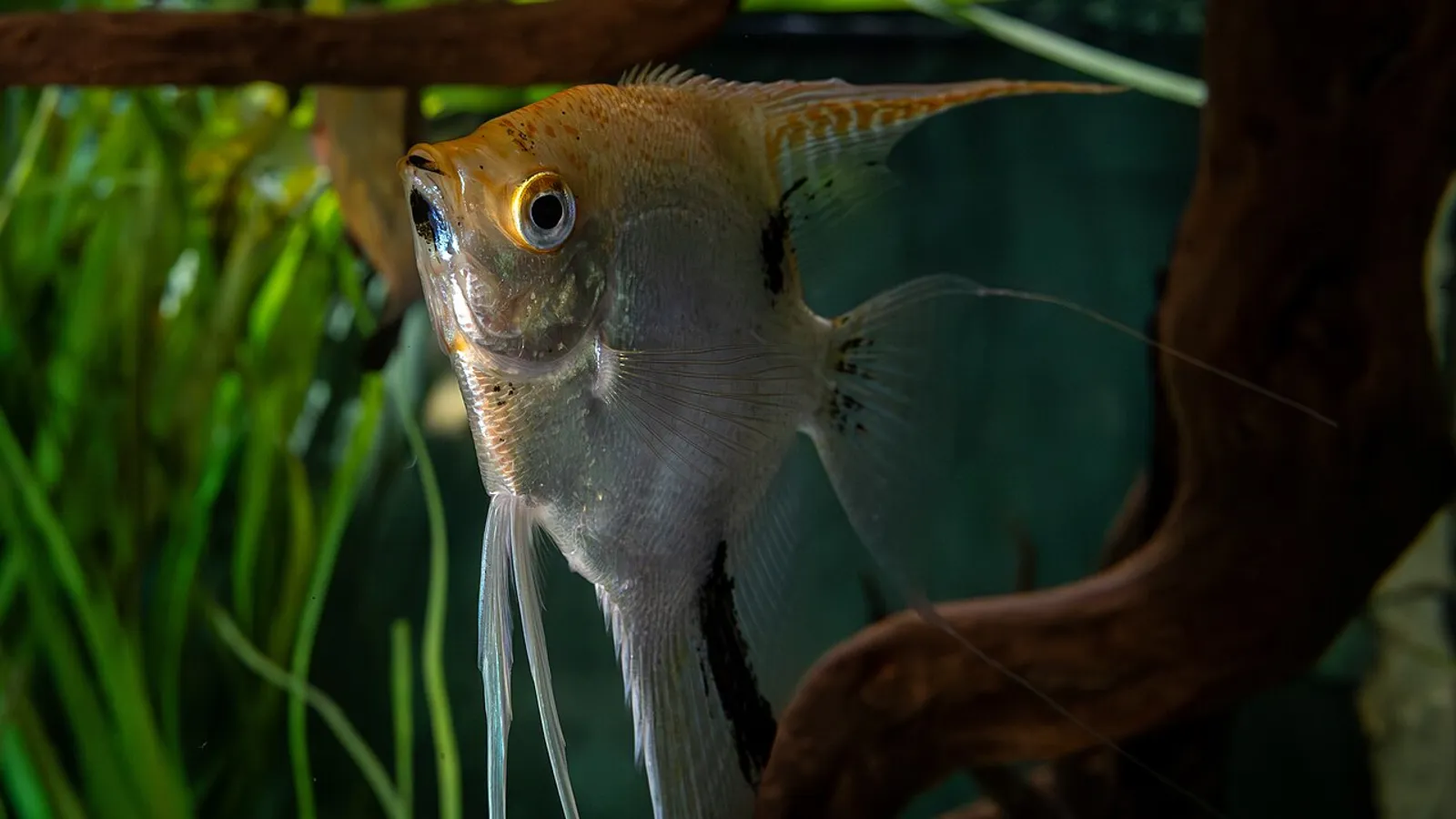
Pterophyllum is “winged leaf”, from pterón and phýllon: the body is flat and diamond-shaped like a leaf, and the dorsal and anal fins stretch out into two blades. Scalare comes from the Latin scalaris, “stepped”, for the profile of the dorsal fin rising in steps. In English it is the angelfish, and here the Italian name is the more exact.
— Facts
- Group
- Fish · Actinopterygii · Chondrichthyes
- Order
- Cichlids
- Habitat
- Still shaded water among the submerged roots of the flooded forest
- Range
- The Amazon basin: Peru, Colombia, Brazil, Guyana
- Size
- 15 cm long but up to 25 cm tall; 80–150 g
- Diet
- Insect larvae, crustaceans, fry
- Lifespan
- 10 years
— Characteristics
- 01
The dark vertical stripes blend it with roots and reed stems.
- 02
It forms stable pairs that defend the eggs together.
- 03
It spawns on a leaf or an upright stem, cleaned in advance.
— What sets it apart
Its shape is entirely an answer to where it lives. In the flooded forest the water is still and full of stems, roots and vertical branches, and a tall thin fish with dark vertical bars moves through it as through a maze without being noticed: the stripes break the outline, the blade of the body passes where an ordinary fish would jam, and the long thread-like fins act as fine rudders. It is one of the world’s best-selling aquarium fish, and its elegance is a disguise as a tangle of roots.
