
John Dory
Zeus faber
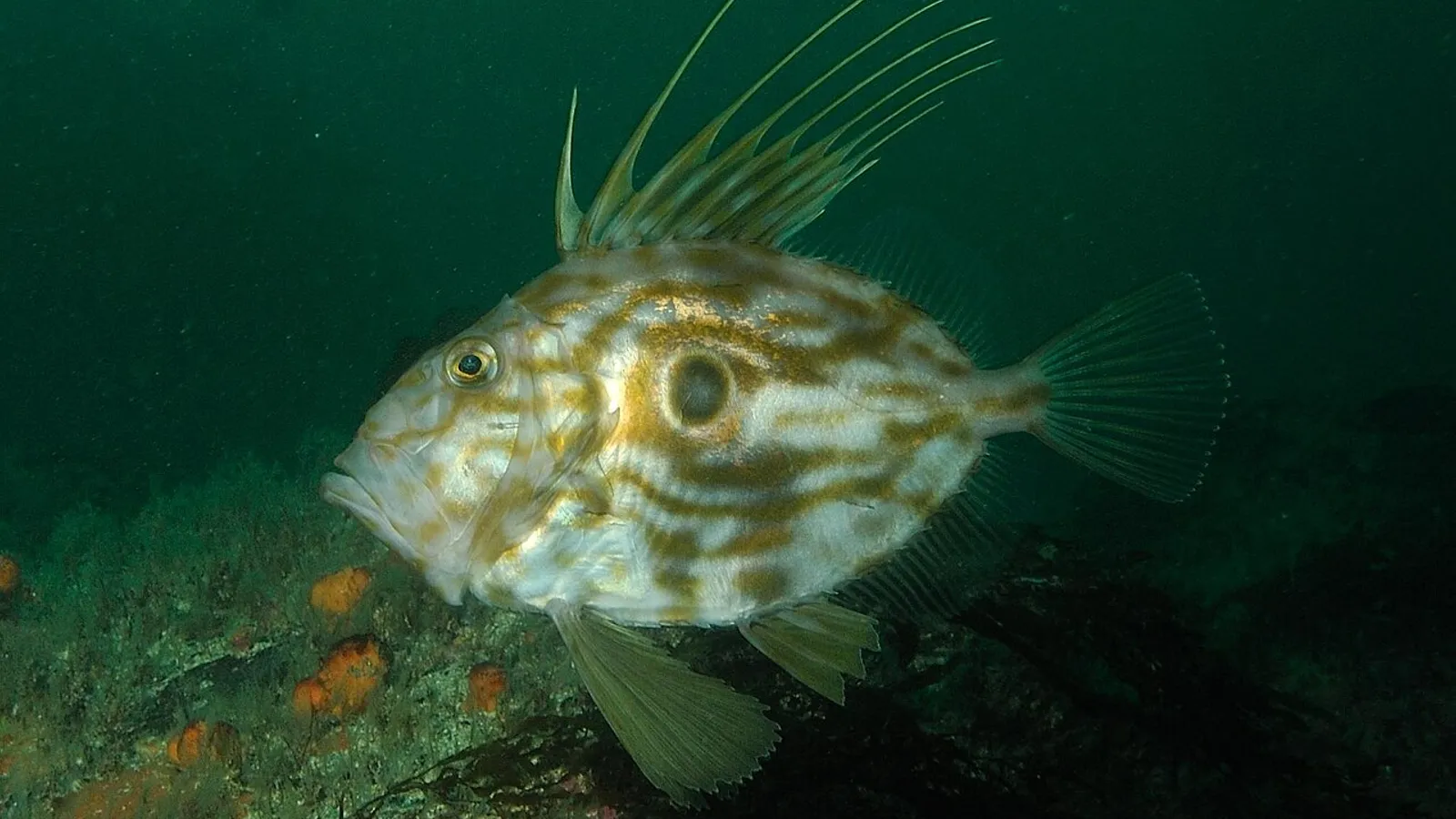
— Where the name comes from
Zeus is the king of the gods and faber the smith: a grand name for a slow flat fish, chosen perhaps for the profile of the head and the hammered look of the flanks. The common name comes instead from the Gospel of Matthew, where Peter finds a coin in a fish’s mouth: the black spot this species carries on its flank is, by tradition, the apostle’s thumbprint.
— Facts
- Group
- Fish · Actinopterygii · Chondrichthyes
- Order
- Dories
- Habitat
- Bottoms between 50 and 400 metres, sometimes in coastal water
- Range
- The eastern Atlantic, the Mediterranean, the Indo-Pacific, Australia
- Size
- 30–50 cm, up to 90 cm; 1–3 kg
- Diet
- Fish, squid, crustaceans
- Lifespan
- 12 years
— Characteristics
- 01
The body is very deep and very thin: seen head on it nearly disappears.
- 02
The mouth shoots forward into a tube, like a drawer opening.
- 03
It swims slowly and approaches prey edge-on, so as not to be seen.
— What sets it apart
It hunts by becoming invisible. The body is compressed to the point that, seen from the front, it is reduced to a line, and the fish approaches its prey in exactly that attitude, moving only the dorsal and anal fins so as to make no waves; when it is close enough the mouth shoots forward several centimetres and the prey is inside before it has noticed anything. The legend of St Peter’s thumbprint, incidentally, is also told of the meagre and of other spotted species: Catholic Europe needed more than one.
