
Japanese pufferfish
Takifugu rubripes
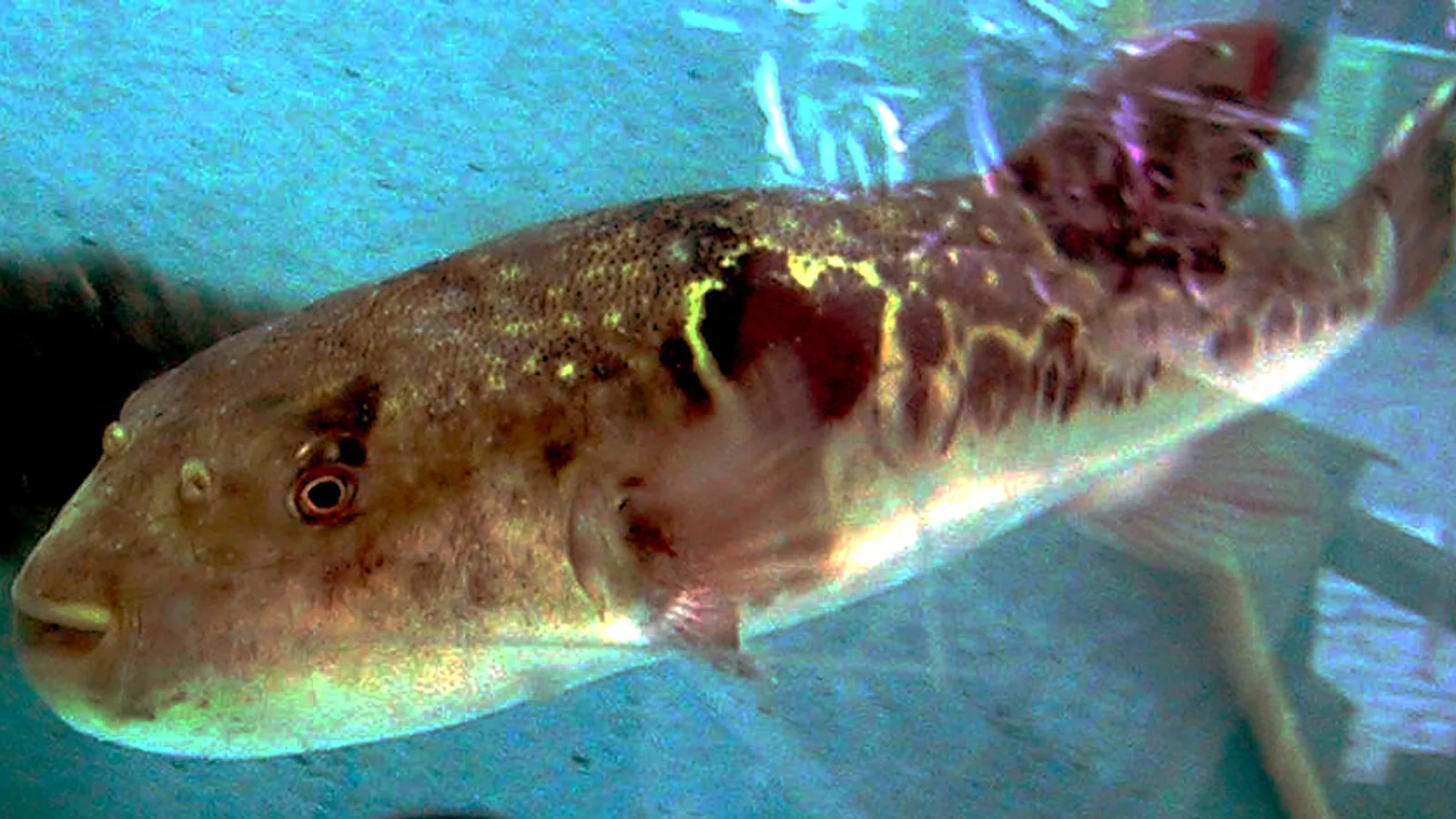
— Where the name comes from
Fugu is the Japanese word for these fish, taken into the genus name; rubripes means “red-footed”, for the reddish pectoral fins. The order is the Tetraodontiformes, “four-toothed”: the jaws are fused into four cutting plates that shear coral and shells like pliers.
— Facts
- Group
- Fish · Actinopterygii · Chondrichthyes
- Order
- Pufferfishes
- Habitat
- Coastal sandy and rocky bottoms, estuaries
- Range
- The seas of China, Korea and Japan
- Size
- 40–70 cm, 2–5 kg
- Diet
- Molluscs, crustaceans, urchins, small fish
- Lifespan
- 10 years
— Characteristics
- 01
It inflates with water to three times its volume if threatened.
- 02
Liver and ovaries contain lethal quantities of tetrodotoxin.
- 03
It does not make the poison: it accumulates it from bacteria in its food.
— What sets it apart
Its genome was the second vertebrate genome ever read in full, in 2002, and not because of the poison: it is the most compact known — an eighth of ours, with nearly the same number of genes but without the vast stretches of non-coding sequence that fill human DNA. Comparing it with ours was precisely the point: where the two still resemble each other after four hundred million years, there is something that matters. The fugu was, quite literally, the map used to try to read our own.
