
Clown triggerfish
Balistoides conspicillum
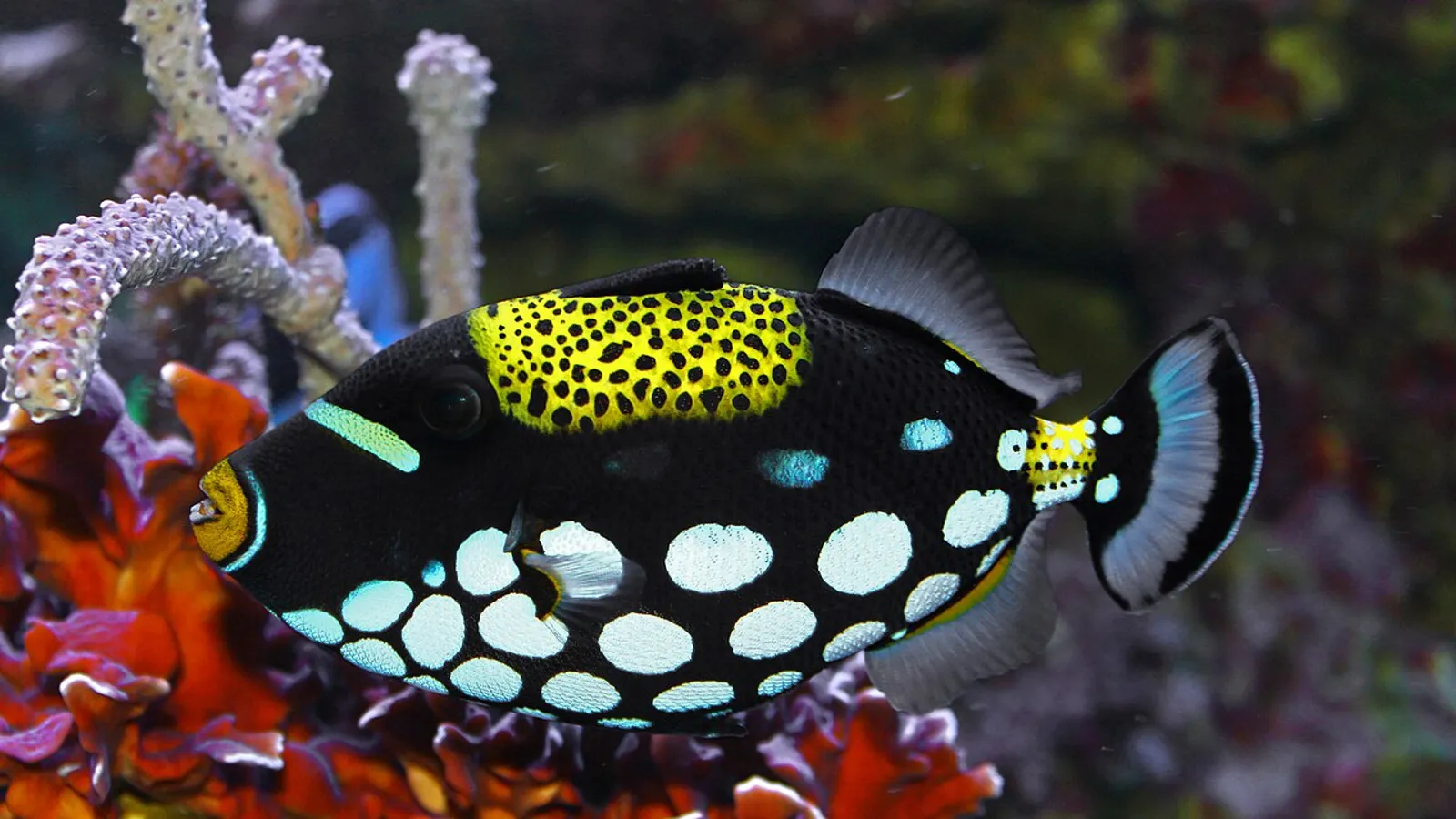
— Where the name comes from
Balistoides derives from Balistes, which comes from the ballista, the torsion siege engine: the first dorsal spine rises and locks, and only by lowering the second — the trigger — is it released. Conspicillum means “spectacles”, for the yellow ring round the eye. The Italian name picked the clown for the white spots on the black belly.
— Facts
- Group
- Fish · Actinopterygii · Chondrichthyes
- Order
- Pufferfishes
- Habitat
- Outer reef walls between 5 and 75 metres
- Range
- The tropical Indo-Pacific, from East Africa to Polynesia
- Size
- 35–50 cm, 1–3 kg
- Diet
- Urchins, molluscs, crustaceans, coral
- Lifespan
- 10 years
— Characteristics
- 01
It has rodent-like teeth able to shatter shells and coral.
- 02
It blows jets of water at the sand to uncover buried prey.
- 03
It flips sea urchins over to attack them from the spineless side.
— What sets it apart
The mechanism that names it is a genuine latch. When it works into a crevice in the reef to sleep it raises the first dorsal spine, which snaps upright and locks: at that point it is wedged in the hole and no predator can pull it out, because pulling only increases the spine’s pressure against the roof. Only the animal can release it, by lowering the second spine. It is the same principle as an expansion bolt, inside a fish.
